
1940s The Church Hat (Crown)
Religion: Christianity
Time Period: 1940s
Type Of Garment: Headpiece
Tags: Black Church, Black Women, Crowns, Head Covering, Headwraps, Respectability, Sunday Best
The Object:
But every woman who prays or prophesies should have her head covered. If her head is not covered, she brings shame to her head. Then she is the same as a woman who has her head shaved. 1 Corinthians 11:5 (ERV)
In the first letter to the church in the ancient city of Corinth (the ruins of which are located near the modern Grecian city of the same name), the Apostle Paul wrote to correct the improper behavior of Corinthian Christians. Among these corrections was an instruction directed toward certain women, particularly married women, who attended worship with uncovered heads. Within early Christian interpretations of biblical teachings on modesty and marital propriety, a married woman with an uncovered head could bring shame to her husband by suggesting sexual availability or signaling that she was unmarried. Head coverings in this context did not refer only to garments but also to long hair, as short hair was considered shameful for women in first century Corinth. In this way, head covering functioned as a visible sign of modesty, marital status, and reverence within early Christian worship (for more on this topic, see Stafford 2024).
Craig Marberry (2000) states in the interviewer’s note for the book, Crowns: Portraits of Black Women in Church Hats, that the Apostle Paul could not have envisioned the “flamboyance” with which Black women would later observe this instruction (4). For generations, Black women have worn “platter hats, lampshade hats, why’d-you-have-to-sit-in-front-of-me hats, often with ornaments that runneth over” to worship services, funerals, weddings, and other events, and sometimes simply as a fashion accessory (4). Yet these church hats, also known as Crowns, are more than decorative fashion items. Within Black church traditions they serve as visible expressions of faith, dignity, and reverence, transforming the act of head covering into a distinctive cultural practice.
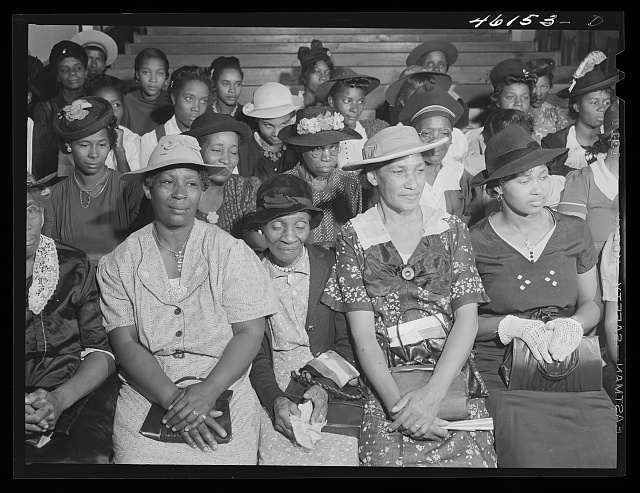
As Marberry’s description suggests, the church hat is not a simple covering but a stylized object meant to adorn and elevate the head (see Figure 1). Hats vary widely depending on budget and personal preference. Costing anywhere from ten to several hundred dollars, they may be constructed from felt, wool, silk, feathers, or furs such as mink and fox (Cunningham and Marberry 2000). They are further embellished according to the milliner’s design aesthetic, trimmed with fabric flowers, beads, veils, feathers, and other decorative elements.
The Context and Creator:
There is no single person credited with creating the church hat. Rather, it developed through the convergence of biblical head covering practices, African traditions of adornment, and the creative expression of Black women in the United States.
In some sub-Saharan African cultures, headwraps carried distinct meanings depending on color and pattern, signaling cultural affiliation as well as markers of identity such as marital status, social standing, or religion (Arnoldi and Kreamer 1995; Lynch and Strauss 2014; JD Institute of Fashion Technology 2021). In some communities headwraps were worn in the presence of in-laws as a symbol of respect or during religious gatherings and ceremonies (Wray 2023). While these headwraps conveyed symbolic meaning, they also served practical functions by protecting the wearer from environmental elements (Morsiani 2018; JD Institute of Fashion Technology 2021). They could also reflect aesthetic preference, enhancing the face while allowing women to display personal taste and skill in styling (Morsiani 2018; Arnoldi and Kreamer 1995; Lynch and Strauss 2014).
These practices took on new meaning during the transatlantic slave trade. Slave traders frequently shaved the heads of captured Africans in an attempt to break their spirits and “objectify and erase the rich culture of African hair grooming passed down for generations” (Neil and Mbilishaka 2019, 160). To conceal the shame of this forced shaving, enslaved women covered their heads with scarves (Malone 2023). The physical demands of slavery also made these coverings practical, protecting workers from the surrounding environment (Hunt 1994; Malone 2023).
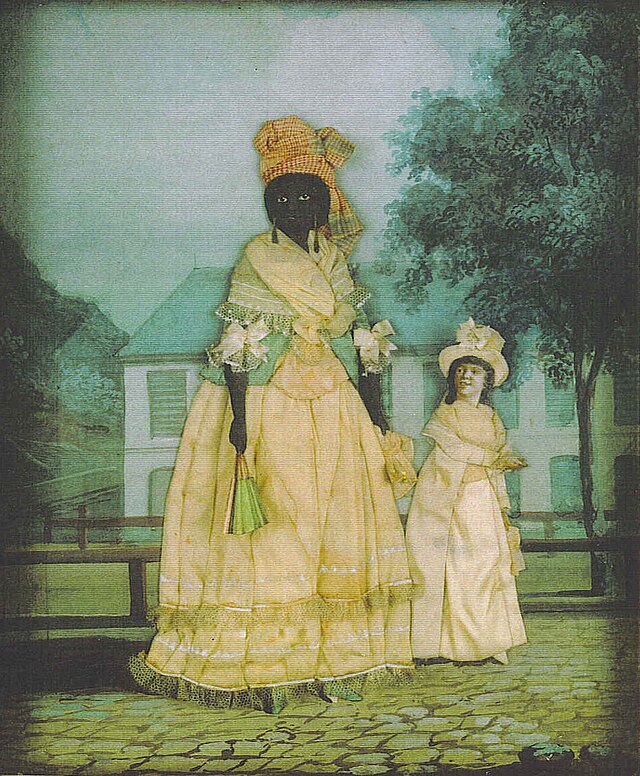
In the mid-eighteenth century, headwraps became legally mandated in Louisiana through the Tignon Laws, which required Black women to wear head coverings in order to mark racial difference within the colony’s social hierarchy (see Figure 2). Slaveowners and colonial authorities sometimes invoked biblical passages, including the writings of the Apostle Paul, to justify these restrictions: “So that is why a woman should have her head covered with something that shows she is under authority. Also, she should do this because of the angels” (1 Corinthians 11:10, ERV). Despite these constraints, Black women transformed the headwrap into a space for creative expression. Women selected fabrics, folded and tied wraps in distinctive ways, and developed styling practices that signaled individuality and skill (Malone 2023; Hunt 1994).
These expressions were particularly visible in church settings. Sunday services were one of the few occasions when enslaved people could dress up and present themselves with dignity while participating in communal worship (Malone 2023). In this context the headwrap became both an act of reverence and a way to express personal style (Wray 2023). During the Reconstruction era, the headscarf gradually gave way to structured hats, laying the groundwork for the modern church hat tradition (see Figure 3).
![Figure 3. Hand-colored sketch depicting an African American congregation. Published by The Illustrated London News, British, 1845 - 2003, November 18, 1876, ink on paper, wood, glass, 18 5/8 x 22 x 7/8 in. Public Domain. Collection of the Smithsonian National Museum of African American History and Culture, Gift of Joele and Fred Michaud [2013.239.7].](https://prod.wp.cdn.aws.wfu.edu/sites/530/2026/03/Figure-3REV.jpg)
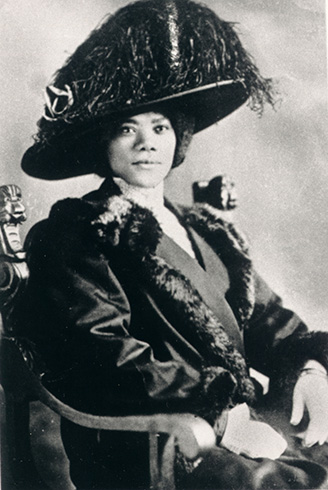
Following Reconstruction and into the Harlem Renaissance, the Crown expanded in cultural significance. Increasingly elaborate hats came to symbolize success, prosperity, and reverence within church communities (see Figure 4; Wray 2023; Malone 2023). This period also saw the rise of Black milliners as millinery became both an area of study and an entrepreneurial practice (Malone 2023). Milliner Mildred Blount, for example, gained recognition for designing hats for the film Gone With the Wind (Wray 2023). Millinery shops owned by Black women also provided spaces where Black women could shop and participate in fashion culture without the surveillance and discrimination they often experienced in department stores (Malone 2023).
During the 1960s, the political significance of the Crown expanded as respectability politics shaped Black dress practices in response to racial discrimination and violence (Higginbotham 1993). Activists often emphasized dressing in one’s “Sunday best” as a strategy for asserting dignity within segregated public spaces. Alongside suits, dresses, and polished accessories, hats formed part of this presentation. In these contexts, however, styles were often more restrained, featuring simpler shapes and muted colors in order to align with white middle class dress norms (Higginbotham 1993; Ford 2015). As fashion historian and curator Darnell Jamal Lisby explains, “If they were going to be these leaders and speak in these spaces that were very white, for them to be heard, they dressed in a very specific way that allowed the information to be digested” (Grechko 2020).
While this restrained style reflected the political realities of the moment, it did not define the tradition. Over time, the expressive and decorative styles associated with church hats reemerged, continuing the long history of creativity and cultural meaning attached to the Crown. To understand its significance today, it is helpful to turn to the women who wear them.
The Wearer:
One way to understand what church hats mean today is to listen to the women who wear them. Michael Cunningham and Craig Marberry’s (2000) book Crowns pairs portrait photography with oral histories of African American women who reflect on the role these hats play in their spiritual and everyday lives. Through these conversations, the hat emerges not simply as an accessory but as part of how many women prepare themselves for worship.
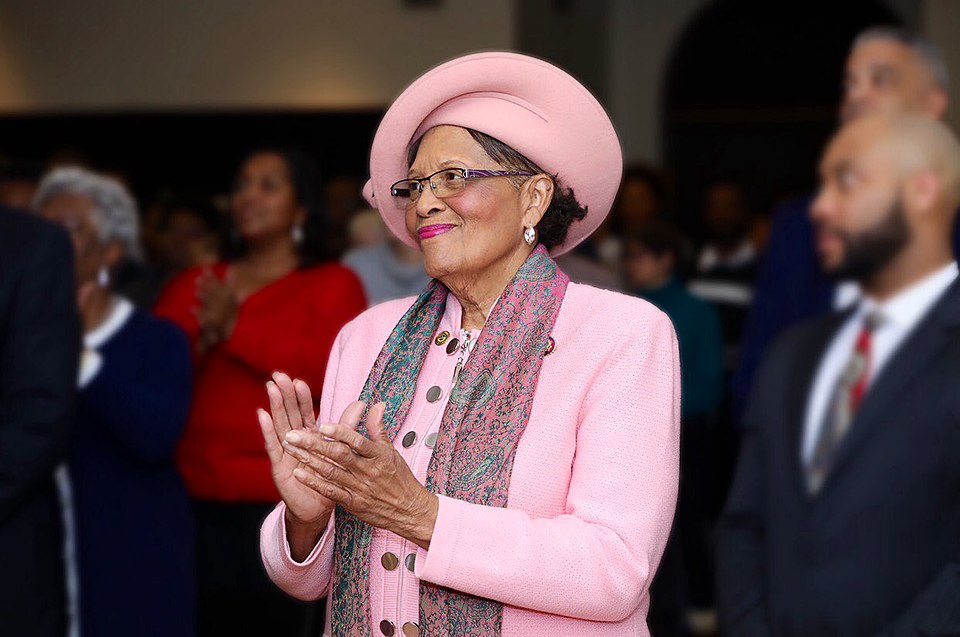
For many women, the hat is an essential part of getting dressed for church. It is often chosen carefully and coordinated with hairstyles and clothing, with some hats designed to match particular outfits. In some denominations, such as the Church of God in Christ (COGIC), hats are widely recognized as part of women’s church culture and are celebrated at large gatherings such as annual conventions in Memphis. Many women value having hats that feel unique to them and prefer not to wear one that someone else already owns. As such, building a collection of hats can become part of one’s church wardrobe and personal expression. Representative Alma Adams, for example, is known to own more than 350 church hats (see Figure 5)
Wearing a hat is also tied to expectations about respect in church. Some women recall learning from a young age that being properly dressed for church meant wearing a hat along with other polished elements such as patent leather shoes, white gloves, and a purse (Cunningham and Marberry 2000; Malone 2023). As Shirley Manigault explains, the practice reflects the belief that when appearing before God “there should be excellence in all things, including your appearance” (Cunningham and Marberry 2000: 75). Addie Webster similarly describes preparing for church as if she were meeting royalty: “When I get dressed to go to church, I’m going to meet the King, so I must look my best” (Cunningham and Marberry 2000: 59).
For some women, hats also carry emotional meaning. Sherry Flynt Wallington explains that they can conceal personal struggles and sorrow. In her study of Black women’s motivations for wearing church hats, Shoji Malone notes that for some women the hat functions as a form of protection and concealment, covering visible signs of hardship so that personal struggles remain private within the church community. At the same time, wearing the hat symbolizes that they remain spiritually covered and protected by God despite these challenges (2023).
Taken together, these histories and personal accounts show that the Crown is far more than a decorative accessory. It is a cultural tradition shaped by faith, history, and creativity, allowing Black women to express reverence, dignity, and individuality within the shared space of worship.
Lauryn Grubbs, PhD Student in Apparel Design, Cornell University
14 March 2026
Tags: Black Church, Black Women, Head Covering, Sunday Best, Respectability, Crowns, Headwraps
References:
Cunningham, Micheal and Craig Marberry. 2000. Crowns: Portraits of Black Women in Church Hats. Doubleday.
Grechko, Irina. 2020. “From All-White To Sunday Best: The Meaning Behind A Century of Protest Uniforms.” Refinery 29, September 1. Available at: https://www.refinery29.com/en-us/2020/09/9991107/protest-fashion-clothing-uniform-history-blm.
Higginbotham, Evelyn Brooks. 1993. Righteous Discontent: The Women’s Movement in the Black Baptist Church, 1880–1920. Harvard University Press.
Hunt, Patricia. 1994. “Swathed in Cloth: The Headwraps of Some African American Women in Georgia and South Carolina During the Late Nineteenth and Early Twentieth Centuries.” Dress 21 (1): 30–38. doi:10.1179/036121194803657103.
Intrabartola, Lisa. 2025. “Exploring the History of Black Church Hats.” Rutgers Today, February 10. Available at: https://www.rutgers.edu/news/exploring-history-black-church-hats.
Johnson, Tabora A., and Teiahsha Bankhead. 2014. “Hair It Is: Examining the Experiences of Black Women with Natural Hair.” Open Journal of Social Sciences 2: 86-100.
Malone, Shoji. 2023. “Rubies in their Crowns: An Examination of African American Church Women and their Head Adornment.” Moderated by Patty Johnson. Virtual lecture, Streamed live May 23, 2023, by the International Sunday School Department of the Church of God in Christ. Youtube, 56: 03. Available at: https://www.youtube.com/watch?v=_fZ9gtKbKAs.
Morsiani, Benedetta. 2020. “Transcultural Body Spaces: Re-Inventing and Performing Headwrap Practice among Young Congolese Women in London.” African and Black Diaspora: An International Journal 13 (1): 15–26.
Neil, Latisha, and Afiya Mbilishaka. 2019. “‘Hey Curlfriends!’: Hair Care and Self-Care Messaging on YouTube by Black Women Natural Hair Vloggers.” Journal of Black Studies 50 (2): 156–177.
Stafford, Grace. 2024. “Veiling and Head-Covering in Late Antiquity: Between Ideology, Aesthetics and Practicality.” Past & Present, no. 263 (May): 1–46. Available at: https://doi.org/10.1093/pastj/gtad017.
Wray, Alexis. 2023. “Sunday’s Best: The Evolution of the Black Lady Church Hat.” Reckon, April 6. Available at: https://www.reckon.news/black-joy/2023/04/sundays-best-the-evolution-of-the-black-lady-church-hat.html.