
1990s “Jesus Forever” Leather Motorcycle Vest
Religion: Christianity
Time Period: 1990s
Type Of Garment: Vest
Tags: Evangelical Christianity, Evangelism, Leather vest, Motorcycle riders, Patches, Pins, Religious Identity, Secondhand circulation, United States
The Object
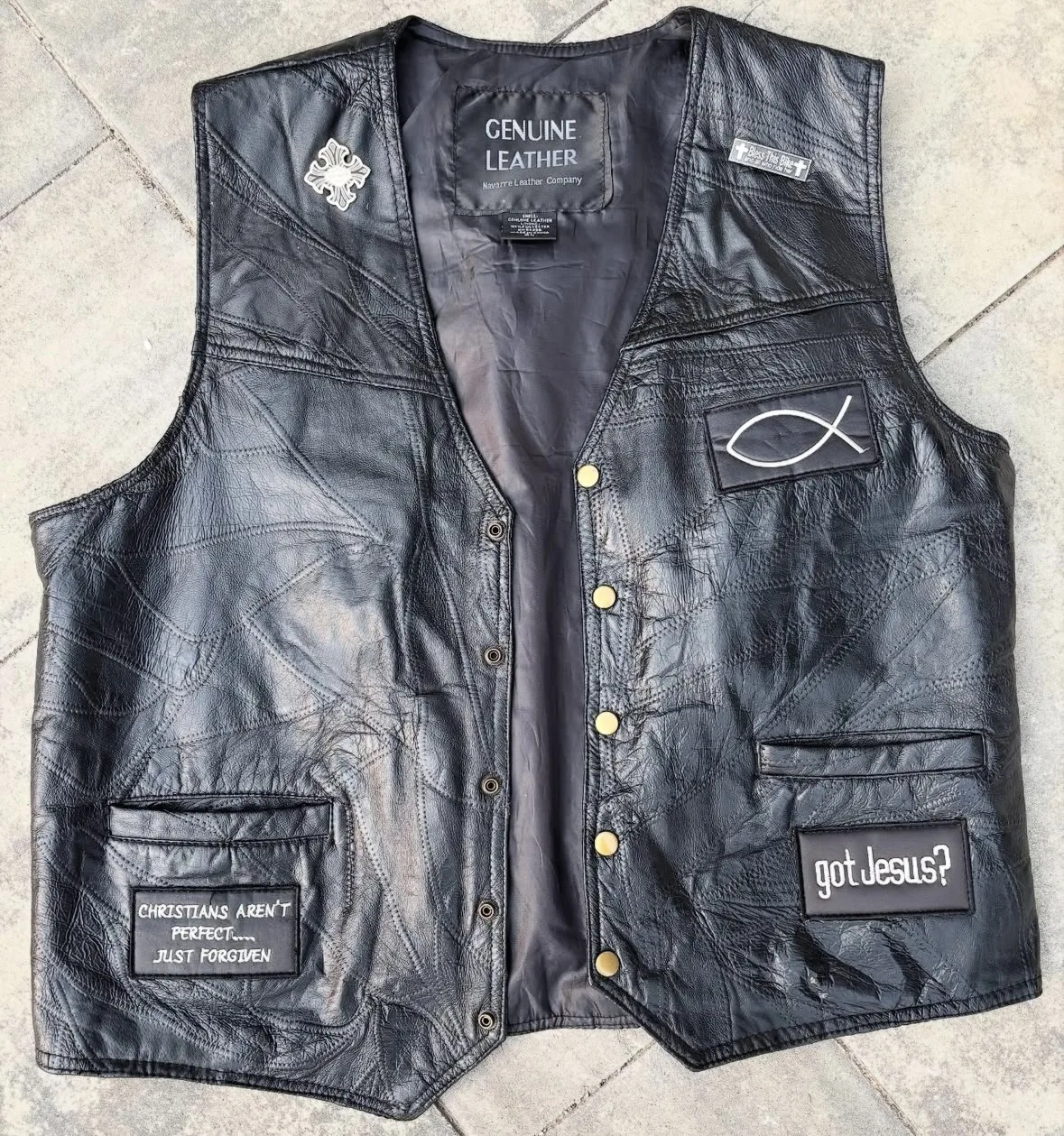
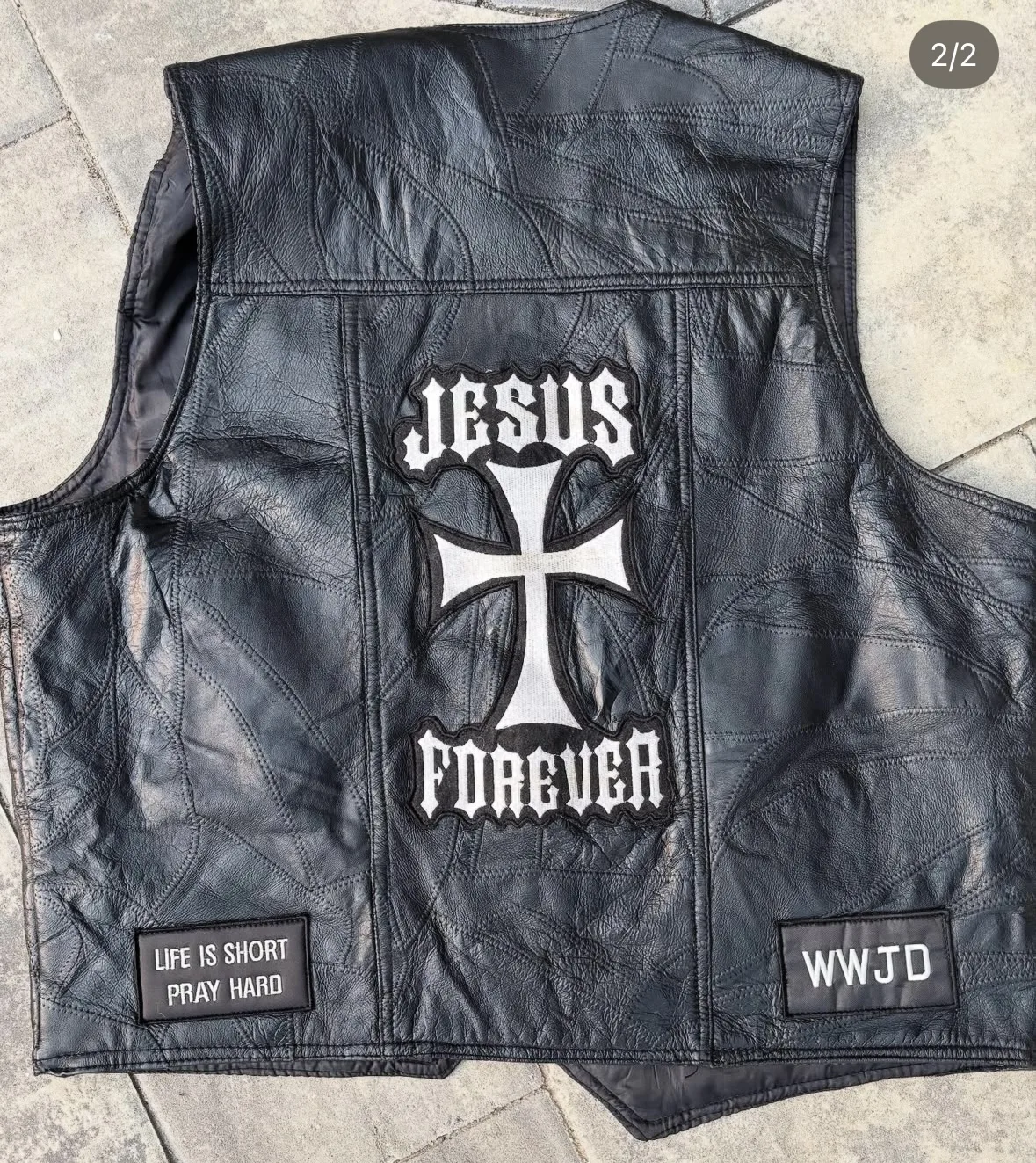
An otherwise ordinary motorcycle vest has been tailored for evangelical Christian buyers and riders. Three patches are sewn on the front: an ichthys fish on the left chest, one that reads “Christians aren’t perfect, just forgiven,” and a playful riff on an iconic cow’s milk marketing campaign that launched in 1993, “Got Jesus?” (see Figure 1). The other side of the vest adds three more patches: “WWJD,” “Life is short pray hard,” and centered on the back is the largest of the set, “Jesus Forever” with a stylized cross (see Figure 2). All are widely circulating signifiers across evangelical communities, advertising the wearer’s religious identity and presenting a theological nugget that pithily reflects and re-creates the tradition.
The front side of the vest also has two pins: a decorative cross on the right shoulder and “Bless This Bike and all who ride her” on the left (for more on pinback buttons in evangelical Christianity see this entry). The interior lining is a polyester sheen, making it slide on easily over clothes or skin. The exterior is “genuine leather,” and it feels well-worn to the touch, supple and durable. Leather and denim are the most common fabrics used for vests and other motorcycle apparel to protect wearers from wind, weather, and potential accidents.
The Creator
This vest was created by the Navarre Leather Company, a clothing and accessories producer based in the United States that outsourced the manufacturing labor to China. Navarre was not strictly a Christian company; they made a wide range of products – from gloves to jackets, vests and handbags – mostly in simple, unadorned black leather. At some point, Navarre saw an opportunity in the consumer market of Christian motorcyclists and mass-produced an unknown number of these vests. The six patches were machine stitched on a factory line, while the two pins were added by the devotional hands of a previous owner.
Navarre is no longer an active business, but their products continue to circulate widely through secondhand venues and online platforms. An Internet search brings forth Navarre products, including other copies of this vest and similarly themed motorcycle vests, on Poshmark, Mercari, Depop, Ragstock, Facebook Marketplace, Craigslist, Amazon, Etsy, and eBay. There is no consensus among online sellers for dating the vest, though most vaguely estimate “the 1990s.”
The Context
I acquired this vest in August 2025 from an antique mall in Guilford, Connecticut. Mike and Dave’s Antique Shop opened in 2021 and has about 20 vendors. The booth inventories are familiar to anyone who has strolled through a U.S. antiques store: boxes of postcards, shelves of books, crates of vinyl LPs, small containers with pinback buttons and patches, stacks of vintage magazines, and jumbled piles of miscellaneous ephemera (to name just a few). I was nearly to the last booth when my eyes landed on the vest. In four years of searching secondhand venues for Christian material culture, I had not encountered anything like it. The price, $75 USD, was higher than what I normally paid for a single item, but it seemed like a singular find and I immediately collected it for purchase.
While paying, I asked the staff if they could share any information about the vest. Two men explained in tandem that one of the vendors had inherited a large collection of motorcycle gear from their father when he died. This vest, and a few black leather riding caps, were the only remnants yet to sell. One of the clerks said that this vest had been in the store for about two years. When I returned home, I did a search for similar vests online and, to be honest, was a little deflated. This was not such a singular find after all. Multiple copies are available through online resale platforms, most for less than what I paid. The one mark of distinction was the two pins that had been added.
Searching for the vest online also revealed that a rich material culture circulates among Christian motorcyclists. Pins abound featuring crosses, illustrations of bibles, bible verses, praying hands, and diverse devotional slogans. Patches also proliferate with proclamatory phrases such as: “I’m the Christian Satan warned you about,” “Loud pipes may save lives, but Jesus Christ saves souls,” “Try Jesus, not me,” and “These are my church clothes.” Bandanas, hats, and shirts bear similar iconography and sayings that mix Christian evangelism with biker affect.
Others circulate with more localized detail; regional and national motorcycle ministries produce materials that identify a place name or riding chapter. The patches and pins reflect the elective affinity between consumer capitalism and personalized expression. Through quantity and combination, they enable mass-produced clothing to be customized (McDannell 1995). The variation on a shared media form, small size, and relatively inexpensive cost also make Christian motorcycle patches and pins highly collectible – yet another iteration of devotional consumption.
This range of materials emerges from two established traditions: the sartorial practices of moto sub-cultures and the formation of motorcycle ministries. The Christian Motorcycle Association is the largest; an evangelical organization, it was founded in 1975 in western Arkansas and estimates ~125,000 members across ~1400 local chapters (see Giles 2016). Despite the longstanding presence of Christian motorcyclists, stereotypes still circulate that render such a social group unlikely. As I paid for the vest, one clerk commented that he would often laugh when he walked by the vest in the booth. I asked why. He described a discrepancy between two images that he harbored: one of bikers as hyper-macho and one of “religion” as more “emotional.” His presumption of incongruity was memorable (along with the false essentialisms and gendered folk notion of religion). In reflecting on this exchange with the clerk, I am struck by the multiple resonances that exist between motorcycle culture and evangelicalism (the Christian subculture to which this vest was marketed and among whom it was worn).
Riding a motorcycle is dangerous, even for experienced and responsible riders. If prayer is used to protect, then a tradition that cultivates an anytime-anywhere disposition toward prayer makes sense (Luhrmann 2012). Motorcycle clubs and churches (as well as parachurch organizations) are prone to using kinship language as registers of self-description, as constituting a family of trust and interdependence. Evangelical Christians have a long tradition of self-identifying as culturally embattled, of experiencing society as stigmatized by a hostile secular mainstream (Harding 2000). Bikers, though for different historical and cultural reasons, are no strangers to marginality. At least since the infamy of the Hell’s Angels, motorcycle groups are associated in popular culture with an outlaw style if not actual criminal activity. Given the way evangelicalism celebrates conversion, it seems inevitable that a ministry would form to target a notorious subculture. Traveling is an enduring heritage for both traditions, from the cross-country motorcycle road trip to itinerant preachers and touring revivals. And, both use pilgrimage as a transformative practice (Dubisch 2005). Casual interpreters may consider a Christian motorcycle vest to be a strange hybrid, but in fact it is wholly understandable.
James S. Bielo, Associate Professor of Religious Studies, Northwestern University.
26 May 2026
Tags: Evangelical Christianity, Motorcycle riders, Evangelism, Religious Identity, Leather vest, United States, Secondhand circulation, Patches, Pins
References:
Dubisch, Jill. 2005. “Healing ‘the wounds that are not visible’: A Vietnam veterans’ motorcycle pilgrimage.” In Pilgrimage and Healing, Jill Dubisch and Michael Winkelman, eds. 135-154. Tucson: University of Arizona Press.
Giles, Christopher C. 2016. The Marriage of Heaven and Hell’s Angels: Herb Shreve, Evangelicalism, and the Christian Motorcyclists Association, 1974-1994. Master’s Thesis, Dept. of History, Auburn University. Auburn: Alabama.
Harding, Susan F. 2000. The Book of Jerry Falwell: Fundamentalist Language and Politics. Princeton: Princeton University Press.
Luhrmann, Tanya. 2012. When God Talks Back: Understanding the American Evangelical Relationship with God. New York: Alfred A. Knopf.
McDannell, Colleen. 1995. Material Christianity: Religion and popular culture in America. New Haven: Yale University Press.