
1990s W.W.J.D. Bracelets
Religion: Christianity
Time Period: 1990s
Type Of Garment: Bracelet, Jewelry
Tags: Bracelets, Charles Sheldon, Evangelical Fashion, Evangelicals, Evangelism, Everyday, Material Christianity, Religious Identity, United States, WWJD, Youth Culture
Context:
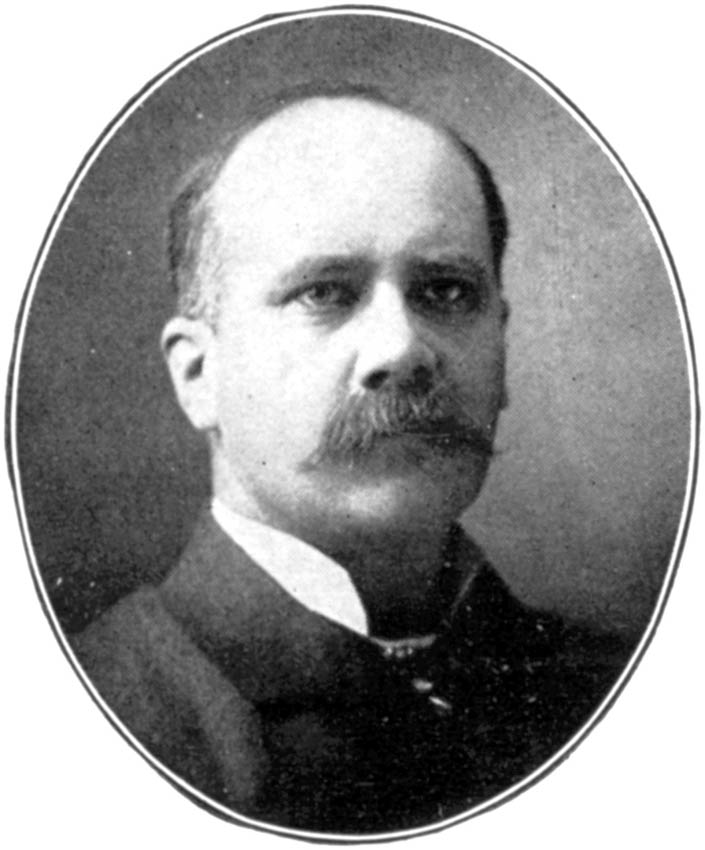
The story of the W.W.J.D. bracelet did not start in 1990s Michigan, but in 1890s Kansas. In the fall of 1896 Charles Monroe Sheldon (1857-1946; see Figure 1), pastor of the Central Congregational Church in Topeka, challenged the young people in his congregation to reflect on whether their actions aligned with their professed faith (Sheldon 1925, 97). Similar to popular serialized fiction at the time, he posed his questions through a series of Sunday evening sermon stories. Each segment compelled the community to return for the next part of the narrative the following week by leaving them with a cliffhanger (Kansas Historical Society 2026). The unifying theme of these sermons was rooted in a simple question: What would Jesus do?
The phrase was not Sheldon’s. British Baptist preacher Charles Spurgeon had employed it decades earlier, drawing on the tradition of imitatio Christi exemplified in a 15th century classic by Augustinian Thomas à Kempis. For Sheldon, who viewed Christian theology through the lens of progressivism, an imitation of Christ offered a practical ethical framework to respond to industrial-era injustices. He drew inspiration from the growing Social Gospel movement that had begun to reshape American Christianity in reaction to the rise of industrialism and increasing social stratifications.
Sheldon’s sermons followed the story of a fictionalized minister, Reverend Henry Maxwell, and his affluent congregation. When a man without a home or job confronts the community about their complacency in refusing to help him while claiming to do all things for Jesus, Maxwell challenges his parishioners to live for one year guided by a sole principle: before doing anything, to first ask “what would Jesus do?” These sermon stories were combined to become Sheldon’s famous novel In His Steps (1896), tracing how a varied cast of characters attempt to apply a Christian ethic to questions of poverty, temperance, and labor rights; pressing concerns of Christian socialism that Sheldon believed were best approached through action.
An error in copyright registration meant that In His Steps entered the public domain almost immediately, which allowed publishers to print copies without paying Sheldon royalties. This mistake permitted mass production worldwide, catapulting the book to become one of the best-selling novels of all time. Sheldon, though bewildered by the legal hurdles and popularity of his story, ultimately expressed gratitude that his message reached so many, even if he did not financially profit from it (Sheldon 1925, 110-111). His situation echoed in the story of What Would Jesus Do (W.W.J.D.) bracelets nearly a century later.
The Object:
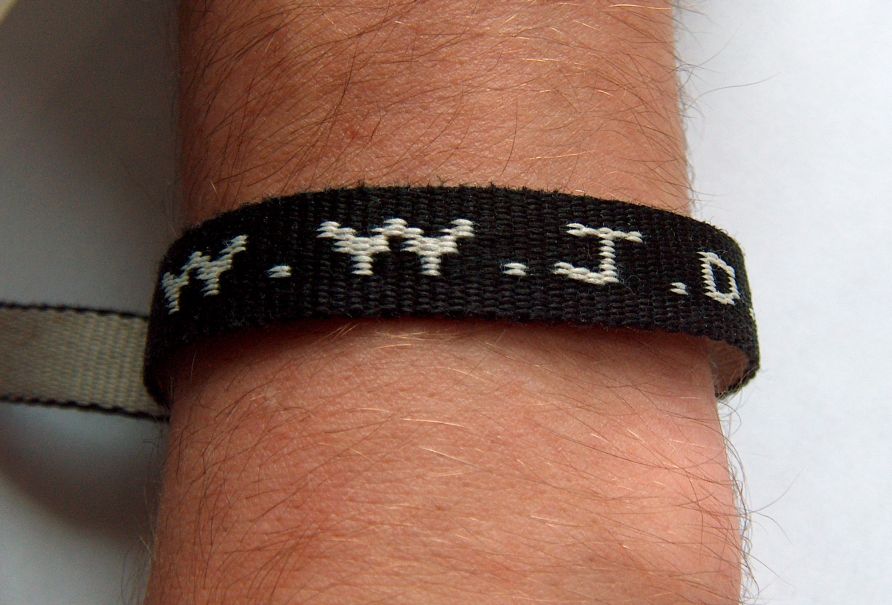
The start of the W.W.J.D. bracelet trend is traditionally linked to Holland, Michigan in the 1980s. Its official origins have been debated, the idea being attributed to Janet Tinklenberg, a youth group leader at the Calvary Reformed Church, as well as to Dan Seaborn, a youth pastor at Central Wesleyan Church (Jones 2012). Inspired by Sheldon’s In His Steps, the 20th-century initiative sought to provide local teenagers with a tangible way to apply their faith when confronting social pressures and moral decisions. Drawing on the popularity of handmade friendship bracelets at the time, 300 woven cloth bracelets bearing the acronym W.W.J.D. were commissioned from a local company, and youth group members were asked to wear them for thirty days (BBC News 2011). The abbreviation was practical, but also invited questions, making the bracelets an accessory for modern moral guidance and evangelism (see Figure 2).
The original W.W.J.D. bracelets were made from simple woven fabric bands, with bold letters in contrasting colors against a solid background. Like friendship bracelets, they evolved to an array of styles to appeal to the aesthetic preferences of 1990s youth. The bracelets had adjustable closures or plastic clasps and were designed for continuous wear. Their form was integral to their function. The bracelet’s physical presence made an abstract theological concept an embodied practice of daily moral reflection. Unlike a poster on a wall or book on a shelf, the bracelets were always with their wearers. When interacting with friends and family, taking an exam, or driving, the letters were visible, prompting young wearers at any moment to ask themselves, “what would Jesus do”?
The bracelets gained popularity with influence extending far beyond initial adoption. In an interview in 2003 Tinklenberg noted that her youth group members began sharing the bracelets soon after receiving them, returning to collect more when friends and family requested them (Graff 2003). This scope of adoption rapidly increased, with some estimates indicating that production surged to twenty thousand bracelets per week as the trend moved from church youth groups into mainstream American culture through Christian bookstores supplied by multiple manufacturers (DeHart 2022). The universal simplicity of the message also made the bracelets well suited for use in international Christian missions, expanding their reach and use far beyond Michigan.
Similar to the effect that the missing copyright had on the initial sales of Sheldon’s In His Steps, the popularity of the W.W.J.D. bracelets spread without legal protection. Because copyright law protects creative expression, short phrases are generally excluded because they are considered too brief to demonstrate originality. While this meant that the W.W.J.D. abbreviation could not be copyrighted, trademark protection remained a possibility, though not one that those associated with the bracelet’s origins initially pursued.
By 1998 several companies, and Tinklenberg, had filed more than a dozen applications with the U.S. Patent and Trademark Office to register “W.W.J.D.” (What Would They Do 1998). Although the trademark was ultimately awarded to Tinklenberg in 2000, the ruling came with a significant caveat: because the logo had become so prevalent, it was now part of the public domain. This meant that companies could continue to manufacture and sell W.W.J.D. bracelets without paying royalties. In order to gain a personal profit from her trademark, Tinklenberg would need to produce and sell bracelets, which would require starting a business and competing in a market already saturated with W.W.J.D. merchandise (Gibson 2000). However, like Sheldon, Tinklenberg seemed more interested in the message and its mission rather than personal profit.
Wearers & Reception:
The initial consumers of W.W.J.D. bracelets were young Protestant Christians, though the trend quickly reached a wider audience. With increased production the appeal of the bracelets expanded to a demographic of religiously active Americans who wore them as markers of religious identity, and as a fashion statement. As with the first users in Michigan, the embodied experience of wearing W.W.J.D. bracelets prompted wearers to pause and consider their choices as a practical faith intervention in daily life.
However, as the bracelets became a mainstream product for general consumption, the gap between their intended meaning and actual use was sometimes called into question. With the rising mainstream popularity of the bracelets, some critics in evangelical communities began dismissing W.W.J.D. as being symbolic of commercialized faith. Especially of concern was the perception of the “what would Jesus do?” question as being oversimplified when compared with complex modern moral situations that Jesus did not directly address in the Gospels (Morris 2022). Others raised theological objections, noting that Jesus’s divine nature meant that believers could not always know or replicate what he would do in a given context, suggesting alternative wording such as “What Did Jesus Say?” or “What Did Jesus Do?” (Kirby 2000). These critiques of the phrase extended across denominational lines when in 2011 Rowan Williams, then Archbishop of Canterbury, similarly cautioned that the phrase risked reducing Jesus to a moral teacher, forgetting his identity as savior (Williams 2011).

Beyond these debates about spiritual intention, the W.W.J.D. movement ignited by the bracelets precipitated a range of secular appropriations and parodies that further complicated its reception. Irreligious variations emerged, including satirical phrases such as “We Want Jack Daniels,” “What Would Judas Do?,” and adaptations featuring political figures and pop culture icons (Gibson 2000). This cultural diffusion illustrates the phrase’s versatility and its vulnerability. It is significant that the W.W.J.D. message resonated outside of Christian communities, but also demonstrates how un-trademarked use allowed for interpretations that strayed far from Sheldon’s message and the intentions of the youth group leaders who worked to revive it.
Whether worn as sincere expressions of faith, ironic fashion statements, or conversation starters about ethics, W.W.J.D. bracelets ultimately helped wearers to navigate questions about religious identity and morality in an increasingly religiously pluralistic society. The success of the bracelets spanned an extensive range of W.W.J.D. merchandise throughout the late 1990s and early 2000s, which included t-shirts, teddy bears, bumper stickers, coffee mugs, a board game, and even underwear (BBC News 2011). Though the initial trend subsided by the early 2000s, the bracelets have experienced renewed interest in recent years, reappearing on platforms like TikTok and Etsy, where Gen Z consumers are buying the bracelets to wear, sometimes sincerely, sometimes ironically, and often both (Hayes 2025).
Emily J. Bailey, Associate Professor of Religious Studies, Towson University
30 January 2026
References
BBC News. “What would Jesus do?: The rise of a slogan.” BBC News Magazine, December 8, 2011.
DeHart, David L. “WWJD Bracelets,” EBSCO Research Starters, 2022, accessed January 6, 2026, https://www.ebsco.com/research-starters/visual-arts/wwjd-bracelets.
Gibson, David. “For Marketers, ‘WWJD’ Message Spells Profit.” Religion News Service, January 1, 2000.
Graff, Vincent. “Four Letters That Shook the World.” The Independent, August 1, 2003.
Hayes, Ellen. “The Rise and Fall of the WWJD Bracelet.” Relevant Magazine, August 5, 2025.
Jones, Victoria Emily. “Dan Seaborn.” The Jesus Question (blog). accessed January 10, 2026. https://thejesusquestion.org/tag/dan-seaborn/
Kansas Historical Society, “Charles Monroe Sheldon/Central Congregational Church Collection,” Collection 222, finding aid, Topeka, KS, accessed January 8, 2026, https://www.kansashistory.gov/p/charles-monroe-sheldon-central-congregational-church-collection/14115.
Kerby, Carl. “WDJS, not just WWJD.” Answers in Genesis, May 11, 2000.
Morris, Shane. “In Defense of WWJD.” The Gospel Coalition, January 5, 2022.
Park, Jerry Z., and Joseph Baker. 2007. “What Would Jesus Buy: American Consumption of Religious and Spiritual Material Goods.” Journal for the Scientific Study of Religion 46, no. 4 (December): 501–517.
Sheldon, Charles M. Charles M. Sheldon: His Life Story. New York: George H. Doran, 1925.
Sheldon, Charles M. In His Steps: What Would Jesus Do? Chicago: Advance Publishing, 1896.
“What Would They Do? Get a WWJD Patent.” 1998. Orlando Sentinel, September 5, 1998.
Williams, Rowan. “The Archbishop of Canterbury’s Christmas Message to RT Readers.” Radio Times, December 2011.