
1997 Heaven’s Gate “Away Team” Patch and Uniform
Religion: Heaven’s Gate
Time Period: 1990s
Type Of Garment: Embroidered Patch, Pants, Shirt, Shoes
Tags: Group Identity, Modesty, Obedience, Science Fiction, Star Trek, UFO Religion, United States
The Creators:
Heaven’s Gate was founded by Marshall Applewhite, a music professor, and Bonnie Lu Nettles, a nurse in the 1970s. They came from distinctly different backgrounds, but they met at a time of struggle in their lives and began looking for new paths together (Davis 2000: 245). They provided each other a spiritual partnership focused on self-transformation that would become the foundation for the Heaven’s Gate movement. After they began spreading their spiritual teachings and gaining followers, Applewhite and Nettles changed their names to Do and Ti respectively. In the theology of Heaven’s Gate, Do and Ti, known as the Two, were members of the “Next Kingdom” and were sent by “the Father” to share the truth on how to overcome death and gain access into the “Kingdom” or heaven (Zeller 2014: 30).
Despite this theological vision, the Two initially struggled to maintain their authority. Some members left to follow more charismatic figures, while others created their own new religious movements (NRMs) (Davis 2000: 246). To prevent their religion from falling apart, the Two travelled to Wyoming with a select group of faithful followers to reset their religious group. During this reorganizing phase they instituted a new set of clear ideals and social structures for followers (Davis 2000: 248). They created detailed guidelines for how followers should conduct themselves and established the Two as the sole authoritative figures from which all teachings and beliefs should come (Zeller 2014: 52). The Two used their new teachings to remodel their group from a collection of individuals seeking spiritual completion to an effective “Next Level” ready for their journey. This was achieved through multiple practices. Members referred to themselves as a crew and adopted new names, and they shared behaviors like dieting, grooming, and wearing uniforms. These practices, as sociologist Rosabeth Moss Kanter explains, de-emphasize the individual and foster commitment to the group (Kanter 1972: 61-125).
The Context:
The Two placed great importance on outer space as the real physical site of the kingdom of God and Heaven. Heaven was a tangible destination that could be reached, and it was the primary goal of followers to travel to this “Next Level” via UFOs and spacecraft. Following the death of Nettles in 1985, Applewhite taught followers that Nettles was able to reach the “Next Level” through abandoning her human physical body. By 1997, members believed she was aboard a UFO in the tail of the Hale-Bopp comet, waiting to transport them to the “Next Level” (Zeller 2014: 30). Smmody, a member of Heaven’s Gate who adopted a new name, stated that the concept of the “Next Level” was the most important contribution the Heaven’s Gate movement had for humanity (Zeller 2014: 104).
In 1997, believing they were joining Ti and transitioning to the “Next Level,” thirty-nine members of the NRM committed a ritual mass suicide in a San Diego suburb. Videos created by members detailed their justification for participating in the ritual, expressing their belief in the teachings of Do and Ti and their conviction that death was a necessary step to reach the “Next Level” (Davis 2000: 241).
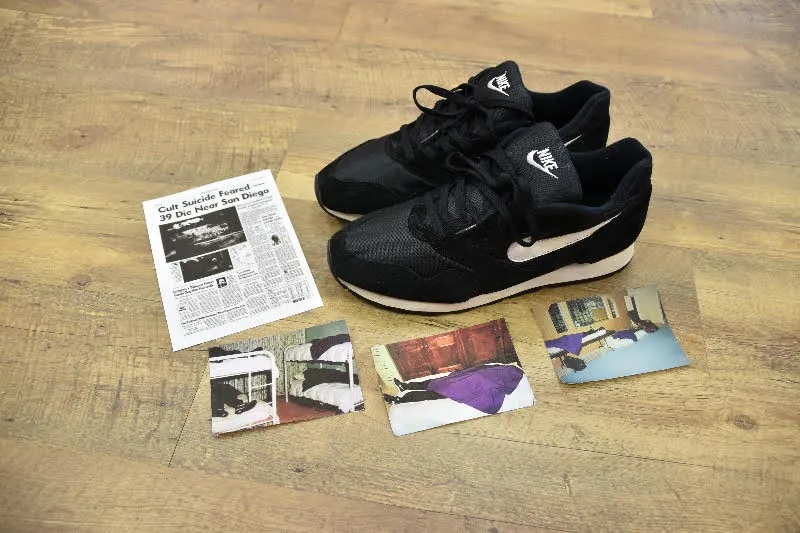
One of the most notable aspects of media coverage following the incident was that every member wore identical uniforms, complete with patches depicting their mission to the “Next Level.” Numerous news outlets published photos of their uniformed bodies covered with purple shrouds with their distinctive black Nike sneakers showing.
The Object:
The Heaven’s Gate uniform was composed of very simple items including black buttoned track-suit-style shirts and pants worn with all black Nike “Decade” sneakers that featured a white swoosh (Zeller 2014: 141; see Figure 1). The clothes were simple and reinforced the movement’s theology and group identity. One member, Neoody, remarked how the uniforms originally helped to make laundry easier for everyone, but it gradually became more of a dress code for members. Over time, the uniforms took on deeper theological significance. Smmody explained, “Ti and Do and their students (crew) have come from a genderless, crew-minded, service-oriented world that finds greed, lust, and self-serving pursuits abhorrent” (Zeller 2014: 104). Their attire reflected these teachings as it emphasized modesty, celibacy, obedience to the rules of conduct, and crew identity (Zeller 2014: 141).
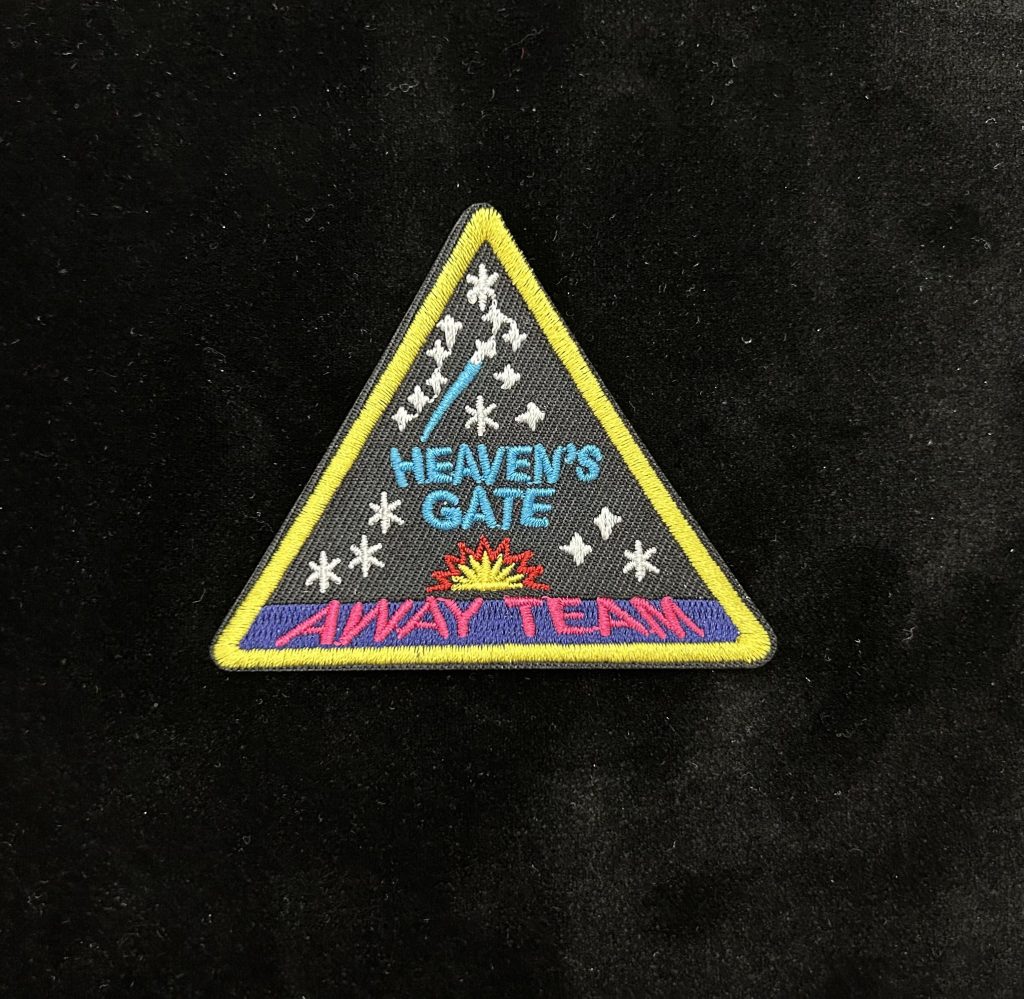
One of the most notable parts of the uniform was a badge sewed onto the upper sleeve. This badge went through many different designs during the movement’s history, but the most recognizable version was its last iteration. The final design was a triangle badge, 9 cm by 7 cm, with a navy blue background and yellow border. It was decorated with a light blue and white comet and stars above a yellow sun with red rays rising above the horizon. The words “HEAVEN’S GATE” appeared in blue in the center below the comet and “AWAY TEAM” in magenta below the sun (see Figure 2). The imagery reflected the group’s theology, especially its emphasis on Nettles’ return.

Patches have historically served organizational functions, indicating group identification, rank, or achievement in military and professional contexts. Space agencies adopted this tradition, using patches to represent the missions astronauts embark on. Heaven’s Gate used patches similarly to highlight their space-focused mission to reach the “Next Level.”
The patches and uniforms also reflect the movement’s deep interest in science fiction. Many followers were avid fans of science fiction shows like Star Trek and would organize watch parties and hold discussions about the show. Followers enjoyed its recurring themes of community, discovery and self improvement, ideas that resonated with their theological vision. This helped to deepen followers’ beliefs in their spiritual journey through Heaven’s Gate to eventually return to the “Kingdom” (Sconce 2004).

The Heaven’s Gate uniforms and badges resembled those worn by the crew of the starship Enterprise featured in Star Trek. Group members made a concerted effort to resemble characters from the TV show. In Star Trek, an “Away Team” refers to crew members sent on missions to explore new planets. Heaven’s Gate adopted this name to signal that its members were similarly exploring earth and would be ready to board their spaceship and return to the “Kingdom” (Sconce 2004).
The uniforms worn by Heaven’s Gate members provided a powerful material expression of their theology, while simultaneously reinforcing crew identity and preparing them spiritually and practically for the “Next Level.”
References
Caffier, Justin. 2017. “The Heaven’s Gate Nikes and the Sneakerheads Who Collect Them.” Vice, 16 March 24. Available at: https://www.vice.com/en/article/the-heavens-gate-nikes-and-the-sneakerheads-who-collect-them/.
Davis, Winston. 2000. “Heaven’s Gate: A Study of Religious Obedience.” Nova Religio: The Journal of Alternative and Emergent Religions 3, no. 2: 241–67.
Fandom Memory Beta. n.d. “Memory Beta, non-canon Star Trek Wiki – Away Team.” Available at: https://memory-beta.fandom.com/wiki/Away_team#:~:text=An%20away%20team%20is%20a,Star%20Trek:%20The%20Next%20Generation.
Heaven’s Gate. 1975. “First Statement of Ti and Do.” Sent out from Ojai, California, March. Available at: https://www.heavensgate.com/book/2-2.htm
Heaven’s Gate. 1976. “The 17 Steps.” November. Available at: https://www.heavensgate.com/book/2-5.htm
Heaven’s Gate. 1988. “Major and Minor Offenses: Additional Guidelines for Learning Control and Restraint – a Self-Examination Exercise.” Available at: https://sacred-texts.com/ufo/hg/book/2-6.htm
Heaven’s Gate. n.d. “Heaven’s Gate – How and When It May Be Entered.” Available at: https://www.heavensgate.com/.
Jwondy. 1996. “Overview of Present Mission.” April. Available at: https://www.heavensgate.com/misc/ovrview.htm
Kanter, Rosabeth Moss. 1972. Commitment and Community: Communes and Utopias in Sociological Perspective. Cambridge, MA: Harvard University Press.
Sconce, Jeffrey. 2004. “Star Trek, Heaven’s Gate, and Textual Transcendence.” In Cult Television, edited by Sara Gwenllian-Jones and Roberta E. Pearson, 199–222. Minneapolis: University of Minnesota Press. http://www.jstor.org/stable/10.5749/j.ctttsjh8.14.
Wikipedia. 2025. “Embroidered Patches.” Last modified August. https://en.wikipedia.org/wiki/Embroidered_patch.
Zeller, Benjamin E. 2014. Heaven’s Gate: America’s UFO Religion. New York: New York University Press. ProQuest Ebook Central.