
2001 The Dress of La Santa Muerte
Religion: Christianity, NRMs
Time Period: 1990s, 2000s
Type Of Garment: Robe
Tags: Blessings, Catholicism, Holy Death, La Santa Muerte, Latin America, Marginalization, Mexico, Ritual
Object:
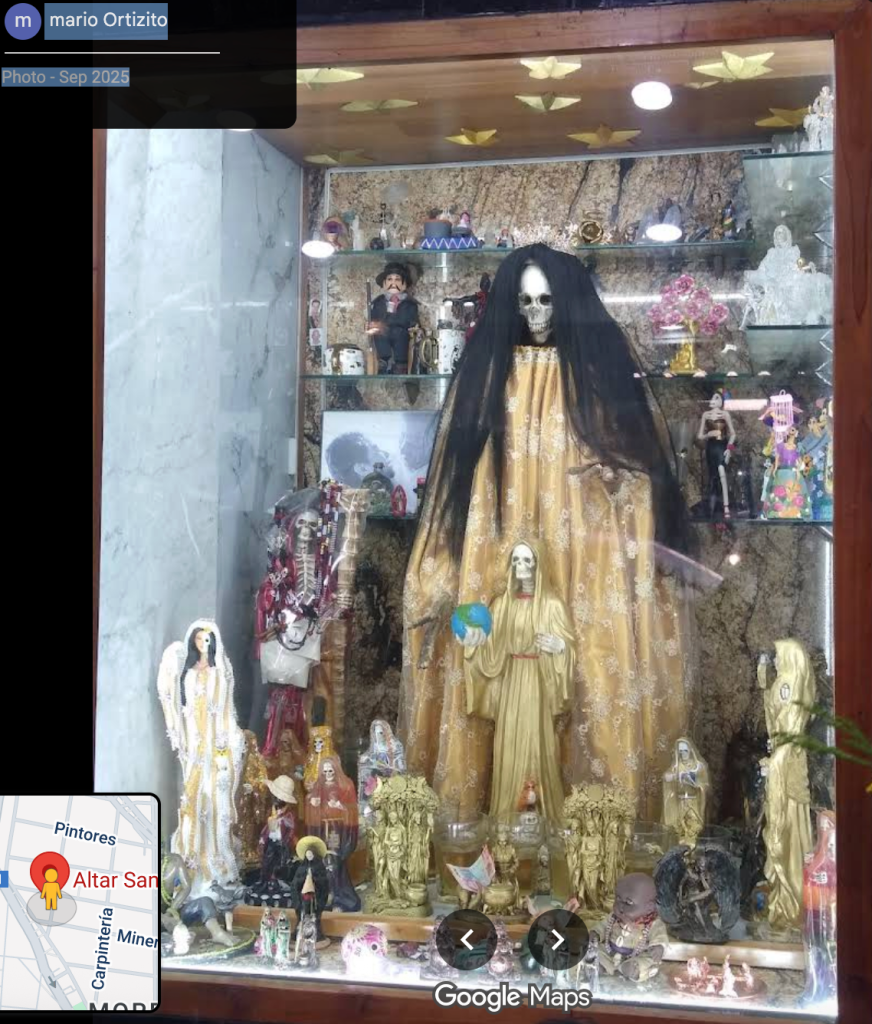
Santa Muerte wears a flowing gold robe that catches the light, the fabric draping gracefully over her tall, skeletal frame. In one hand, she holds a globe, and in the other a scythe. At times, she can also carry an owl or balancing scales. Her skull and bones are stark white, contrasting sharply with the richness of her clothing. A long black wig falls over her shoulders, and a crown rests on her head, gleaming above the dark hair. This particular figure, created by Enriqueta Romero, stands tall and commanding, towering over her devotees as both a handmade creation and a sacred presence (See Figure 1).
The uniform of La Santa Muerte, specifically depicted at the altar of Enriqueta Romero (also referred to as Doña Queta) of Tepito, Mexico, is a prime example of the Santa Muerte garments typically seen at altars worshipping the Saint. The uniform consists of a skeleton, robe, scythe with other hand objects, headpiece or a hood, and jewelry. This symbolism of the dress is significant for those who follow the Holy Saint of death in the Cult of La Santa Muerte.
In the depiction of the altar of Doña Queta, see Figure 1, the gold robe represents and amplifies petitions to the Saint for success, abundance, and wealth (Pocahotnassz 2024). The objects in the hand of the Saint also hold significance. For example, the globe symbolizes the power that the Saint holds over the material world, while the scythe symbolizes the absoluteness of death and the severing of negative energies (Dixon 2023).
La Santa Muerte’s power is embodied in her dress; depictions of the Saint vary widely in their symbolic colors and objects, reflecting followers’ diverse desires and needs. The attire emphasizes that the Saint has the power to fulfill whatever petition or request the devotee desires. These symbols also frame the Saint not as a figure of fear, but as a compassionate force that restores balance and protects the vulnerable. Practitioners reimagine death as helpful, fair, and benevolent, rather than evil or violent, and in doing so challenge stereotypes and characterizations of Santa Muerte as a dangerous or destructive “cult.”
Creator:
The power of this symbolic attire is channeled through its creator and caretaker, Enriqueta Romero. Romero’s aunt introduced her to the Cult of La Santa Muerte when she was just a little girl. She remembers how her aunt would pray and worship in the privacy of her home, a norm for many followers of the religion at the time. Romero, however, transformed this passion and practice by promoting the public worship of the Saint. After receiving a statue of La Santa Muerte from her husband, Romero dressed and displayed it in the window of her home. She now has over five thousand visitors every month. While Romero was not the sole inventor of the Saint’s “uniform,” she transformed devotion to the Saint into a powerful public practice.
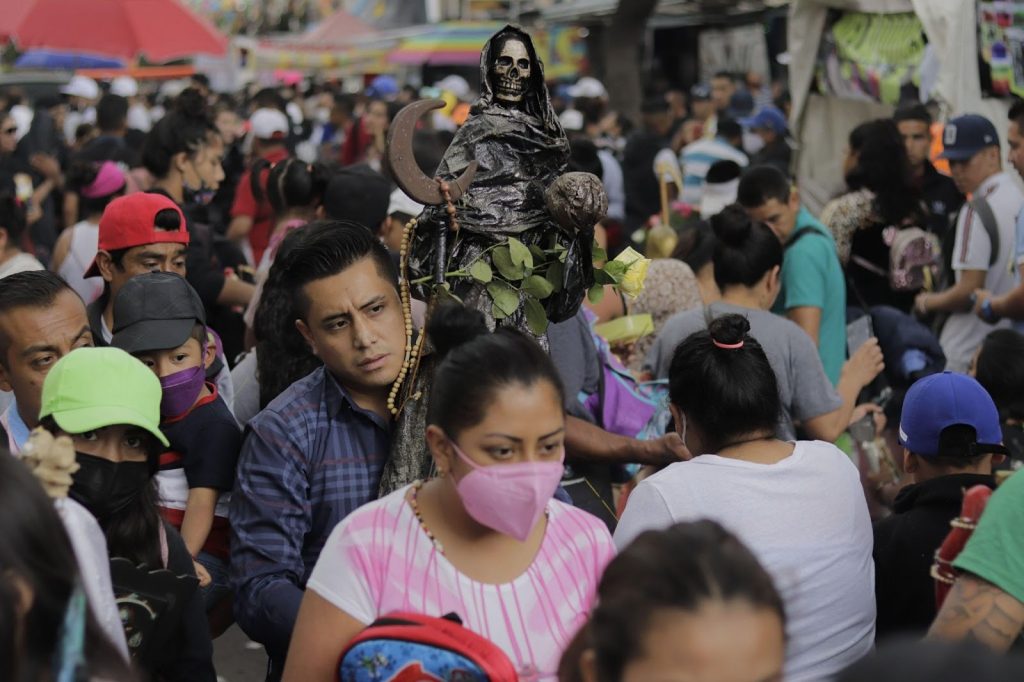
This transformation has been dramatic; Doña Queta now has so many visitors that she also runs a souvenir shop and hosts regular gatherings. Her religious devotion has become a family business with the help of her son and husband. She changes the outfit displayed on the Saint based on the petitions of her visitors. Devotees familiar with the symbolic meanings of the colors recognize their petitions being acknowledged through the different dresses and objects displayed (Crespo 2014). As scholars like Pansters and Rollin note, when devotees dress Santa Muerte in a wedding gown, they are not simply decorating her but expanding her symbolic power. This creative reimagining strengthens the movement’s devotional core and shows how Santa Muerte resists secularization by continually generating new sacred meanings.
Context and Reception:
The dressing of the Saint draws from Catholic tradition, where worshippers adorn statues of female saints with elaborate garments to show reverence and devotion. In this case, the visual re-creation of Santa Muerte through clothing functions as a devotional practice that elevates everyday material objects into the realm of the sacred. It reflects the material theology of her devotees, the belief that divine power can take physical form and act within the everyday world. By clothing death in beauty and color, followers express their conviction that death can be just, protective, and compassionate. In sociologist Rosabeth Moss Kanter’s terms, the act of dressing Santa Muerte exemplifies “transcendence,” showing the belief that ordinary objects can be transformed into vehicles of sacred power and expressing the belief that death itself is a divine agent who can protect, guide, and enact justice within the world (Kanter 1972,72).
In the case of La Santa Muerte, dressing her also gives agency to marginalized people who often feel overlooked by both the Catholic Church and the state. Each robe color corresponds to a specific petition or need. Even though Enriqueta Romero serves as the cult’s “mother” and a central conduit for requests, the devotional landscape remains highly decentralized: followers create their own altars and dress the Saint according to their individual needs. In response, Romero continually adjusts her public display to reflect the diverse petitions brought to her shrine. If the Saint wears white, this signals clarity and spiritual guidance; red represents love and emotional strength; black symbolizes protection and resilience; green addresses justice or legal disputes; yellow offers healing and prosperity; blue provides wisdom and knowledge; and multicolor embodies all of the needs of followers (Dixon 2023). The wide range of clothing styles and colors available allows for endless petitions to be fulfilled, which helps explain the Saint’s widespread appeal.
The veneration of Santa Muerte stems from a complex history in which Indigenous Aztec traditions merged with Catholicism following the Spanish conquest. Through their choices of fabric, color, and adornment, devotees form a personal connection to blessings, justice, and protection, making the Saint’s body a reflection of their hopes and struggles (Pansters 2019: 29-32, 62-68). Although the Catholic Church condemns this devotion as heretical, followers continue to turn to Santa Muerte for comfort, miracles, and empowerment in an exclusionary world. Many times, these followers do not see themselves as straying from the Catholic Church; rather, they pray to the Catholic God for permission to work with the Saint. This highlights how people create hybrid religious identities and practices, as well as the porous boundaries that separate institutional religion from new religious movements.
The figure and clothing of La Santa Muerte are instantly recognizable throughout Mexico and beyond. Her dress and overall image are often linked to people who have been in prison or are part of marginalized communities. This association contributes to the common stereotype that devotion to her is violent or dangerous. In addition, many outsiders view both the followers and the image of death itself as threatening. However, for devotees, death represents something entirely different: a benevolent and fair force that protects and delivers justice to those who are overlooked or mistreated by society. Although some cartel members have adopted her as a spiritual figure, countless other followers have no connection to crime and live ordinary, peaceful lives (Rollins 2017: 19-21). To many followers, Santa Muerte is not a symbol of crime, but a source of protection, honesty, and stability in their daily lives. They emphasize that their devotion grows out of everyday struggles like raising families, surviving economic insecurity, and seeking fairness in a world that often overlooks them. Dressing La Santa Muerte, for them, is an act of both faith and devotion—proof that the divine listens to those whom institutions ignore.
Soany Aguilar, Religious Studies Major, Spanish Minor (WFU ‘26) and Libby Marcantonio, Religious Studies and Applied Mathematics Majors, Creative Writing Minor (WFU ‘26)
8 December 2025
Tags: La Santa Muerte, ritual, Latin America, Holy Death, Blessings, Marginalization, Mexico, Catholicism
References:
Crespo, Erick Baena. 2014. “La Guardiana de La Santa Muerte.” Grupo Milenio. July 20, 2014. Available at: https://www.milenio.com/estados/la-guardiana-de-la-santa-muerte.
Dixon, Tracy. 2023. “Exploring the Vibrant Mystique of Santa Muerte: Colors, Symbols, and
Their Meanings.” Medium. December 18, 2023. Available at: https://medium.com/@Tracy_Dixon/exploring-the-vibrant-mystique-of-santa-muerte-colors-symbols-and-their-meanings-8b5d49c9a86b
Journeyman Pictures. 2016. “Worshipping at the Altar of Saint Death (2009).” YouTube Video. YouTube. https://www.youtube.com/watch?v=ssI96kBTQF4
Kanter, Rosabeth Moss. 1972. Commitment and Community: Communist and Utopias in Sociological Perspective. 1st ed. Cambridge: Harvard University Press.
Pansters, Wil G. 2019. La Santa Muerte in Mexico: History, Devotion, and Society.
Albuquerque: University Of New Mexico Press.
Pocahotnassz. 2024. “TikTok – Santa Muerte Robe Colors.” Tiktok.com. October
Rollin, Tracey. 2017. Santa Muerte. Weiser Books.