
2009 Contemporary Korean Shaman’s Cheolik (철릭, 天翼)
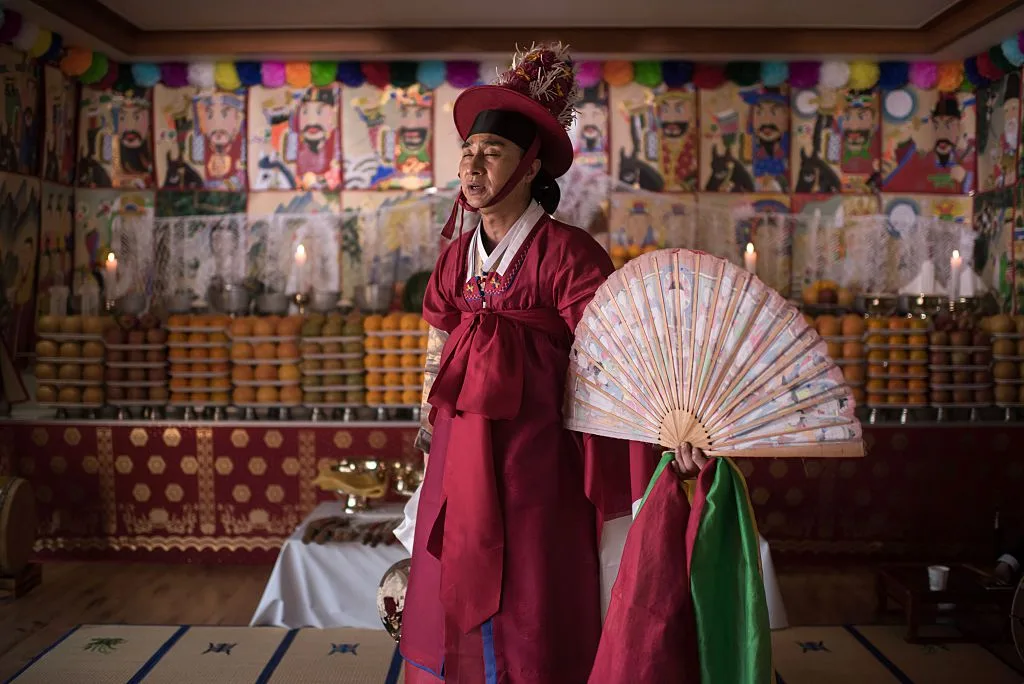
Religion: Korean Shamanism
Time Period: 1300s, 2000s
Type Of Garment: Hat, Robe
Tags: cheolik, cross-dressing, hanbok, Korean indigenous religion, Korean shamanism, military dress, Mongol Empire, Mongolia, mudang, ritual costume
The Object:
The first time the word appears in writing, it is wedged inside a Goryeo (高麗, 918–1392) dynasty love song. The anonymous singer of Jeongseokga (鄭石歌) swore an impossible oath: only once a cheolik tailored from cast iron and pleated with steel wire had finally worn through would the lover consent to leave. The garment named in the song was by then already a foreign import, carried into the Korean Peninsula during the thirteenth-century Mongol invasions. In its Mongol form, the terlig was a riding coat with a pleated lower half built for the steppe; it would travel further still, lodging in Mughal India, in Egypt, in Persia (Cho et al. 2015). In Korea it stayed, and by the late Joseon dynasty it had settled into the working dress of royal military officials, regulated by color, fiber, and rank (Kim and Lee 2018). Seven centuries after the song, the cheolik is the garment a Korean woman puts on when a male general’s spirit comes to inhabit her body (see Figure 1).

Cheolik is a kind of po (포, 袍), a long robe-like garment that reaches the knees or below, worn over inner trousers and cinched at the waist with a cord and decorative belts. As a po for military officials, the cheolik allowed for free movement in running and riding. Some sleeves were made detachable for archery (Keum 2010). The material varied, with linen, silk, and cotton most common; rank determined which fabric a wearer could use. Contemporary shamanic dress now relies heavily on synthetics such as polyester, valued for their affordability and durability. Color was the more contested register. The premodern palette was kept restrained by court regulation; the ritual cheolik worn by twentieth-century shamans turned the dial in the other direction, into vivid contrasts of red and navy (Kim and Yim 2015). The premodern cheolik went without the wide decorative rank badge (hyungbae, 흉배, 胸背) that marked civil and military office. The badge now adorns the twentieth-century shaman’s cheolik for decoration and the legibility of authority.


Consider the two photographs (Figures 2 and 3). Kim Keum-hwa, designated holder of Important Intangible Cultural Property No. 82 and among the most celebrated Korean shamans of the twentieth century, wears a red cheolik with a matching red hat (Figure 2). The view from behind (Figure 3) shows the wide decorative rank badge, the embroidered insignia of a Joseon government official, at the back of the garment, where court regulation never placed one on an active-duty official’s cheolik.
Wearers and Reception:
Korean shamanism centers on a single figure, the mudang (also mansin in the northwest and simbang on Jeju Island). She performs rituals that mediate between the living and the spirits, on behalf of a community or an individual. The majority of Korean shamans are women, and their everyday dress is hanbok, the broad category of Korean traditional clothing, which encompasses hundreds of forms varying by gender, age, class, and occupation. Among the many different kinds of hanbok, contemporary Korean shamans have adopted the cheolik as one of their central ceremonial garments, and it stands out for both its flamboyance and the specific religious work it performs.
A kut, the Korean shamanic ritual, is composed of successive possessions by multiple spirits. The order and composition of those spirits vary by the purpose of the kut and by region, but recurring figures remain. General Im (Im Gyeong-eop, 1594-1646), the baby spirit, samsin halmoni (an elderly woman spirit), and the shaman’s ancestor (often a grandmother or grandfather) appear regularly in her repertoire. The shaman changes clothes throughout the ritual according to the spirit possessing her at each stage. She wears the cheolik when possessed by a male military general drawn from history, such as Im Gyeong-eop or General MacArthur. Under the possession of these military heroes, she wields more formidable power, capable of driving away malicious spirits or persuading disgruntled ones to relent on the client’s behalf. She acts the masculine part out, smoking and drinking.
Anthropologist Laurel Kendall has argued that shamanic costume becomes the material condition through which gods become present: “the costumes that the shamans wear become vehicles for the gods’ presence” (Kendall 2009, 78). On a female shaman’s body, the cheolik performs this labor of presence across a gendered line. The result is a practice of cross-dressing, and one of long standing. Historian Merose Hwang’s study of colonial discourse on shamanism cites a 1513 Joseon record of male shamans entering shrine chambers in women’s dress (Hwang 2009, 197–198). The colonial gender debate over Korean shamanism involved Isabella Bird Bishop (1831-1904), an early British traveler to Korea; Choe Nam-seon (1890-1957), a major modern Korean historian; and Yi Neung-hwa (1869-1943), an early Korean folklorist. Bishop read shamanism as evidence of Korea’s supposed effeminacy, contrasting it with masculine Christian rulership and using it to argue for foreign governance. Yi and Choe, in turn, sought to recover a repressed masculine past against this colonial discourse. The female mudang in male military dress condenses this contested history.
The shaman pantheon has long absorbed new powerful figures into its ritual cast, and Kendall (2009) documents the entry of the Spirit Warriors of Business and Commerce, the Grandfather Sage, and other modern personages into the kut repertoire. Douglas MacArthur is a striking case: a twentieth-century American general whose spirit a Korean shaman invokes. Remembered as the liberator from Japanese occupation, MacArthur entered Korean popular memory as a good general spirit, his Cold War American power absorbed into the shamanic pantheon (Kwon and Park 2022, ch. 2; Noh 2024).
Context:
Often persecuted as a premodern superstition in twentieth-century Korea, Korean shamanism reclaimed its place as indigenous culture and spirituality in the latter half of the century, supported by anthropological research and rising interest in national tradition. The Important Intangible Cultural Properties system, established in 1962, brought major shamanic rituals under state protection, and Kim Keum-hwa became one of the most visible of the designated holders. The minjung intellectual movement of the 1980s read shamanism as a repository of Korean folk authenticity. With destigmatization and rapid capitalist transformation, Korean shamanism has grown into one of the most vibrant cultural and religious practices in contemporary South Korea, diverging substantially from its older forms.
The cheolik‘s trajectory belongs to that provenance. Its origin goes back to the thirteenth century, when the Mongol invasions of the Korean Peninsula carried the garment in, and its etymology traces to terlig, the Mongol word for the riding coat. Joseon court ordinance then made the cheolik a marker of military rank, until King Gojong abolished it in the late nineteenth century for its impracticality (Kim and Lee 2018). The garment was already a palimpsest by the time it came to rest in the shaman’s wardrobe. Mongolian shamanism is in principle gender-neutral and has been reasserting its male center under post-socialist conditions(Buyandelger 2013); Korean shamanism has been female-dominated since at least the middle Joseon. The two trajectories diverge in revealing ways. The Mongol terlig moved through male military bodies in its homeland and remained on those bodies as it traveled across Asia. Only in Korea did the garment cross gender. A Mongol-derived military garment, routed through Joseon court regulation, lands on the body of a Korean female shaman summoning a male general’s spirit. The garment’s whole biography is one of crossing.
The cheolik has now traveled further, into K-pop and television drama. It appears in the opening shamanic sequence of KPop Demon Hunters, the 2025 animated film, and recurs across South Korean period dramas with shaman characters. On screen, the ritual cheolik becomes a sign for an indigenous Korean spirituality that the colonial and Cold War twentieth century tried, and failed, to extinguish. The visual cue is efficient: a camera lingers on the red folds and the rank badge at the back, and a viewer who has never read an ethnography of Korean shamanism recognizes what the image carries.
Note on Korean-language romanization: Throughout the text, I use Revised Romanization for Korean terms.
Minjung Noh is Assistant Professor in the Department of Religion, Culture & Society at Lehigh University. Her research examines transnational Christianity, Korean religions, race, gender, empire, and U.S. power across Korea, the United States, and Haiti. Her current book manuscript, Transnational Salvations: Korean Evangelical Missionaries in Haiti, traces Korean Protestant mission networks through histories of racialization, Cold War geopolitics, and gendered religious labor. Her second book project turns to Korean Mudangs and Haitian Mambos in diaspora.
20 May 2026
Tags: Korean shamanism, mudang, cheolik, hanbok, ritual costume, cross-dressing, Mongolia, Mongol Empire, military dress, Korean indigenous religion, K-Pop Demon Hunters
References:
Buyandelger, Manduhai. 2013. Tragic Spirits: Shamanism, Memory, and Gender in Contemporary Mongolia. Chicago: University of Chicago Press.
Cho, Woo-hyun, et al. 2015. “The Dress of the Mongol Empire: Genealogy and Diaspora of the Terlig.” Acta Orientalia Academiae Scientiarum Hungaricae 68 (3).
Hwang, Merose. 2009. “The Mudang: Gendered Discourses on Shamanism in Colonial Korea.” PhD diss., University of Toronto.
Kendall, Laurel. 2009. Shamans, Nostalgias, and the IMF: South Korean Popular Religion in Motion. Honolulu: University of Hawai‘i Press.
Keum, Jong-Suk. 2010. “A Study on Cheollik, the Military Officials’ Clothes, in the Joseon Dynasty.” Research Journal of the Costume Culture 18 (5): 960–976.
Kim, Eun-jung, and Lynn Yim. 2015. “A Study of Official Hats Shown on Shaman’s Costumes of Seoul Village Gut.” Fashion and Textile Research Journal 17 (3): 364–371.
Kim, Myung-Ja, and So-Young Lee. 2018. “A Study on Cheollik in The Annals of the Joseon Dynasty.” Journal of the Korea Fashion and Costume Design Association 20 (4): 105–115.
Kwon, Heonik, and Jun Hwan Park. 2022. Spirit Power: Politics and Religion in Korea’s American Century. 1st ed. New York: Fordham University Press. https://doi.org/10.2307/j.ctv2t5xfzz.
Noh, Minjung. 2024. “Religion and American Power in Transnational Korea.” American Religion 5 (2): 232–242. https://dx.doi.org/10.2979/amr.00013.