
2010s Modest Dressmaking and the Women of the Twelve Tribes
Religion: NRMs
Time Period: 2010s
Type Of Garment: Dress
Tags: communal labor, dressmaking, handmade clothing, Jesus Movement, Modesty, NRMs, renunciation, sewing, Twelve Tribes, United States, Yellow Deli
Context:
Understanding the handmade clothing of the Twelve Tribes requires understanding the world in which these garments circulate. As sociologist Rodney Stark argues, new religious movements tend to survive only when they maintain a “medium level of tension” with surrounding society, deviant enough to mark themselves as distinct, yet not so deviant that recruitment becomes impossible (Stark 1987). The Twelve Tribes’ handmade dress does exactly that by being visibly countercultural yet grounded in a somewhat familiar biblical modesty, making it legible enough to outsiders to draw interest while distinct enough to sustain communal boundaries. From the vantage point of former member Tamara Mathieu, the clothing was not merely a modest aesthetic but the visible surface of a dense social system in which dress structured everyday life, governed social relations, and mediated tensions between the community and the outside world (Mathieu 2025). Her memories offer a human-scale entry into the community’s broader social context.

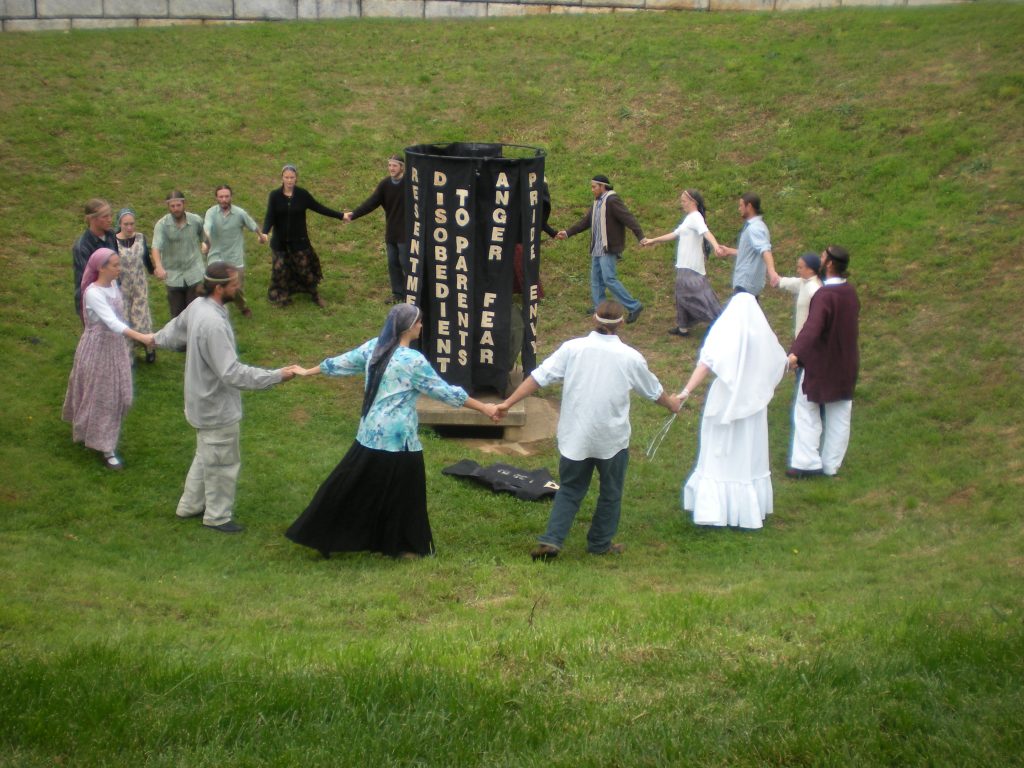
The Twelve Tribes emerged from the 1970s Jesus Movement but quickly distinguished themselves by adopting a separatist communal lifestyle rooted in the Book of Acts (Palmer 2010). Within this worldview, ordinary labor became a means of restoring the apostolic church and preparing for Yahshua’s return (Palmer 2010). Clothing soon became one of the most visible markers of that restoration. These visible practices placed the Tribes at a high level of cultural tension with surrounding society. Their aesthetic signaled a deliberate withdrawal from mainstream consumer culture, marking members as symbolically, and materially, set apart (see Figure 2).

This visible separateness, however, also drew intense scrutiny from outsiders. Scholarship on the anti-cult movement shows that visually distinctive appearance often becomes a focal point for public suspicion and state intervention, functioning as what scholars call a “surface symbol” of deeper alleged deviance (Bromley and Melton 2012). In the Twelve Tribes, modest dress became exactly such a flashpoint. During the 1980s and 1990s, particularly surrounding the 1984 Island Pond Raid, state agencies and the burgeoning anti-cult movement interpreted the community’s unusual appearance as evidence of extremism or potential child endangerment (Swantko 2000; Palmer 2010). Long hair, handmade garments, and gender-distinct clothing were framed by critics as signs of indoctrination and control (Palmer 2010). These interpretations persisted despite repeated failures to substantiate any allegations in court (Swantko 2000; Palmer 2010). Clothing therefore acted in a dual role. It expressed a members’ internal devotion while simultaneously functioning as a beacon for external suspicion.
At the same time, dress served as a strategic form of public presentation in the Tribes’ outreach work. In their Yellow Deli cafés, members wear their handmade garments while cooking, serving, and interacting with customers. This aesthetic conveys pastoral calm, humility, and timelessness, acting to counter accusations of coercion and replacing them with an image of hospitality and rootedness. Mathieu noted that the modest clothing was explained as a way to help keep the community spiritually pure, but it also worked to project stability and harmony to the outside world (Mathieu 2025).
Because clothing in the Twelve Tribes operates simultaneously as a marker of identity, a tool of discipline, and a mode of public representation, the garments themselves become the clearest entry point into this cultural system. The clothing cannot be separated from the history, theology, and communal practices that give it force. Clothing organizes belonging, manages the community’s image, and shapes how members understand their bodies, their obligations, and their spiritual roles. With this broader social context in view, we can now turn to the material object at the center of these dynamics and examine how a single garment embodies the community’s values and expectations.
Object:
To understand the role of dress in the Twelve Tribes, it is most effective to ground the analysis in a single, representative object: the standard women’s long cotton skirt and the accompanying tunic-style blouse (see Figure 3). This everyday outfit, ankle-length, loose, fully covering the body, and sewn from pure, natural fibers, functions as an objectified belief. As my interviewee, and former member, Tamara Mathieu explained, modesty was not simply a virtue but a collective obligation rooted in the community’s spiritual expectations (Mathieu 2025). Mathieu emphasized that women were expected to dress in ways that protected “purity” and signaled full devotion: “We had to be fully covered, and with loose, baggy styles… necklines above the collarbone, sleeves below the elbow” (Mathieu 2025). Even when pants were worn, they were the handmade, extremely blousy “Sus pants,” a uniquely internal garment whose design ensured the body’s shape was never visible (Mathieu 2025).

The theological foundation for these material restrictions draws directly from the group’s interpretation of the Bible. Women frequently invoked Deuteronomy 22:5, 1 Timothy 2:9-10, and 1 Peter 3:3-4, verses that reinforce modesty, renunciation of adornment, and strict gender separation (Mathieu 2025). These texts were not abstract guidelines but functioned as regulating principles for daily life. The clothing became a form of discipline directed toward maintaining “pure” male thoughts, an explicitly gendered rationale Mathieu heard repeatedly: women dressed modestly “to keep the men’s minds pure” (Mathieu 2025).
The everyday outfit thus embodies what sociologist Rosabeth Moss Kanter calls renunciation, or the visible rejection of mainstream fashion, self-expression, and adornment (Kanter 1972). This renunciation was intensified through detailed rules governing fabric, color, and fiber. Only natural materials were permitted; polyester was strictly banned. Tamara Mathieu described how these rules shaped daily decisions about clothing, with Mathieu recalling in our interview that even small items made of synthetic fibers were viewed as spiritually compromising (Mathieu 2025). Mathieu recounted having to discard scarves, fleece mittens, and headwraps when she first joined the Twelve Tribes Community because they were “100% polyester” (Mathieu 2025). Even underwear was regulated: “We had to wear simple, brief-style underwear… I was told bikini underwear could give off a ‘sexual spirit’” (Mathieu 2025).
Over time, the clothing itself became deeply entangled with systems of correction and discipline. Patterns were named after the women who made them, “Sarah’s blouse,” “Leah’s blouse,” and others, but choosing the wrong fabric weight, color, or drape could prompt immediate admonishment (Mathieu 2025). Mathieu explained how even carefully sewn garments could be judged unsuitable if they drew unintended attention to the body (Mathieu 2025). She recalled sewing a blouse she felt proud of, only to be told it “accentuated her bust” because the thin fabric lay incorrectly; she obediently disposed of it (Mathieu 2025). Palmer, in her work The Twelve Tribes: Preparing the Bride for Yahshua’s Return, similarly notes that women regularly met to review updated clothing standards and then collectively purged wardrobes to maintain uniformity across households (Palmer 2010).
These practices reveal how the garment not only represents belief but enforces conformity, operating as a material instrument through which discipline is enacted and internalized. As bright or patterned fabrics were later deemed inappropriate and replaced with navy, brown, or dark purple dyes, clothing became a mechanism shaping identity across generations. Mathieu described how painful these restrictions were for her daughters, who longed to wear “pretty” things but learned that color or even a single decorative sequin could be framed as spiritually dangerous (Mathieu 2024).
In this way, modest dress reflects not only Kanter’s renunciation but also her mechanism of communion: clothing functioned as a shared symbolic system that generated emotional cohesion and collective identity (Kanter 1972). The constant expectation to “receive” correction, the shared labor of sewing, and the uniformity of color and silhouette created a common emotional world in which belonging was both expressed and enforced. The everyday dress therefore becomes a material technology of obedience, emotional regulation, and communal attachment, through which the Twelve Tribes’ moral vision is stitched directly onto the body.
Creator:
The creators of these garments are, above all, the women of the Twelve Tribes. As Tamara Mathieu emphasized in our interview, this work was not simply domestic labor; it was framed from within as a spiritual vocation. Sewing for others, whether that be your children, husbands, unmarried brothers, guests, or newcomers, was taught as “an expression of love,” a tangible way of building the restored “People of Acts 2 and 4” (“Modesty: Is It All But Lost?” n.d.). Utilizing this insider way of framing, garment-making was a sacred extension of communal life and a daily practice through which women participated in what they believed was a divine project of rebuilding God’s true people on earth.
Beginning with this internal perspective reveals the emotional and theological meaning that made sewing feel deeply purposeful. Mathieu described how learning to sew her first garments brought a sense of pride and belonging to the Kingdom the group believed they were restoring (Mathieu 2025). In Palmer’s account, this meaning-making is central as labor is sanctified as part of the Tribes’ effort to live out an apostolic model of shared work and shared goods (Palmer 2010). Sewing thus becomes a devotional act, not merely a task.
However, when contextualized with scholarly critique, this labor takes on a more complicated character. As researcher Navah Chestnut argues, the Tribes’ gender system “systematically removes agency,” channeling women’s skills toward community needs while tightening structures of control (Chestnut 2024, 27). While women create the garments, they do not create the rules that govern them. Mathieu explained that clothing standards were developed by “leading women with men’s oversight,” with new regulations delivered through revelations referred to as “visions” (Mathieu 2025). Once a rule changed, members were expected to conform immediately. This meant purging wardrobes, re-sewing entire sets of garments, and ensuring that others’ clothing also reflected updated standards. Those who hesitated or questioned were not just corrected; they faced spiritual sanction (Mathieu 2025). As Mathieu stated, women who resisted clothing rules could be “cut off,” losing the ability to drive, handle money, teach children, dance at gatherings, or attend Breaking of Bread. They remained in this spiritually suspended state until they publicly repented (Mathieu 2025).
Kanter’s framework brings this dual role of sewing into clearer relief. Sewing operates as investment, as one can imagine the countless hours spent sewing for others deepens emotional dependence on the community, creating what Kanter describes as a “stake in the group’s success” (Kanter 1972). Each garment a woman produces binds her labor, identity, and time more tightly to the collective. But sewing is also a form of mortification, with the women’s personal creativity systematically narrowed by strict rules. Returning to Mathieu’s story of sewing a blouse she loved, only to be told it “accentuated her bust” and must be discarded, an illustration is drawn as to how personal expression is subordinated to communal discipline (Mathieu 2025).
Thus, we find the creator role is both empowering and constraining. Women’s skill sustains the community materially and symbolically. Their craftsmanship enables the very aesthetic that defines the Tribes to outsiders. Yet this same labor binds them more tightly to institutional authority.
Madelynn Keller, double major in Sociology and Religious Studies with a minor in Arabic Language Studies, WFU ‘27.
20 February 2026
Tags: Modesty, handmade clothing, communal labor, Twelve Tribes, NRMs, dressmaking, sewing, renunciation, United States, Jesus Movement, Yellow Deli
References:
Bromley, David G., and J. Gordon Melton. 2012. “Reconceptualizing Types of Religious Organization: Dominant, Sectarian, Alternative, and Emergent Tradition Groups.” Nova Religio: The Journal of Alternative and Emergent Religions 15 (3): 4–28. https://doi.org/10.1525/nr.2012.15.3.4.
Chestnut, Navah. 2024. Gender Performance in “Cult” Conversion Narratives: The Twelve Tribes. Departmental Honors Thesis, University of Tennessee at Chattanooga. https://scholar.utc.edu/honors-theses.
Kanter, Rosabeth Moss. 1972. Commitment and Community: Communes and Utopias in Sociological Perspective. Cambridge, MA: Harvard University Press.
Mathieu, Tamara. 2024. All Who Believed: A Memoir of Life in the Twelve Tribes. Rootstock Publishing. https://www.rootstockpublishing.com/rootstock-books/p/all-who-believed.
Mathieu, Tamara (former member, Twelve Tribes). 2025. Personal Interview with the author. 19 November 19.
“Modesty: Is It All But Lost?” n.d. Our Twelve Tribes. Available at: https://www.twelvetribes.org/article/modesty.
Palmer, Susan J. 2010. “The Twelve Tribes: Preparing the Bride for Yahshua’s Return.” Nova Religio: The Journal of Alternative and Emergent Religions 13 (3): 59–80. https://doi.org/10.1525/nr.2010.13.3.59.
Stark, Rodney. 1996. “Why Religious Movements Succeed or Fail: A Revised General Model.” Journal of Contemporary Religion 11 (2): 133–46. doi:10.1080/13537909608580764.
Swantko, J. A. 1999. “The Twelve Tribes’ Communities, the Anti-Cult Movement, and Government’s Response.” Social Justice Research 12 (4): 341–364. https://doi.org/10.1023/A:1022021125576.
tamaramathieu (Tamara Mathieu). 2025. “Things We Were Not Allowed to Do in the 12 Tribes Cult Part 4.” TikTok video. Posted 12 August 12. Available at: https://www.tiktok.com/t/ZTM4jSONP/.
tamaramathieu (Tamara Mathieu). 2025. “Shoes in the Twelve Tribes.” TikTok video. Posted 26 October. Available at: https://www.tiktok.com/@.tamaramathieu/video/7565334628597288223.