
2014 Le Jardin d’Eden Dress by Valentino
Religion: Christianity
Time Period: 2010s
Type Of Garment: Dress
Tags: Adam, couture, embroidery, Eve, Fashion Advertising, fashion and art, Garden of Eden, Genesis 3, Lucas Cranach the Elder, Martin Luther, Mary, opera, Protestantism, serpent, temptation, Valentino, Venus
Object:
Valentino’s Spring 2014 couture collection, designed by Maria Grazia Chiuri and Pierpaolo Piccioli, featured fifty-five looks inspired by opera, including La Traviata, La Bohème, and Carmen (Phelps 2014). The first look established the theme with the musical score of Verdi’s La Traviata boldly embroidered across the tulle skirt of the gown. The third look, though, embraced prominent religious figures from the Judeo-Christian tradition—Adam and Eve. In keeping with the theme, their appearance perhaps references Jules Massenet’s Eva (1875) or Johann Thiele’s Adam und Eva (1678).
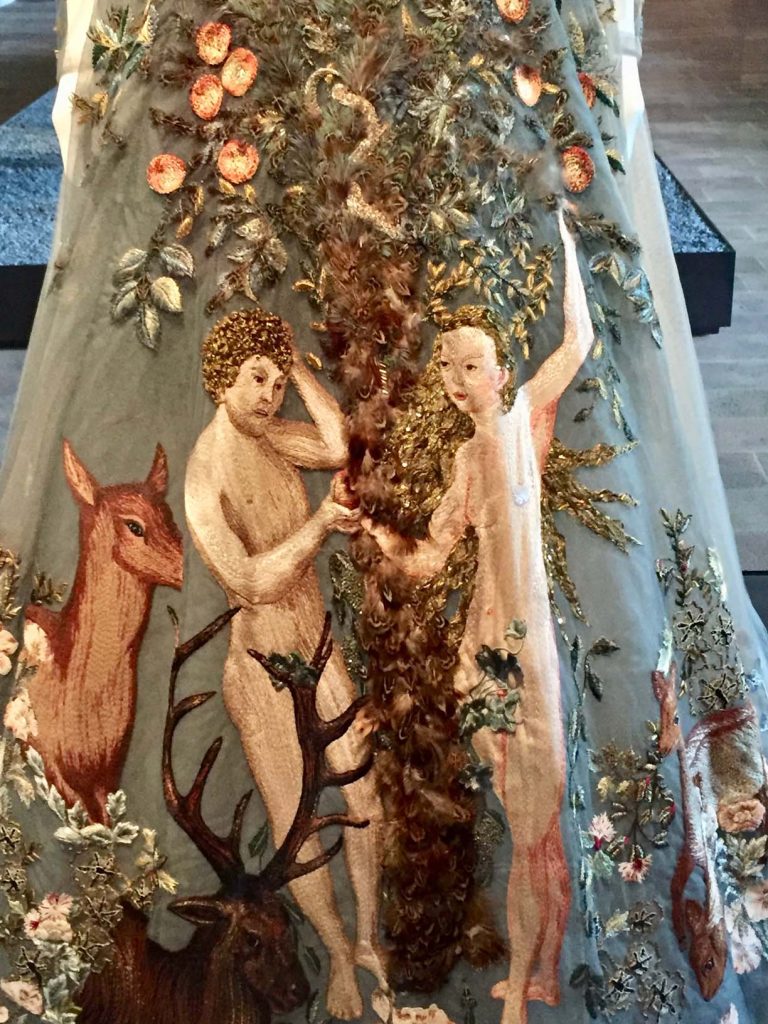
The gray gown features a flowing skirt and bustier-style top with a sheer overlay. The design of the dress and the style of the model are restrained—simple lines, pulled back hair, and a no-makeup look. This minimalism provides a backdrop for the exuberant silk embroidery that brings life to this gown called “Le Jardin d’Eden” or the Garden of Eden. For those familiar with Genesis 3, the scene is easy to decode. Embroidered leaves adorn the bodice and sleeves of the gown and lead the viewer’s gaze to a naked Adam and Eve on the skirt (see Figure 1).

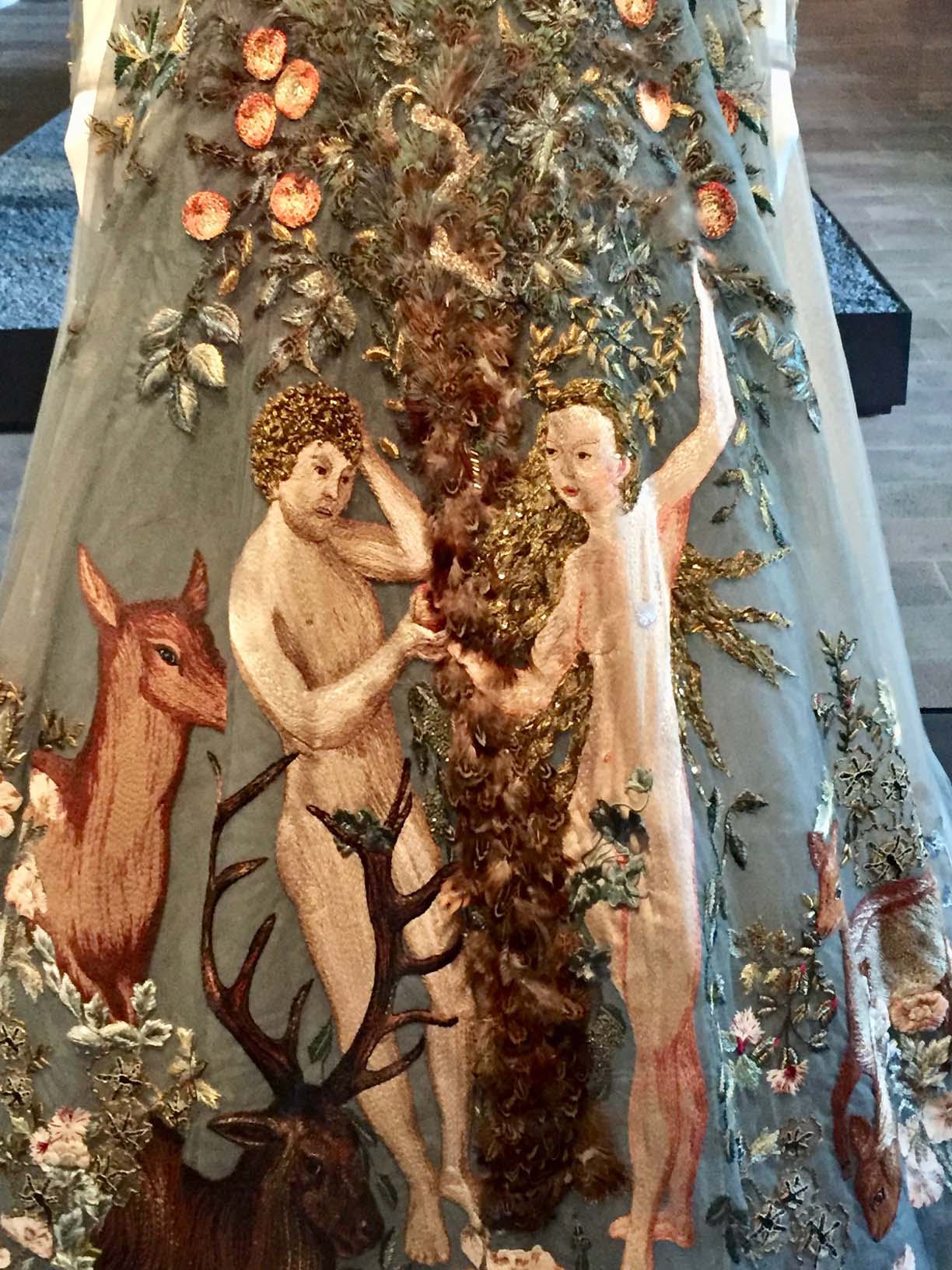
A hind, a stag, and flowers surround the couple highlighting both the garden and paradise dimensions of the biblical Eden. A reference further emphasized by their position alongside a fruit-bearing tree in which a serpent lurks and faces Eve. With one hand Eve holds a branch from the tree and with the other she offers Adam a piece of the fruit. They stand on the precipice of the Fall from innocence into sin. The embroidery, which took 2200 hours to create, tells the story and captures the viewer’s attention, while highlighting the couture status of this gown (see Figure 2).
Context:
Reflecting the close relationship between fashion and art, the embroidery on the gown replicates elements of a 1526 painting of Adam and Eve by Lucas Cranach the Elder (c. 1472-1553), a subject that he returned to over twenty times (Ozment 2011, 6-7) (see Figure 3).
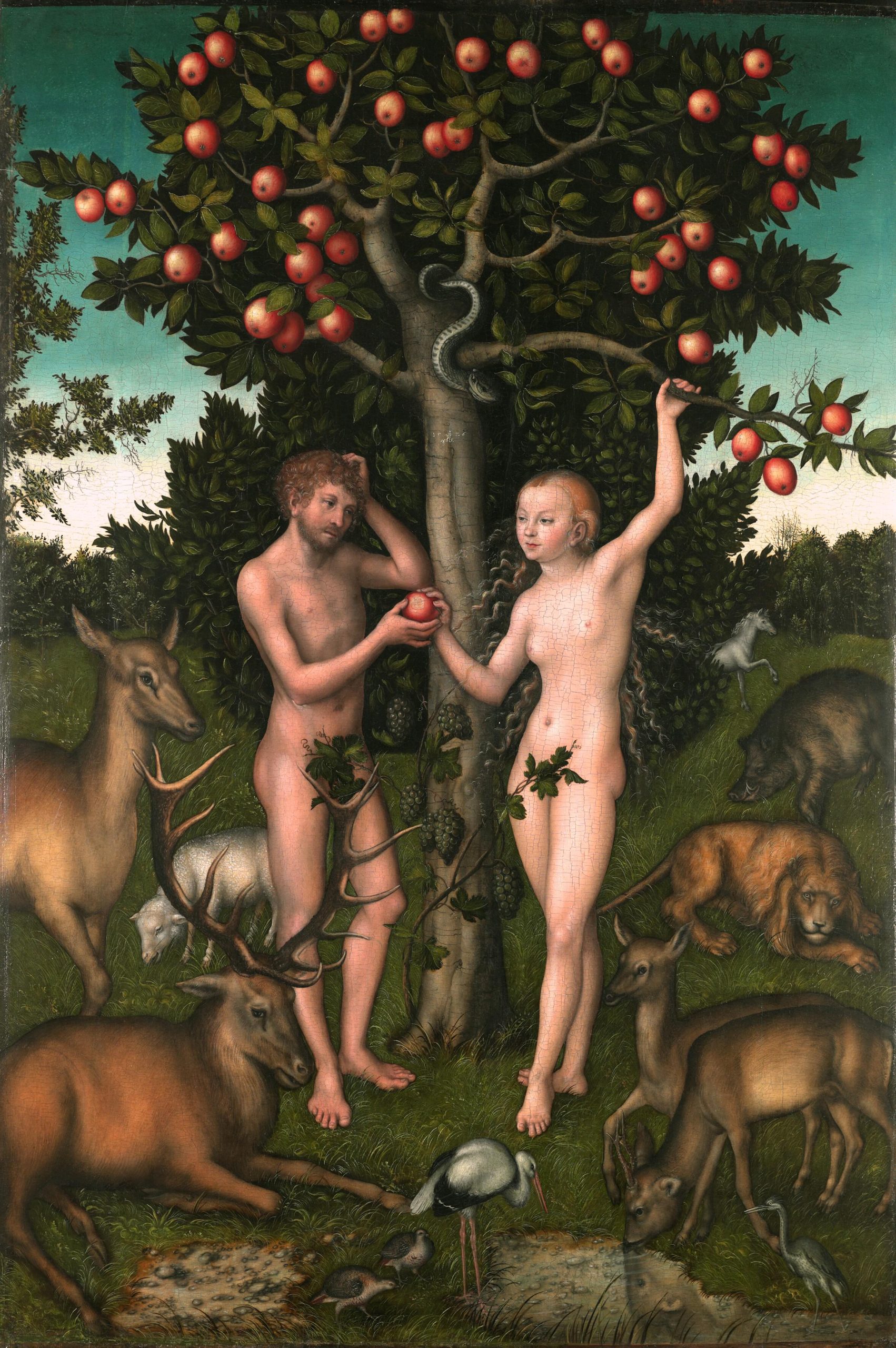
The dress preserves many of the details of Cranach’s painting, including the Tree of Knowledge, Adam, Eve, the serpent, and the red deer (hind and stag), that render the story legible and its resemblance to the painting recognizable. Given the opera-focused theme of the collection, it seems likely that editing out some details of the painting reflected the limited space of the gown, rather than the designers’ desire to make a theological statement.
Cranach, though, was known for his friendship with and promotion of a prominent theological thinker–Martin Luther (1483-1546). Cranach served as “court painter to the electoral Saxon dynasty seated in Wittenberg” and through this role he became a close friend of the monk turned reformer (Ozment 2011, 1). Cranach served as godfather to Luther’s son Johannes, while Luther did the same for Cranach’s youngest child (Ozment 2011, 5). Cranach also created engravings of Luther, notably Martin Luther as an Augustinian Monk (1520), and portraits of Luther and his wife Katharina von Bora over the years.
Protestantism and Luther influenced Cranach’s works, which can be seen in this Adam and Eve painting, which emphasizes the natural scene and avoids any inclusion of Catholic imagery (Courtauld Gallery 2015). He was also a court painter and known for his classical paintings of Venus and Apollo, among others. Historian Steven Ozment explains that “the vitality and charm typical of Cranach’s classical women–particularly in his soulmate, Venus–appears to flow from the painter over to the more somber biblical counterparts, especially the figure of Eve” (Ozment 2011, 180) (see Figure 4). Eve, in Cranach’s paintings and in this Valentino gown, resembles Venus with her hair color and style, her nudity, and her setting. Cranach’s Venus often appears in a similar pose alongside a fruit tree with her son Cupid (see Figure 5).


While Adam and Eve were a frequent subject for Lucas Cranach the Elder, the duo rarely makes an appearance on designer fashion garments. Occasionally there may be a gown that emphasizes an Eve-garden theme or a pair of Adam and Eve costumes, but figural representations of Adam and Eve (alone or together) on apparel do not often occur. Other Christian figures, including the Virgin Mary, Jesus, and various Saints, regularly adorn gowns and other apparel as the popularity of Christian and more broadly religious themes wax and wane.
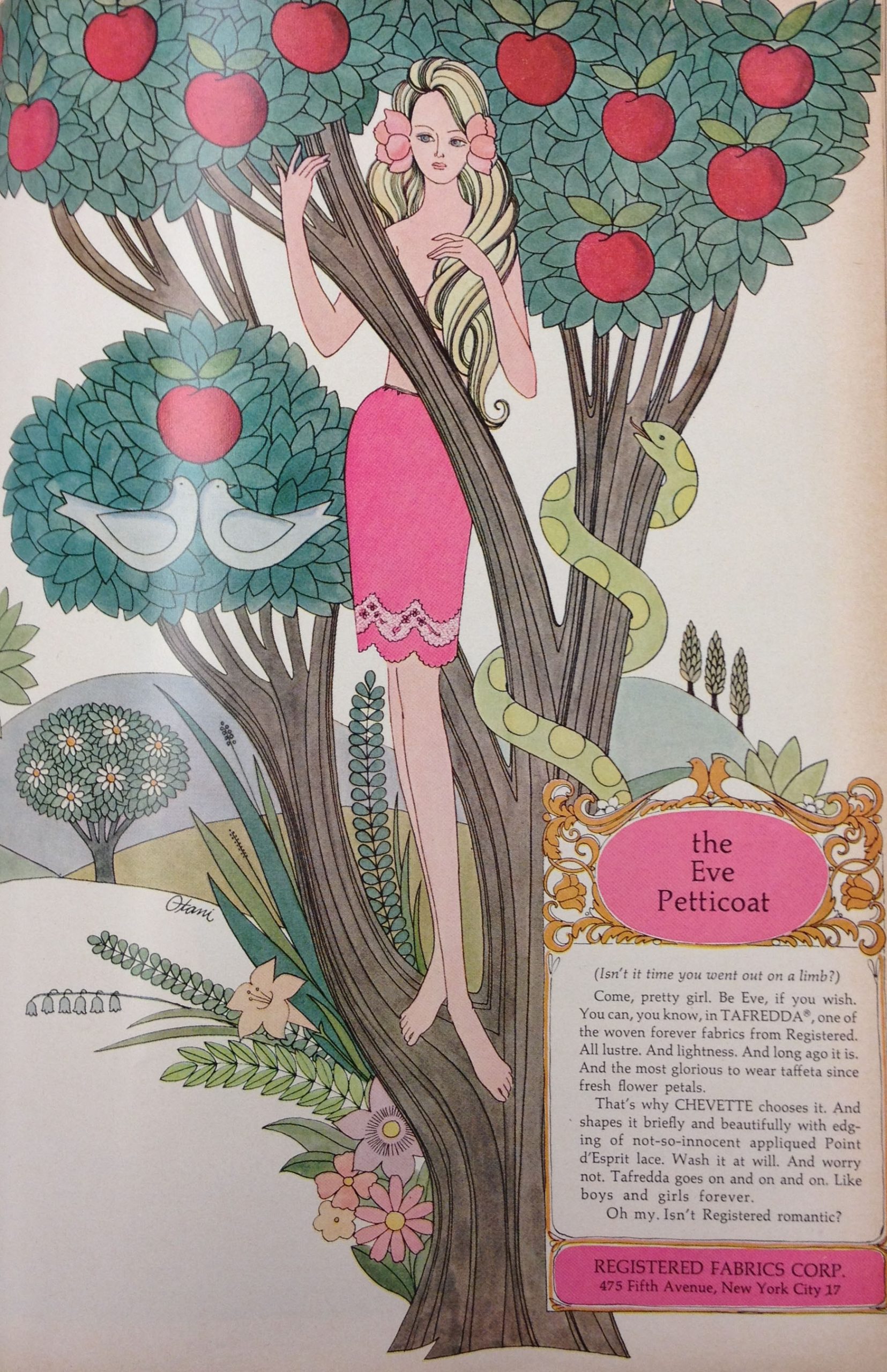
The avoidance of Adam and Eve on designer apparel seems significant given the ubiquity of Genesis 3 in fashion advertising. Throughout the latter half of the twentieth century and into the twenty-first, fashion advertisements regularly featured Eve, the apple, a serpent, and the language of Eden, temptation, and more (Neal 2019, 73-80). From lipstick and perfume to bathing suits and petticoats, Eve symbolized the temptation of fashion. Advertisers utilized cultural knowledge of her story as a way to entice female consumers to purchase new fashion goods. By doing so, ads promised that these women could achieve Eve’s vaunted status as a beauty (see Figure 6).
Perhaps what makes Eve work so well as an advertising icon, her associations with sin and temptation, are the very qualities that prevent her from working well as fashion adornment. Historically, Eve’s theological status as the “first sinner” prevented her from being celebrated in the Christian Church. As a result, translating Eve into fashion designs is challenging given that a sinless Eve wears no clothes and post-Fall she dons fig leaf attire. How would Eve be legible in fashion without textual or visual cues, such as the serpent and the apple? Even in fashion advertising, the serpent and the apple increasingly replaced figural representations of Eve to recall the Genesis story (Neal 2019, 73-80). Interestingly, in the same Valentino collection, look 6 featured a gown with a serpent coiling around the bodice.
Fashion designers may have also avoided Eve because they had a less controversial and more celebrated option: Mary. Christian theology has long positioned Eve’s sinfulness and sexuality in contrast to Mary’s perfection and purity. These archetypes have shaped ideas about gender and impacted countless people as they “are embedded in Western culture and, by transference, in colonial contexts across the globe” (Sawyer 2008: 305). While fashion is not one to shy away from general provocation, designers and the industry tended to avoid figural Christian imagery until the 1990s. This seems due to both fashion’s tendency for the abstract over the representational, as well as a desire to circumvent religious controversy. When they did begin utilizing Christian holy figures they focused on heroes and heroines of the Christian Church, not its problematic progenitor.
The Valentino gown makes Eve both recognizable and acceptable through its use of Cranach’s painting. By including the whole scene, Eve and Adam are presented and preserved in a moment of possibility on the brink of the Fall, which invites viewers to imagine other possible tellings, interpretations, and endings to the story. A perfect invitation for a collection dedicated to the opera.
Creator and Reception:
A dress embellished with an embroidered Adam and Eve inspired by a Protestant artist for Valentino, an Italian design house led by two Italian designers, comes at an interesting moment. This collection appears a year after British Vogue declared that a “Holy Spirit” permeated the fashion runway (Hirschmiller 2013). Numerous designers, including Dolce & Gabbana, Givenchy, Sarah Burton (for McQueen), and Karla Špetić, utilized Christian imagery and themes, but Adam and Eve do not appear. Further, some collections, notably “Tailored Mosaic” by Dolce & Gabbana, included designs that carefully replicated their artistic inspiration, whether through digitally printed fabrics and/or mosaic-inspired embellishment. The careful rendering of Cranach’s Adam and Eve on this Valentino gown highlights a similar emphasis on exquisite craftsmanship and faithful rendering. Given this milieu, in some ways the appearance of a Christian theme on a couture gown is not surprising. Chiuri and Piccioli are tapping into fashion currents of the time. Christianity was a theme that Piccioli returned to in his Fall 2017 couture collection.
Fashion journalists and critics celebrated the collection’s “austere beauty” and “divine splendor,” while another proclaimed that “the show sang like a Rossini aria” (Phelps 2014; Boyle 2014). Not surprisingly, many expounded on the opera theme, but they also noticed “all the animals–a veritable menagerie of them” (Phelps 2014; see also Nguyen 2014). Few explicitly mentioned the Garden of Eden dress, probably lumping it in with the noticeable animal theme. However, one column singled out the dress, the Cranach inspiration, and its “reveling in the glories of nature” (2014). In this review, the writer critiqued the “unsubtle quality” of the designs, but concluded that “Come Oscar night, given a choice between a mermaid parade and Adam and Eve on a skirt, we’ll take the apple pickers. No contest” (WWD Staff 2014). Given the positive reception of this gown, perhaps we will see Eve adorning more fashionable apparel in the future as fashion continues to find new ways to negotiate the theological baggage that has long kept her off the runway.
Lynn S. Neal, Professor of Religious Studies, Wake Forest University
24 February 2026
Tags: Valentino, Adam, Eve, Garden of Eden, Genesis 3, opera, serpent, Martin Luther, Lucas Cranach the Elder, fashion advertising, Mary, embroidery, couture, Venus, Protestantism, temptation, fashion and art
References:
Boyle, Katherine. 2014. “For Paris Couture Shows, Venues as Chic as the Fashions They Showcase.” Washington Post, February 1, E3.
Courtauld Gallery. 2015. “Lucas Cranach the Elder’s Adam and Eve.” YouTube. Available at: https://youtu.be/9-rdl-gDVxw?si=R99G428Ynhea8chY.
Hirschmiller, Stephanie. 2013. “Holy Spirit.” British Vogue, October, 239.
Neal, Lynn S. 2019. Religion in Vogue: Christianity and Fashion in America. New York: New York University Press.
Nguyen, Long. 2014. “The Wild Things Came Out at Valentino Couture Spring 2014.” Fashionista, January 12. Available at: https://fashionista.com/2014/01/the-wild-things-came-out-at-valentino-couture-spring-2014.
Ozment, Steven. 2011. The Serpent and the Lamb: Cranach, Luther, and the Making of the Reformation. New Haven: Yale University Press.
Petry, Frauke Maria. n.d. “Lucas Cranach the Elder—Adam and Eve.” The Art Inspector. Available at: https://www.the-artinspector.com/post/lucas-cranach-the-elder-adam-and-eve.
Phelps, Nicole. 2014. “Valentino: Spring 2014 Couture.” Vogue, January 21. Available at: https://www.vogue.com/fashion-shows/spring-2014-couture/valentino.
Sawyer, Deborah F. 2008. “Hidden Subjects: Rereading Eve and Mary.” Theology and Sexuality 14 (3): 305–320.
WWD Staff. 2014. “Valentino Couture Spring 2014.” WWD, January 22. Available at: https://wwd.com/runway/spring-couture-2014/paris/valentino/review/.