
1986 Christening Gown by Feltman Brothers
Religion: Christianity
Time Period: 1980s
Type Of Garment: Dress
Tags: Baptism, Catholicism, Children, Christening, Culture Wars, embroidery, Family, Family Tradition, Feltman Brothers, Lace, Moral Majority, Prince William, Protestantism, Ritual, Vintage
The Object:
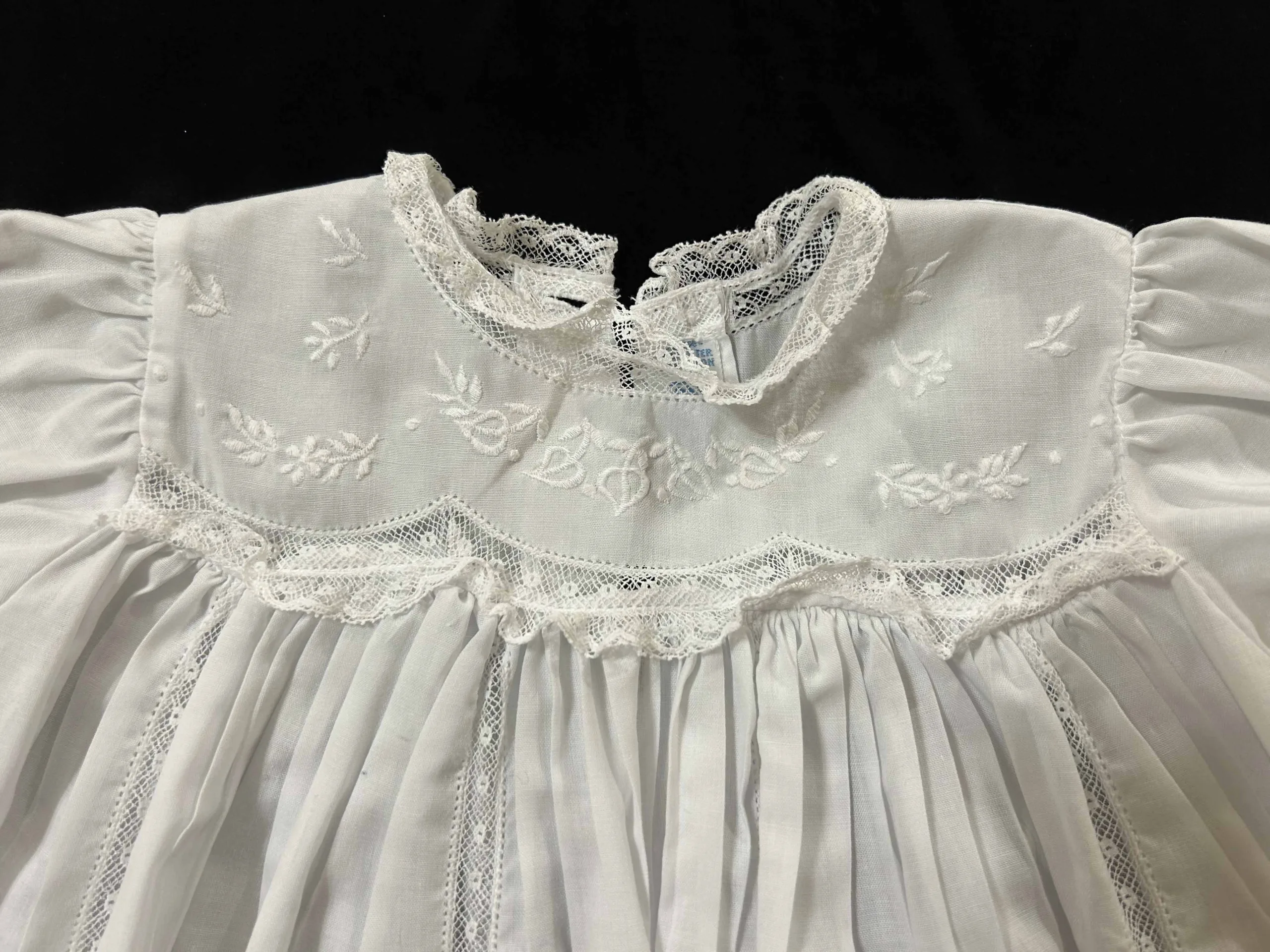
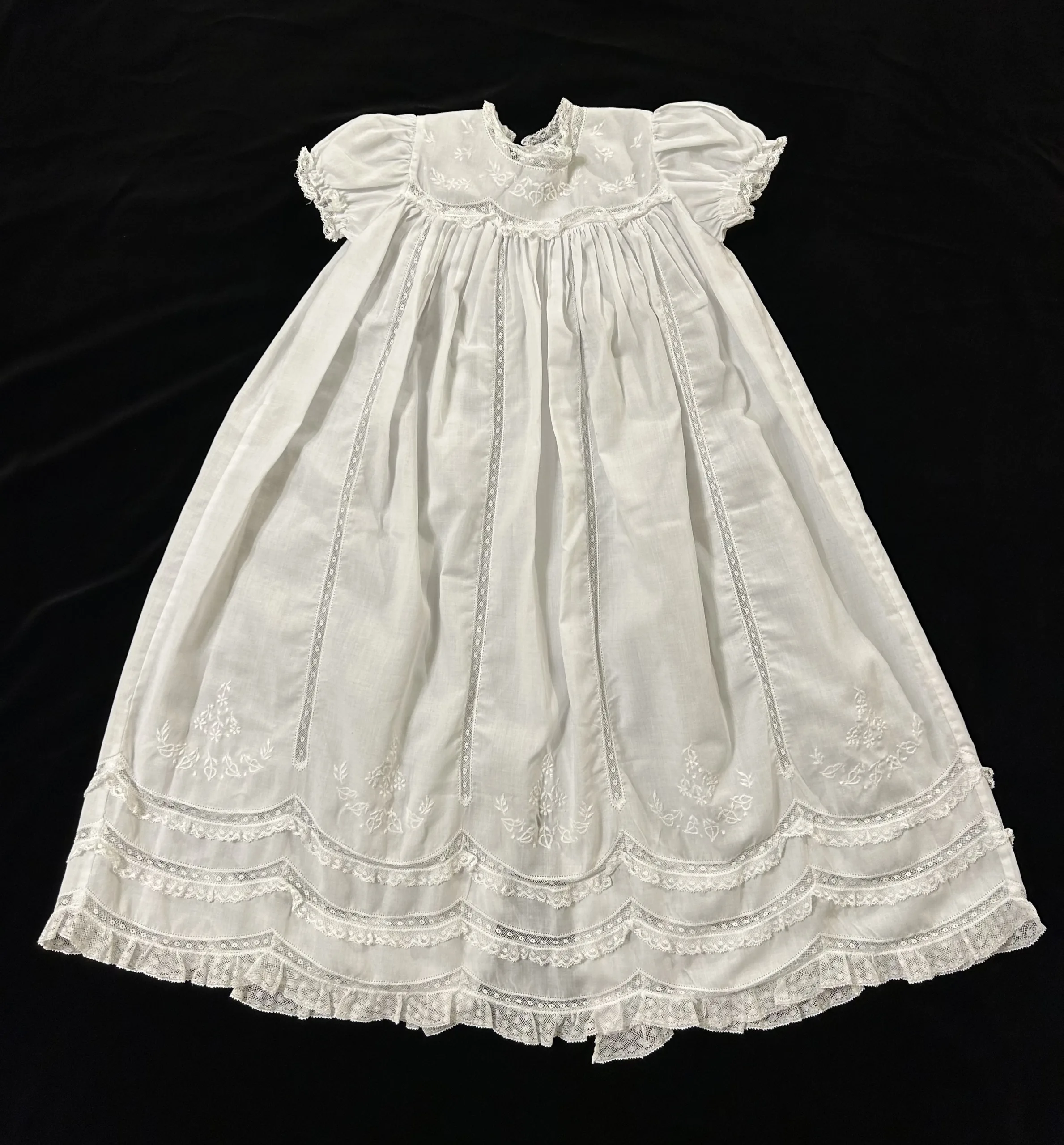
This christening gown is white and measures 25” long from shoulder to hem. Delicate lace trims the neckline and cap sleeves, while white hand-embroidered flowers and leaves adorn the bodice. The gown’s gathered skirt includes four vertical rows of narrow lace that create five symmetrical panels of equal width. The bottom of each panel features a variation of the same embroidered white flowers and leaves in a curved design. Three rows of scalloped lace accentuate this embroidered design and decorate the bottom of the gown (see Figures 1 and 2).
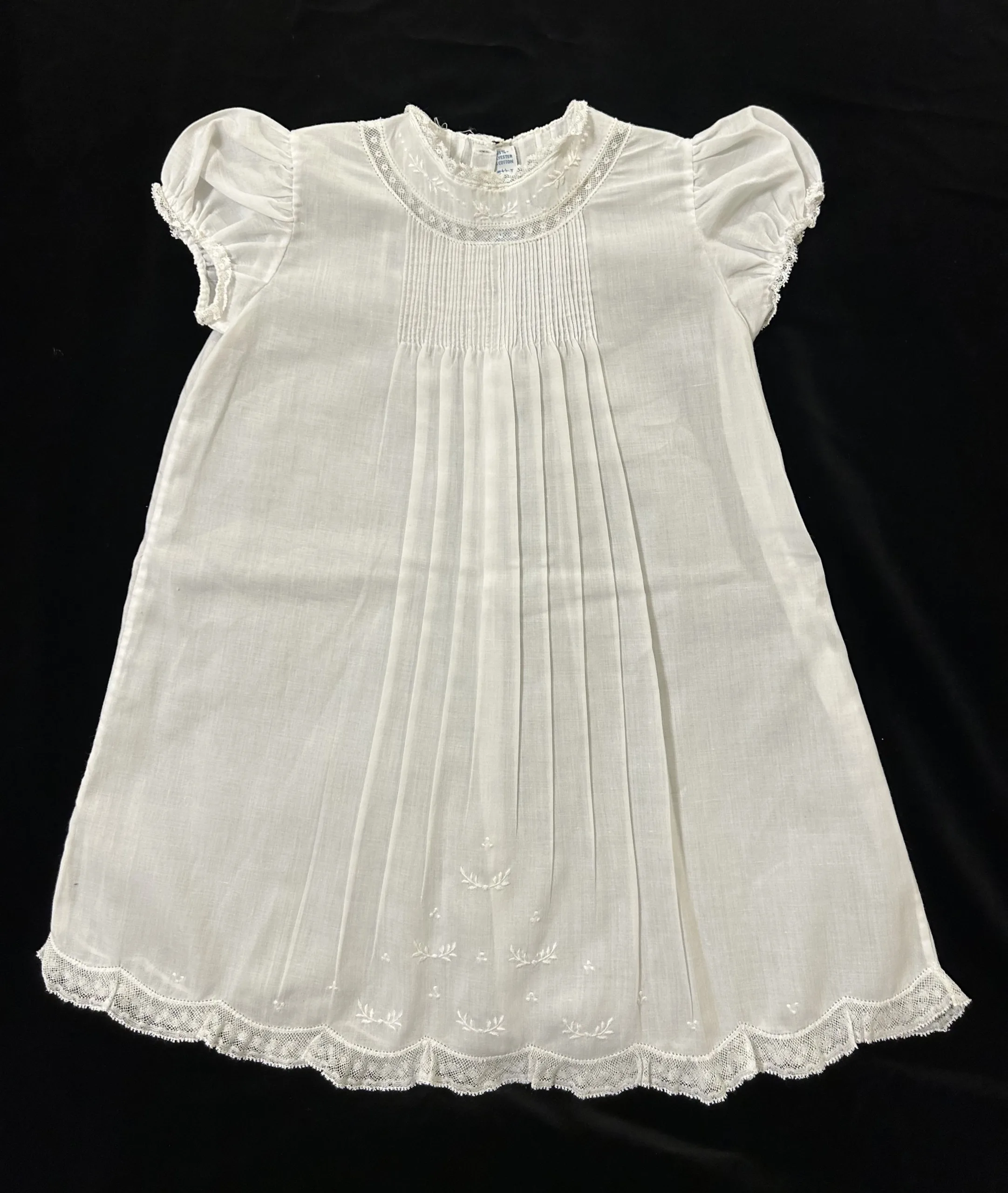
No embroidery decorates the back of the gown. However, the lace detail on the neckline, bodice seam, and hemline continues on the back. Small white plastic buttons run down the back, connecting the two sides of the gown and providing parents with an easy way to dress their infant.
The dress comes with a long sleeveless slip that is worn underneath. Lace trim decorates the neckline and armholes of the slip, and the same embroidered flowers and leaves appear at the bottom of the slip. The slip’s scalloped lace-edged hem echoes that of the gown.
The label in the gown indicates that it was made by Feltman Brothers (in the Philippines) and features hand embroidery. The tag also indicates that the gown is made from a polyester/cotton blend and can be machine washed in warm water. While no exact date for the garment is known, the fabric dates it to the 1960s or later, when cotton blends became common. Further, Feltman Brothers’ popularity in media discourse peaked in the 1980s, so it seems likely that this gown is from that era.
The Creator:
Founded in 1916, Feltman Brothers established a reputation for quality children’s clothing with “lots of lace trim, smocking, handmade pintucks, and hand embroidery” (see Figure 3; Feltman Brothers 2026). Still in business today, the company celebrates this heritage and continues it through special-occasion outfits, including christening gowns, and a variety of other collections. By embracing these “old-fashioned” sewing techniques, associated with the history of women’s sewing and craftsmanship, Feltman Brothers creates “heirloom” garments that look simultaneously traditional and stylish, classic and sophisticated.
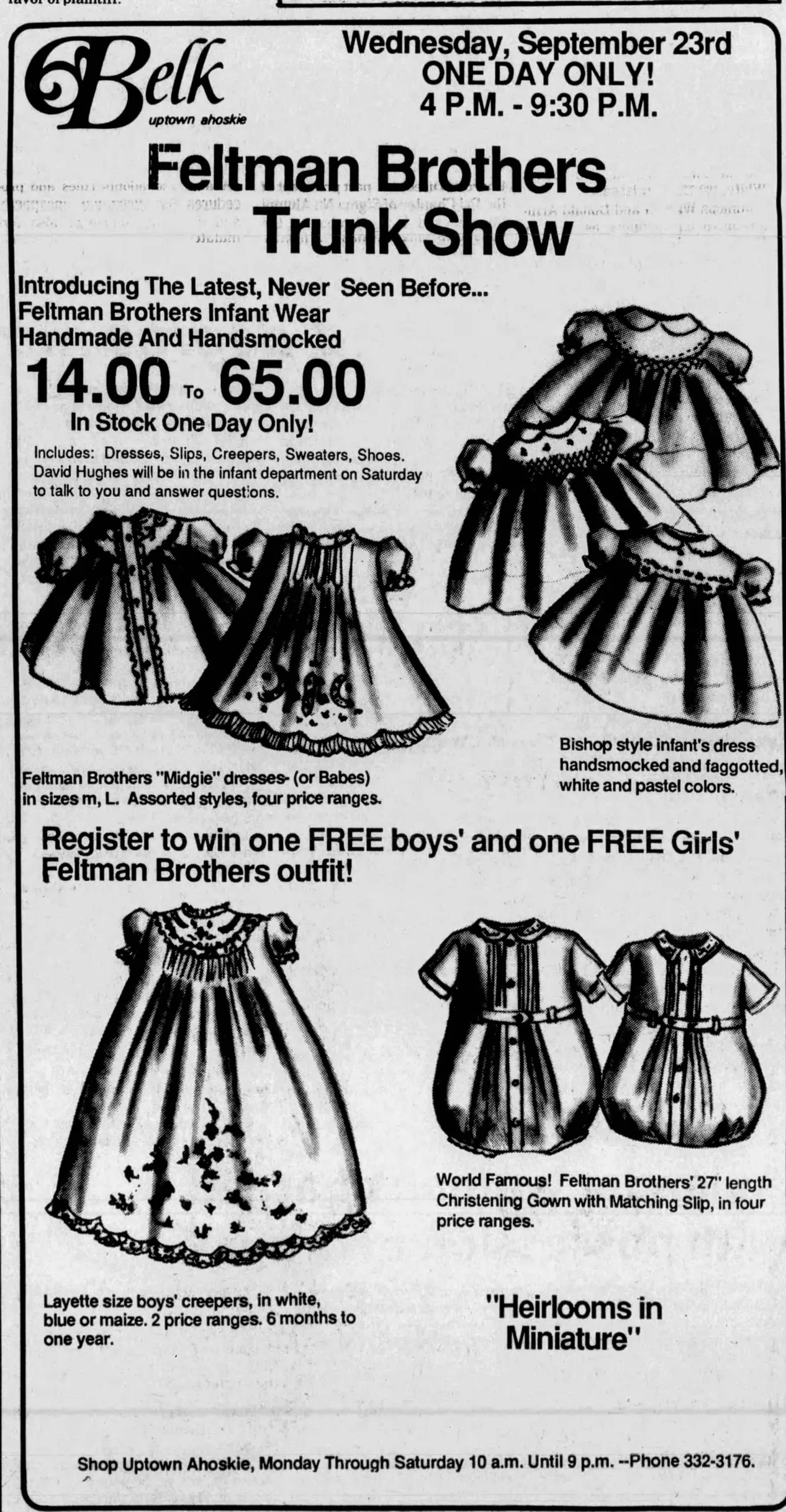
While the garments read vintage in the present day, they also appeared that way in the late 1980s and early 1990s. At this time, local department stores promoted Feltman Brothers through a series of trunk shows, advertised in regional newspapers. Newspaper advertisements included illustrations of a variety of infant garments, while touting their “handmade and handsmocked” status. As one tagline proclaimed, they made “The absolute finest in infantwear” (Belk Advertisement 1986). While these ads promoted dresses for girls and “handsome Bobby suits” for boys, the most vaunted items in the Feltman Brothers collection were their christening gowns.
One in particular was described as “World Famous!” This dress was 27” long, came with a matching slip, and was sold “in four price ranges” (see Figure 4). Many of the features of this gown, including the hand embroidery, scalloped hem, and lace trim, resemble the one described above. The tagline, “Heirlooms in Miniature,” was prominently displayed alongside the illustrations and ad copy (Belk Advertisement 1987). Feltman Brothers offered consumers who did not have an heirloom gown a chance to purchase their own and establish a family tradition.
By emphasizing family and tradition, Feltman Brothers tapped into the history of Christianity. Christening gowns are a form of religious clothing that developed as ritual attire for the Christian practice of baptism, a rite that initiates people into the church. While infant baptism is not common to all Christian denominations, it is part of the Roman Catholic Church, Eastern Orthodoxy, and some Protestant traditions. Given the fear that unbaptized infants faced eternal damnation, infant baptism emerged as a common Christian practice by the sixth century CE (Obladen 2017, 320-321; Ferguson 2013). Scholar Ruth A. Johnston notes that the “two important events in a medieval baby’s life were live birth and baptism” (2011, 43).
While there is no one person credited with creating the christening gown, the importance of this ritual in the Christian life cycle has historically been marked by the wearing of special clothing. Prior to the eighteenth century, many children were swaddled so they wore “decorative bibs, collars, and stay bands that covered the swaddling clothes” to celebrate this spiritual rite of passage (Toomer 2006, 39). The christening gown, in its current form, emerged in the mid-eighteenth century, when children’s clothing trends shifted from swaddling to looser gowns (Toomer 2006). Feltman Brothers’ christening gowns invoked this Christian history, underscored the importance of family traditions, and in the 1980s found a ready audience.
The Context:
The 1980s saw the rise of the Moral Majority, Ronald Reagan’s presidency, and “family values” rhetoric. Sociologist James Davison Hunter described the political and social debates swirling at this time as the “culture wars” and identified the family as the primary battlefield (1991). The Moral Majority celebrated the idealized traditional family structure and opposed perceived threats to it, including feminism, abortion, and gay rights (International Encyclopedia of the Social Sciences 2008). This focus on the family created an atmosphere that heightened the importance of continuing and/or creating family traditions, including that of infant baptism and heirloom christening gowns.
The christening of Prince William in 1982 also created renewed interest in christening gowns and family rites (see Figure 5). Newspapers emphasized how the Prince wore “the same gown of Honiton lace ordered by Queen Victoria 141 years ago for the christening of her son, later King Edward VII” (New York Times 1982, 2). Notably, the gown featured British textiles (Honiton lace, Spitalfields silk) and was inspired by Queen Victoria’s wedding dress (Angell 2019).
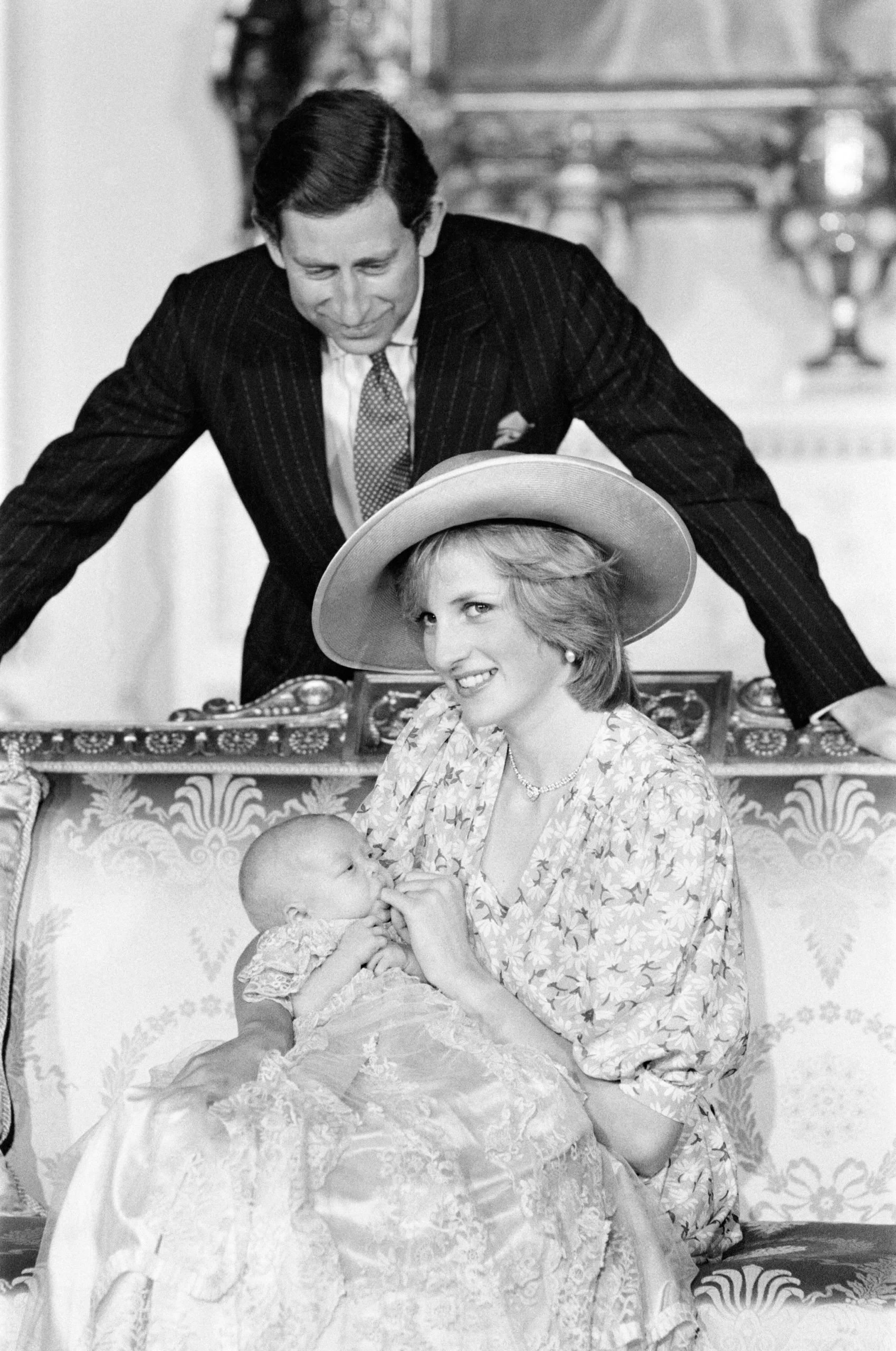
American newspaper headlines reminded readers that christening gowns were not just for Prince William. As one journalist reported, “a baby doesn’t have to be a future king or even a future president to wear an heirloom christening gown.” People “without an ounce of blue blood” could begin their own family traditions. For example, four-month-old Katlyn Eaton wore a hand-smocked and hand-embroidered christening gown made by her great aunt. According to Katlyn’s mom, the aunt thought “we needed a family heirloom.” The gown’s bottom tucks not only provided a decorative feature, but space for embroidering the names of those who wore it. The article assured readers that if they did not have an antique christening gown or an aunt who could make one, they could buy a beautiful one and create memories. Detailed advice on how to care for the gown and preserve it for future generations concluded the article (Donovan 1982).
Other newspaper articles from the 1980s emphasized establishing family traditions and the work of sharing an heirloom christening gown. One story highlighted how a christening gown had been worn by thirteen family members. The gown’s specialness emerged not only through the family’s meticulous care of the garment, but also through its transmission. Rather than mailing it, family members hand-delivered the gown to its next wearer’s family, which was considered “part of the ritual.” The family emphasized the effort it took to start and continue such traditions (Brown-Hawley 1984).
For those not inheriting a christening gown, this ritual meant purchasing one. An “heirloom” gown could be purchased for between $40 and $300 ($121-$900 in 2026 dollars). While antique gowns were expensive, rare, and often too small, readers could purchase reproductions. The article then identified the work of Feltman Brothers with this vintage-heirloom aesthetic. “Traditional christening gowns of lace and batiste made by Feltman Brothers, a company in the Philippines, are staples with several local children’s shops” (Reisser 1986; see also Johnson 1999).
The Wearer:
The wearer of a christening gown, whether one from Feltman Brothers, a great aunt, or another source, is a young child, typically an infant. Long gowns are designed to be seen as the child is held and displayed by an adult, whether parent, godparent, or officiant. The skirts hinder a crawling or walking child’s movements. Many children, as the articles note, will not remember the event and only view it through the lens of family photographs. This ritual with its accompanying attire initiates children into the Christian fold, but as religious studies scholar Susan Ridgely notes, accounts of religious rituals are often “about children rather than informed by children” (2005, 14). In rituals, “What the child is matters less than what we think it is,” as James R. Kincaid explains (quoted in Ridgely 2005, 14).
Advertisements for and newspaper accounts of christening gowns focus less on the reality of a child who may soil a pristine white dress or find the lace scratchy on their delicate skin; rather, these accounts emphasize how a child in christening attire becomes a symbol that links past, present, and future generations of family and faith. As one woman explained, the christening gown says to previous generations, “Thank you for keeping the faith,” and urges the new baby to “Hold fast to the fire of God’s love and faith” (Tighe 2000). The christening gown concretizes abstract ideas about familial and spiritual lineage by transforming the child into a symbol of adult aspirations.
Lynn S. Neal, Professor of Religious Studies, Wake Forest University
22 September 2026
Tags: Children, Ritual, Christening, Baptism, Catholicism, Protestantism, Vintage, Feltman Brothers, Prince William, Embroidery, Lace, Moral Majority, Culture Wars, Family, Family Tradition
References:
Angell, Elizabeth. 2019. “The Royal Family’s Christening Dress Has a Fascinating History.” Town & Country, 6 July. Available at: https://www.townandcountrymag.com/society/tradition/a22064592/british-royal-family-christening-gown-history/
Brown-Hawley, Donna. 1984. “Babies Puttin’ On Their Sunday Best.” The Town Talk (Alexandria, LA), 18 July, 23.
Donovan, Joy. 1982. “Christening Gown Not Just for Prince.” The Sunday Oklahoman 19 August, 85, 88.
“Family Values.” 2008. In International Encyclopedia of the Social Sciences, 2nd ed., edited by William A. Darity, Jr., vol.3, 95-97. Detroit, MI: Macmillan Reference USA. Gale In Context: Global Issues. Available at: https://link-gale-com.wake.idm.oclc.org/apps/doc/CX3045300798/GIC?u=nclivewfuy&sid=summon&xid=762e9f57.
Feltman Brothers. 2026. “About Us.” Available at: https://feltmanbrothers.com/about-us/.
Ferguson, Everett. 2013. “Baptism.” In Oxford Bibliographies in Biblical Studies, edited by Christopher R. Matthews. https://doi.org/10.1093/obo/9780195393361-0004
Hunter, James Davison. 1991. Culture Wars: The Struggle to Define America. New York: Basic Books.
Johnson, Marilyn. 1999. “Great Beginnings: Special Dresses for Happy Occasions: Gowns for Christening Range from Simple to Sumptuous.” The Atlanta Constitution (Atlanta, GA), 19 August, Buyer’s Edge 1.
Johnston, Ruth A. 2011. “Babies.” In All Things Medieval: An Encyclopedia of the Medieval World, 43-45. Santa Barbara, CA: Greenwood.
Obladen, Michael. 2017. “Social Birth: Rites of Passage for the Newborn.” Neonatology 112 (4): 317-323. https://doi.org/10.1159/000477955.
“Prince William is Christened.” 1982. New York Times, 5 August, 2.
Reisser, Peggy. 1986. “Little Traditions Can Mean a Lot.” The Commercial Appeal (Memphis, TN), 19 January, H3.
Ridgely, Susan B. 2005. When I Was a Child: Children’s Interpretations of First Communion. Chapel Hill: University of North Carolina Press.
Tighe, Theresa. 2000. “Christening Gown Turns 100, Was Worn by More Than 50 in the Jacobsmeyer Family.” St Louis Post-Dispatch (St. Louis, MO) 13 January, S5.
Toomer, Heather. 2006. “The de Saumarez Layette.” Costume 40: 39-55.