
1960 Fruit of Islam Uniform by the Nation of Islam
Religion: Islam, NRMs
Time Period: 1960s
Type Of Garment: Uniform
Tags: Civil Rights, Elijah Muhammad, Fruit of Islam, Nation of Islam, New Religious Movements, Ritual, Uniform
The Context and Creator:
Wallace D. Fard Muhammad established the Nation of Islam (NOI) in 1930. After his disappearance, Elijah Muhammad succeeded him and presided over the organization from 1934 to 1975. Within the organization, Elijah Muhammad functioned as a “messenger” of Allah (Rucker 2010: 914). A blend of Islamic ideals and Black nationalism, the group gained notoriety and followers in the 1950s and 1960s as the Civil Rights movement gained momentum. In contrast to the ideas of equality and integration promoted by figures like Martin Luther King Jr., the NOI was known for separatist attitudes that intertwined with notions of Black personhood and independence (Pinn 2009: 244). Well-known figures such as Louis Farrakhan and Malcolm X emerged from the movement.
The reclamation of Black self-identity constituted one of the key tenets of the NOI. Within the movement, figures such as Malcolm X posited that white supremacy had left many Black Americans with no identity or history (Pinn 2009: 244). The teachings of W.D. Fard Muhammad and Elijah Muhammad addressed both of these issues. They focused on “true” knowledge of the self (Muhammad 1957: 11), courage against the enemy of white supremacy (15), and salvation from the legacy and perceived dependence of slavery (32). Obtaining salvation and knowledge was a multifaceted process that often involved giving up a person’s “slavename” (21), learning and utilizing self-defense (27), and shedding pride by submitting to the teachings of Islam (35). Elijah Muhammad emphasized the inherent goodness and righteousness of Black Americans (36).
This theology was powerful for adherents given the stereotypical treatment of the Black body in media, literature, and politics. The Nation of Islam focused on protecting the Black body as part of a larger vision of Black personhood. According to Elijah Muhammad, the solution was to establish a level of masculinity, cleanliness, and order, particularly for the Black male body. Elijah Muhammad proclaimed that Islam “dignifies the black man. It gives him the desire to be clean, internally and externally…It heals both the physical and spiritual by teaching what to eat, when to eat, and what to think, and how to act” (quoted in Curtis 2010: 97). Dress, including what to wear and how to present oneself, was also a central component of this process.
Through the establishment of the Fruit of Islam (FOI), the paramilitary subunit of the Nation of Islam, the NOI worked to achieve this goal. The group was made up of male NOI members, who functioned as security agents, ushers, and enforcers of internal discipline within the group (Rucker 2010). Historian Dawn-Marie Gibson writes that “the FOI, and by extension the larger NOI community, provided men with a sense of group solidarity, protection, and status in a society that regarded them as second-class citizens at best” (Gibson 2020: 320).
Members of the FOI wore a uniform that fostered the acceptance and internalization of NOI teachings and norms. Associated with militarism, conformity, and hygiene, the Fruit of Islam uniform elevated its wearers by reinforcing their reclaimed masculinity. At the same time, it also upended negative stereotypes about Black men and replaced them with a sophisticated, organized, “civilized” visage. The uniform, then, emerged as a powerful tool for instilling and embodying the teachings of the NOI.
The Object:
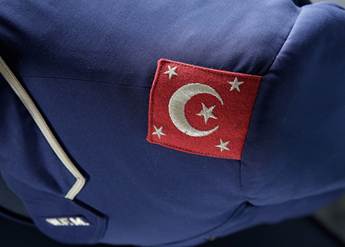
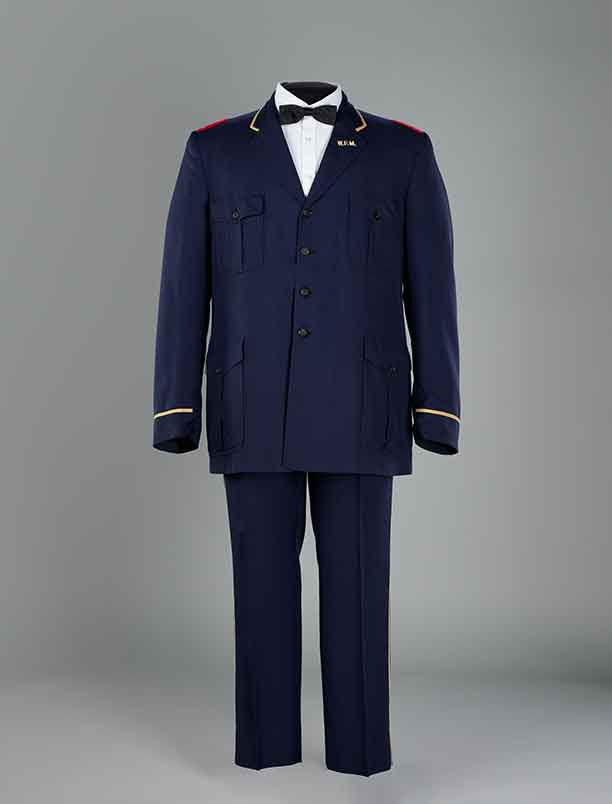
The Fruit of Islam issued this uniform, made of polyester, cotton, and patent leather. The three-piece suit ensemble was almost entirely navy blue, with white braided stripes down the pants legs. The Nation of Islam symbol, positioned on both shoulders, functioned as the jacket’s epaulets (“Fruit of Islam Uniform”) (see Figures 1 and 2).
The use of the suit as the official FOI uniform is unsurprising. Within the Nation of Islam more broadly dress was expected to be conservative for both men and women and men were often expected to be dressed in dark business suits (Curtis 2006: 109). The business suit, of British origin, became accessible to greater numbers of Americans after 1850. By the mid-twentieth century, it carried powerful associations of respectability, professionalism, and middle-class status (Gau 2010). The NOI and FOI sought to reclaim these attributes for Black men.
The Wearer
Within the FOI, the uniform functioned as a recruitment tool, signaling the group’s beliefs and values to potential members. The clean, militaristic suit projected confidence, fearlessness, and moral righteousness that attracted other young men (Gibson 2020: 321). Members compared the level of “orderly protocol” and care about visual appearance to being in the army: during FOI classes, inspectors would check that clothes were clean and neat, as well as hair and fingernails. This army-like stringency reinforced the interconnection of militarism and Black masculinity within the Fruit of Islam (Abdullah 2012: 149). And outsiders described FOI members as “clean-cut” and well dressed (“Secret Police Document Says”).
A uniform serves several functions. At its base, a uniform functions to identify a group and designate membership (Joseph and Alex 1972: 722). They can also create conformity and diminish individuality through standardization (722). By combining identifiable status and conformity, one can see someone in a uniform and for the most part understand the wearer’s intentions, duties, and values. Furthermore, this conformity and ‘fitting in’ can help in boosting self-esteem and providing gratification (726).
Sociologist Rosabeth Moss Kanter demonstrates how NRMs foster commitment through a variety of mechanisms, including sacrifice, investment, and communion (1972: 73-74). The FOI uniform embodied all three. By donning the uniform, members sacrificed their secular, individualistic identity, simultaneously investing themselves in the group’s mission. As members of the Fruit of Islam, these men invested their time and energy upholding ideals of masculinity while working within their local NOI communities. Finally, wearing standardized uniforms created communion as this practice diminished individualism while forging communal bonds and making members identifiable as part of the group.
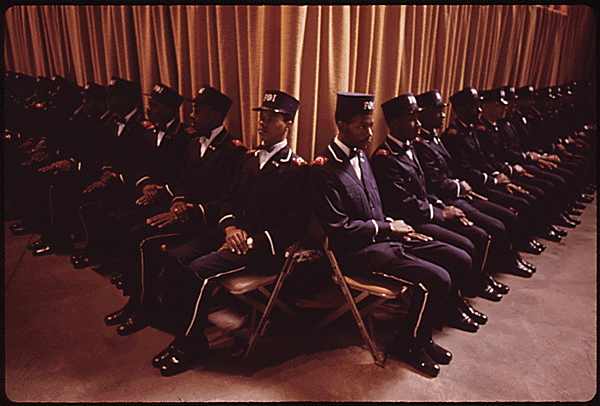
There are various racist stereotypical labels applied to Black men and the larger African American community, such as violence, laziness, and “irrational hostility” (Melson-Silimon et al., 2023). By donning the uniform, Black men in the Fruit of Islam worked to combat these stereotypes, consciously or unconsciously. Protecting their community conveyed an image of sophistication, bravery, and courage, thus making it more difficult for institutions and individuals upholding white supremacy to apply those stereotypes without some level of cognitive dissonance. There is nothing irrational, lazy, or unkempt about these uniformed men. Within the group context and the rhetoric of Islam as providing dignity, they embodied discernment and refinement that directly challenged racist assumptions. Their membership within the Fruit of Islam made them righteous (Muhammad 1957, 30), active members of the community (Gibson 2020, 333).
By joining the FOI and donning the uniform, Black men in the Nation of Islam reclaimed a vision of masculinity that white supremacy had systematically denied them. This reclaimed masculinity not only provided an alternative to white supremacist persecution and denigration, but also functioned as a direct assertion of Black dignity, discipline, and self-determination.
Katherine Claybrook, Religious Studies Major with a Double Minor in Arabic and Middle Eastern and South Asian Studies (WFU ‘26).
8 December 2025
Tags: Fruit of Islam, Elijah Muhammad, Ritual, Nation of Islam, New Religious Movements, USA, Civil Rights, Uniform
References:
Abdullah, Zain. 2012. “Narrating Muslim Masculinities: The Fruit of Islam and the Quest for Black Redemption.” Spectrum: A Journal on Black Men 1 (1): 141–77.
Curtis IV, Edward E. 2006. Black Muslim Religion in the Nation of Islam, 1960-1975. Chapel Hill: University of North Carolina Press.
Gau, Colleen. 2010. “Conventional Work Dress and Casual Work Dress.” In Berg Encyclopedia of World Dress and Fashion: The United States and Canada, edited by Phyllis G. Tortora. Oxford: Bloomsbury Academic. http://dx.doi.org/10.2752/BEWDF/EDch3042.
Gibson, Dawn-Marie. 2020. “Making Original Men: Elijah Muhammad, The Nation of Islam, and The Fruit of Islam.” Journal of Religious History 44 (3): 383–99.
Joseph, Nathan, and Nicholas Alex. 1972. “The Uniform: A Sociological Perspective.” American Journal of Sociology 77 (4): 719–30.
Kanter, Rosabeth Moss. 1972. Commitment and Community: Communes and Utopias in Sociological Perspective. Cambridge, MA: Harvard University Press.
Melson-Silimon, Arturia, Briana N. Spivey, and Allison L. Skinner-Dorkenoo. 2023. “The Construction of Racial Stereotypes and How They Serve as Racial Propaganda.” Social and Personality Psychology Compass 18 (1): e12862. https://doi.org/10.1111/spc3.12862.
Muhammad, Elijah. 1957. The Supreme Wisdom. Chicago: University of Islam.
Muhammad Speaks (Chicago, Illinois). 1961. “Secret Police Document Says—You’re A Muslim If You’re Well-Dressed, Clean-Cut.” November.
National Museum of African American History and Culture. n.d. “Fruit of Islam Uniform.” Accessed October 8, 2025. https://nmaahc.si.edu/object/nmaahc_2010.47.
National Museum of African American History and Culture. n.d. “The Fruit of Islam.” Accessed October 30, 2025. https://nmaahc.si.edu/object/nmaahc_2016.118.8.
Pinn, Anthony B. 2009. “Nation of Islam.” In African American Religious Cultures, vol. 1, edited by Anthony B. Pinn, 326–32. Santa Barbara, CA: ABC-CLIO.
Rucker, Walter C. 2010. “Nation of Islam.” In Encyclopedia of African American History, edited by Leslie M. Alexander and Walter C. Rucker, vol. 3, 242–46. Santa Barbara, CA: ABC-CLIO.