
1991 Virgin Mary Halter Top by Versace
Religion: Catholicism, Christianity
Time Period: 1990s
Type Of Garment: Top
Tags: Byzantine, Catholicism, High Fashion, Italy, mosaics, Ravenna, Versace, Virgin Mary
The Context:
In the 1990s, sociologist Wade Clark Roof described the U.S. religious landscape not in terms of religious revival or decline, but as a “religious kaleidoscope” to capture its diverse and constantly changing forms (Roof 1996, 184). During this time, more individualized forms of spirituality that emphasized the affective and the sensual were gaining popularity (Neal 2019, 180-181). Some focused on goddess worship and recovery of the divine feminine. Mary, as both mother and intercessor, became a focal point of this renewed interest: a number of Marian apparitions occurred in places ranging from Conyers, Georgia to Litmanová, Slovakia, sustaining and fueling interest in Mary and her message to the world as the millennium approached. Fashion designers were not immune to these spiritual currents, and the 1990s marked a turning point in how they engaged with religious imagery.
In the mid-twentieth century, fashion designers increasingly drew artistic inspiration from the Christian imaginary–religious paintings, stained glass windows, and Catholic religious attire. These colors, shapes, and forms inspired a variety of designers, then and now. However, it was not until the early 1990s that fashion designers began to incorporate representational Christian figures into their designs. Protestant fears about the power of religious imagery along with fashion’s preference for artistic abstraction and a desire to avoid “too much” controversy contributed to this avoidance of garments featuring Christian saints, the Virgin Mary, and Jesus (Neal 2019, 157-158).
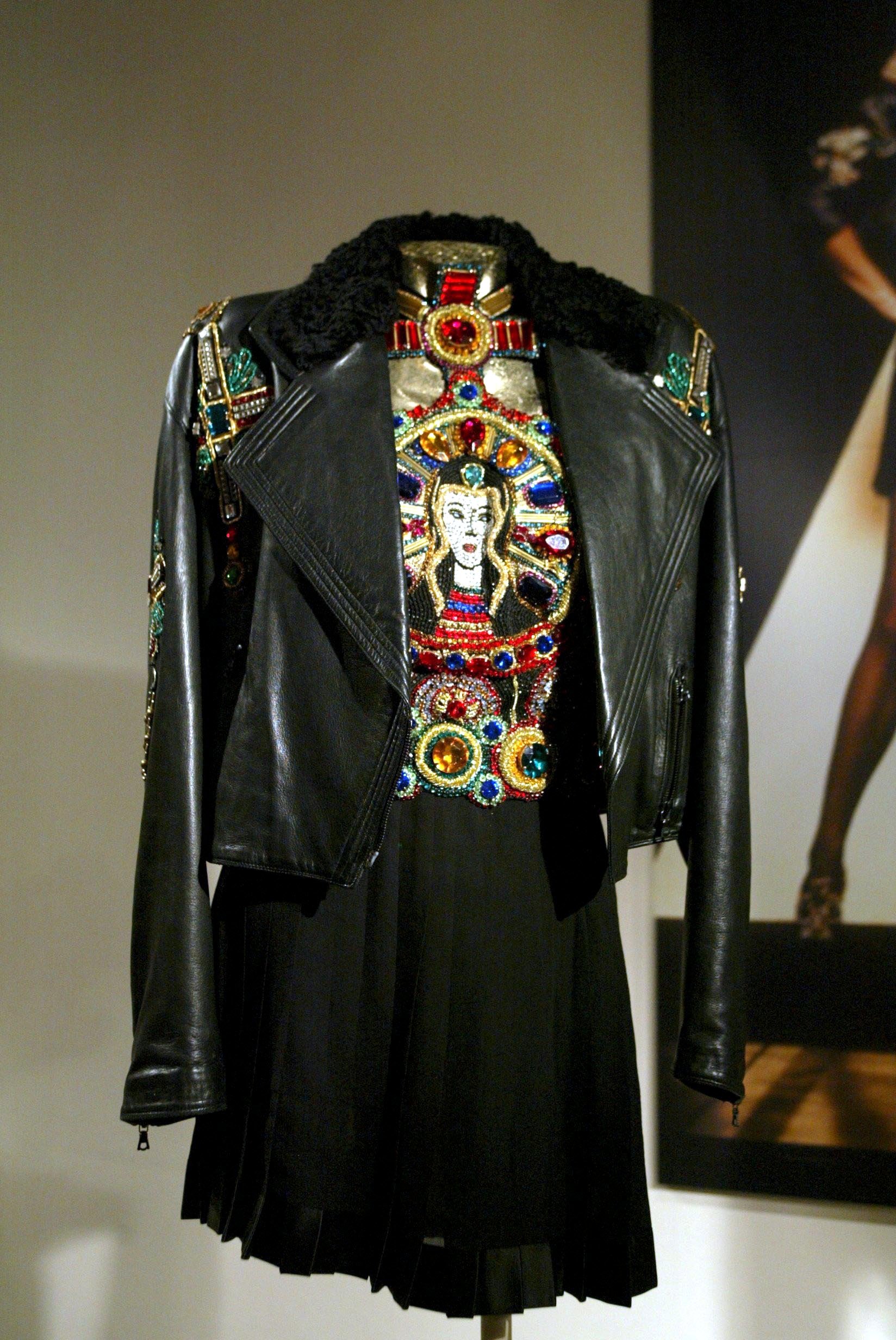
Fashion darling Gianni Versace (1946-1997), no stranger to pushing aesthetic boundaries, was one of the first to challenge this implicit prohibition with his Fall/Winter 1991 Ready-to-Wear collection. Supermodels of the day, including Linda Evangelista, Claudia Schiffer, and Christy Turlington, walked the runway accompanied by Joan Jett’s 1982 hit “I Love Rock ‘n’ Roll.” The collection featured vibrant colors, bold prints, and form-fitting silhouettes. Journalist Bernadine Morris described it as “clothing for rock stars” (1991, B6). As the runway show built to the finale, this rock star aesthetic became more clear as models wore short, flowy black skirts, beaded bustiers, and leather biker jackets. One of these looks, though, stands out. Worn under a biker jacket embellished with crosses and not revealed until the apex of the runway, was a halter top boldly featuring the Virgin Mary (see Figure 1).
The Object:
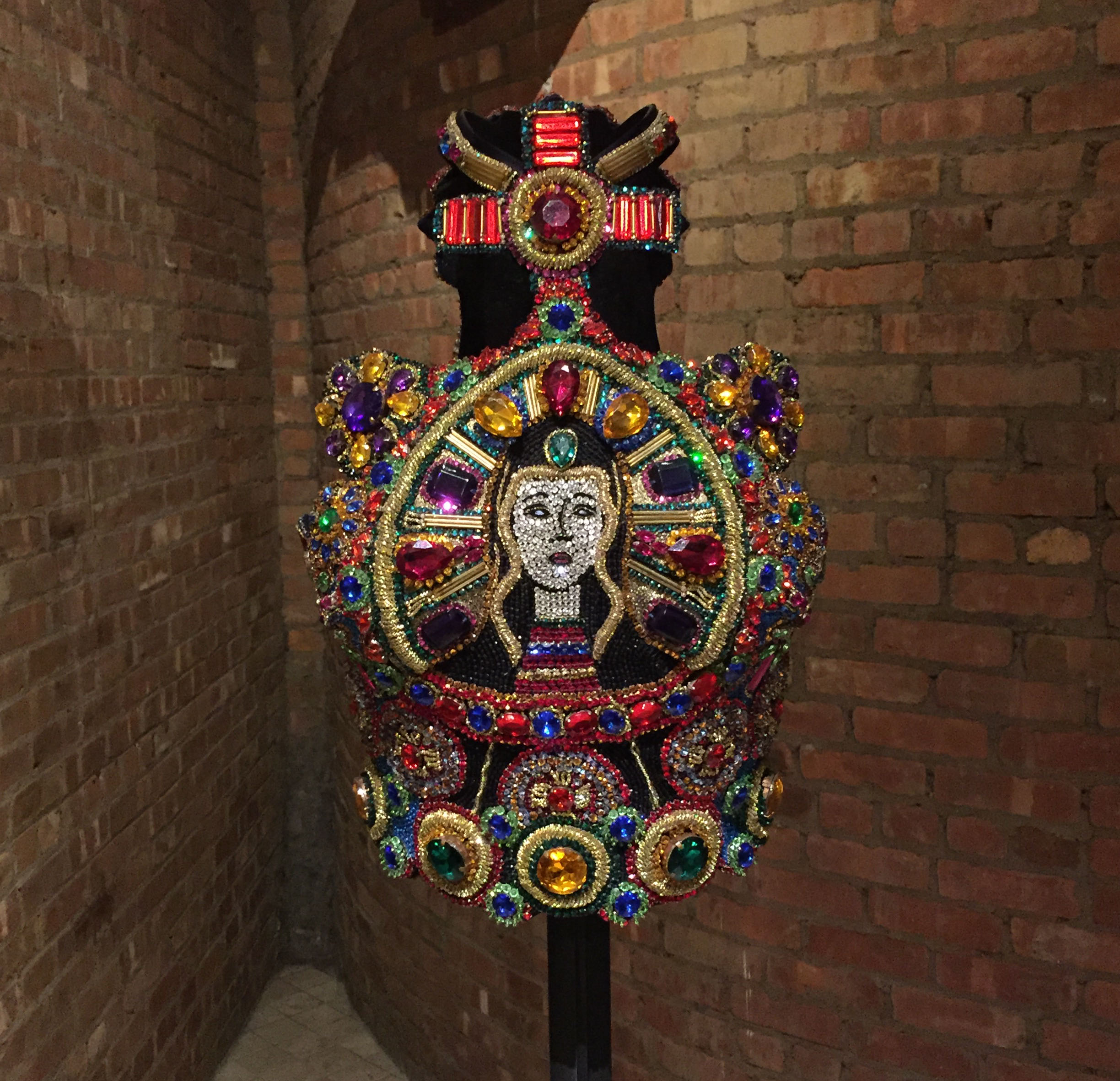
The halter utilizes beads and gems of various sizes and bright colors (red, blue, yellow, purple) to create a mosaic-style design of the Virgin Mary. She appears in the center of the bodice wearing a veil and surrounded by a halo of larger gems (see Figure 2). Her expression is serious and thoughtful, in keeping with Byzantine mosaic depictions of her. The shape of the halo, anchored by a beaded band at the bottom, resembles that of a mitre, a ritual cap worn by Catholic religious leaders (bishops, cardinals, the Pope). Atop this mitre shape, the beaded neckpiece forms the shape of a cross made from a mosaic of red gems. The overall effect is stunning and exuberant–an explosion of color and a celebration of Mary’s status in Catholicism and in fashion.
The imagery on the back is equally striking, but differs in color and scale. The figure of Mary holding the infant Jesus dominates the back of the halter (see runway show video). Beads and gems in shades of blue make up Mary’s flowing robes and veil. Blue is a color traditionally associated with Mary that symbolizes her purity and special “royal” status as “blue was a color associated with Byzantine royalty” (Fuchs 2015) and in Catholic theology Mary is the “Queen of Heaven.” Her special status is further emphasized by the halo, made of larger gems, that surrounds her head and attaches to the neckpiece. In contrast to the blue worn by Mary, the baby Jesus wears red robes, often used in art to symbolize his sacrificial death. Here, though, we see him held lovingly in Mary’s arms. With its emphasis on blue, use of smaller beads and gems, and its maternal focus, the back appears more subdued than the front, traditional albeit with added sparkle and shine.
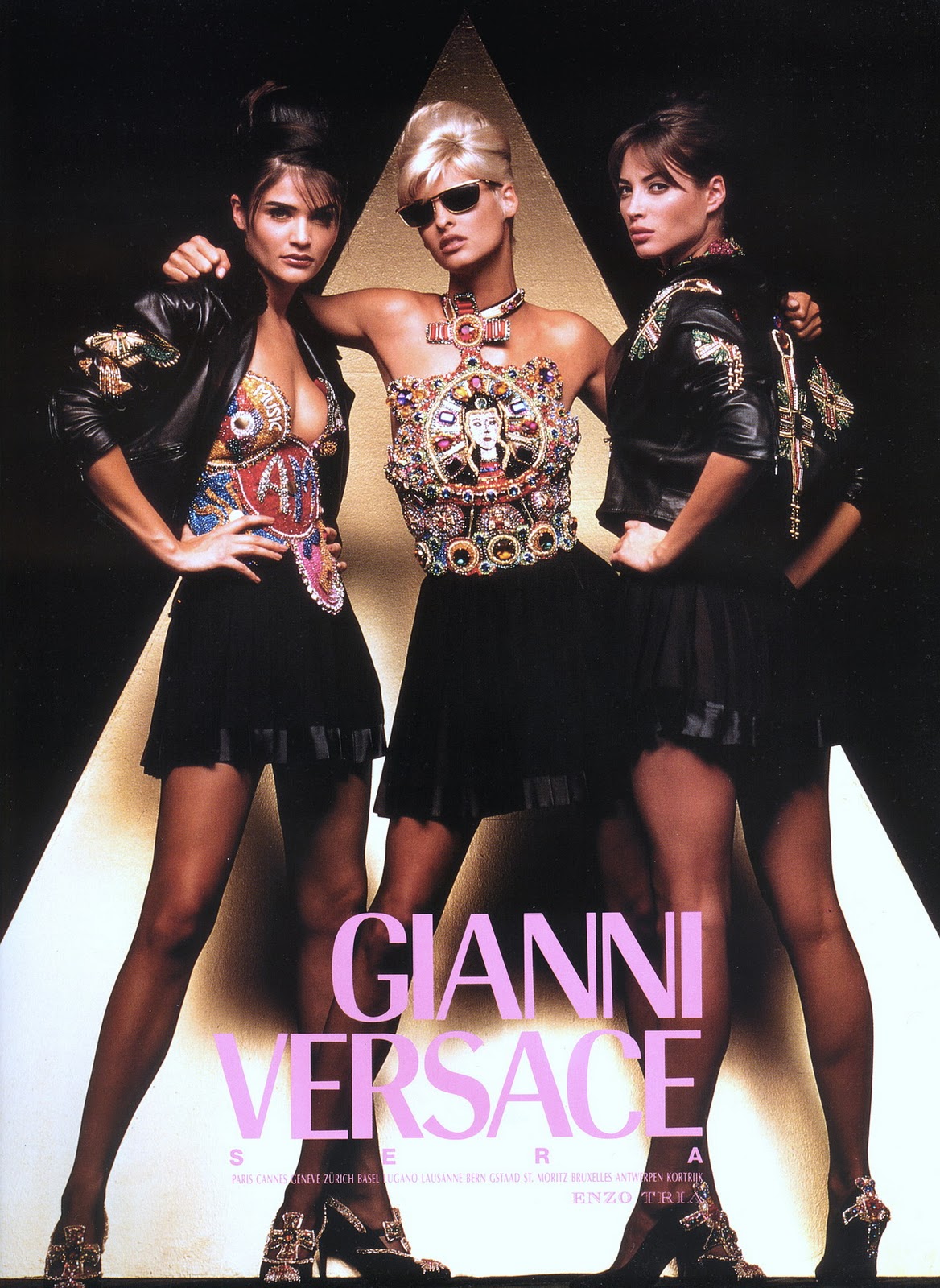
Altogether, the halter stands out for its bold inclusion of a revered Christian figure. In Versace’s design, Mary remains recognizable, but is also updated, celebrated, and re-introduced to audiences, fashion and otherwise, in the 1990s. The garment not only occupied pride of place in the runway show, appearing as part of the finale, but it was also featured prominently in advertisements for the collection (see Figure 3)
The Creator:
Gianni Versace’s challenging of fashion norms in this collection should come as no surprise. Known for his bold use of prints, his use of unconventional materials, and his embrace of sexuality, Versace pushed boundaries with what fashion historian Richard Martin referred to as his “prostitute style” (Martin 1997, 12). He forged relationships with celebrities and rock ‘n’ roll musicians to bring new ideas and audiences into his designs and the world of fashion (Neal 2019, 161).
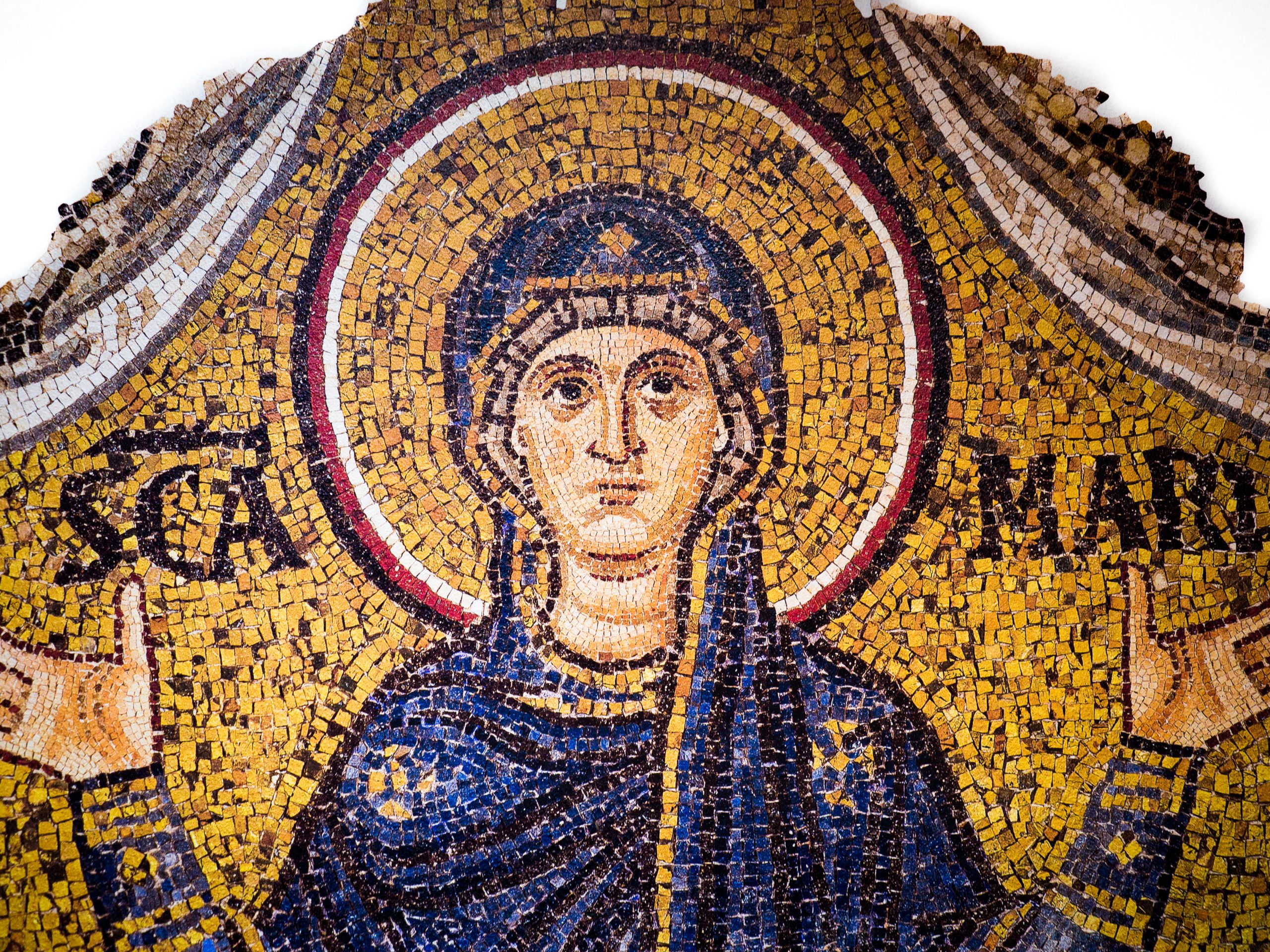
At the same time, Versace also looked to the past. He stated, “When you are born in a place such as Calabria and there is beauty all around a Roman bath, a Greek remain, you cannot help but be influenced by the classical past” (Spindler 1997). He regularly visited museums and studied the Byzantine collection at the Met (Mackrell 2005, 155). His study of and interest in Byzantine art also inspired a visit to Ravenna, a city in northeastern Italy that was the capital of the Western Roman Empire in the fifth century. The city is famous for its historic religious sites that feature extensive mosaics, including the Basilica of Sant’Apollinare Nuovo and the Church of San Vitale. These sites not only feature mosaics of the Virgin Mary (see Figure 4), but also include the Empress Theodora wearing a garment adorned with the three kings or wisemen along the bottom hem (see Figure 5). This is an early example of holy figures being placed on garments and seen as a part of both religion and fashion.
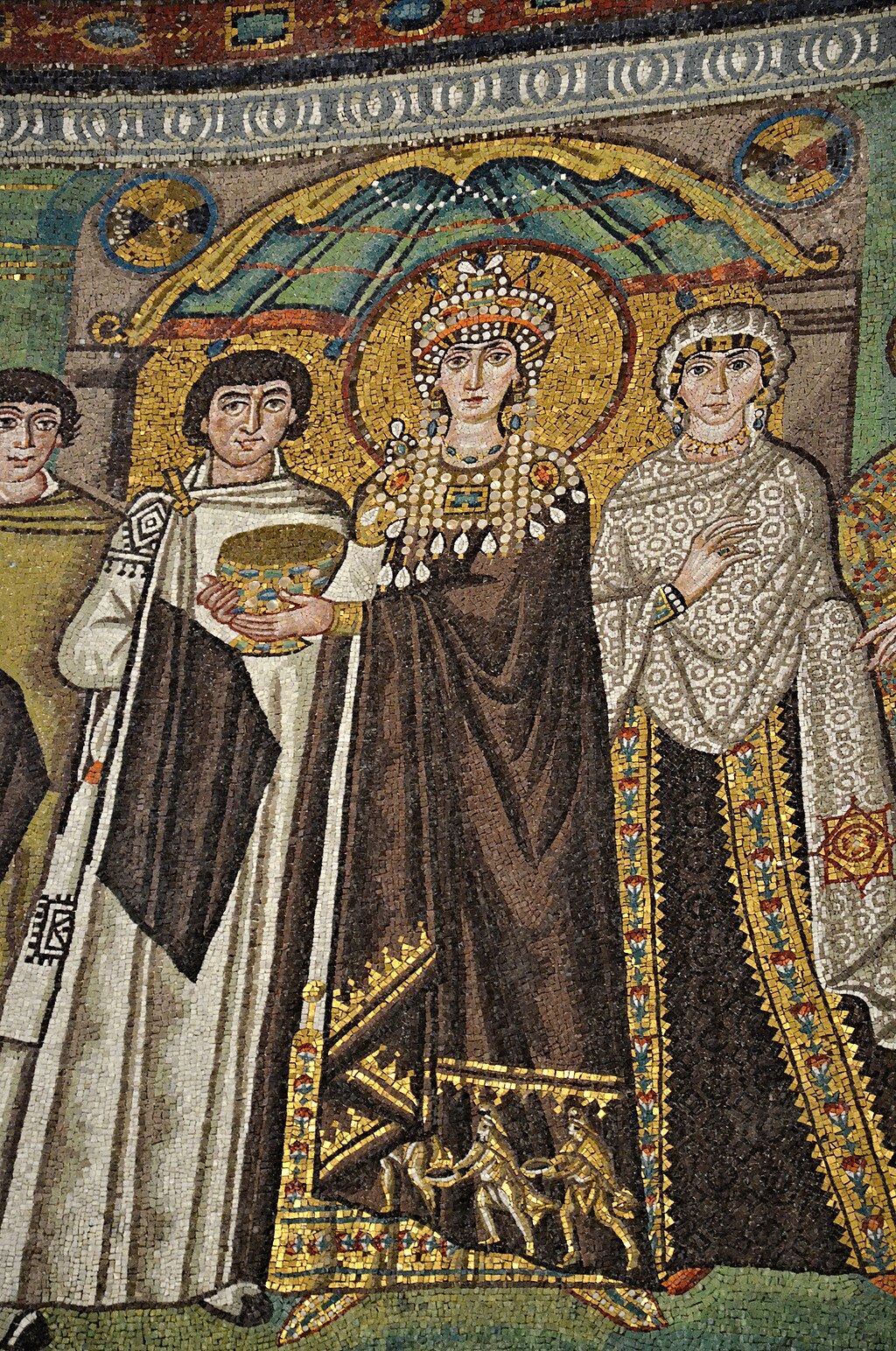
In the Mary-inspired halter, Versace highlighted his knowledge of Byzantine art, his skill in emulating their mosaic-making techniques, and his ability to make these historical elements relevant and inspirational to a twentieth-century audience. Richard Martin explains, “Versace’s translation of Byzantium derived from his inspection of artifacts and his certainty that he could perform something akin. It is as if history inspired Versace to say ‘I can do that,’ even with regard to the most venerated and monumental traditions” (Martin 1997, 65). This seemingly applies not only to the techniques Versace used, but also his decision to include representational Christian figures on his garments.
The Reception:
Fashion journalists celebrated Versace’s collection, but his inclusion of Christian imagery garnered little comment (Neal 2019, 165-166). The reasons for this remain elusive, but it suggests a few things. Namely, that the variety of design elements in Versace’s collection overshadowed the religious motif. It was a large collection with many different garments and themes. It also seems that, by this time, religious imagery on clothing was not a “big deal,” as fashion journalist Nina Hyde stated in 1989.
Yet, in terms of the intersection of religion and fashion, this collection was a big deal and its impact could be seen in subsequent years. Versace paved the way for other fashion designers, including Jean Paul Gaultier, Dolce & Gabbana, and Karla Špetić, who began incorporating Christian figures (Mary, Jesus, saints) and themes more prominently in their designs. In doing so, he transformed the Virgin Mary from a figure too sacred to adorn the body into a legitimate source of artistic and spiritual inspiration, fundamentally reshaping the relationship between fashion and Christian iconography.
Lynn S. Neal, Professor of Religious Studies, Wake Forest University
26 January 2026
Tags: Versace, Virgin Mary, Catholicism, Byzantine, mosaics, Ravenna, Italy, high fashion
References:
Fuchs, Margie. 2015. “Mary and the Colors of Motherhood,” National Museum of Women in the Arts. Available at: https://nmwa.org/blog/nmwa-exhibitions/mary-and-the-colors-of-motherhood/
Hyde, Nina. 1989. “In London, Pop Profanity,” Washington Post, 14 March, E1.
Mackrell, Alice. 2005. Fashion and Art. London: BT Batsford.
Martin, Richard H. 1997. Gianni Versace. New York: Metropolitan Museum of Art.
Morris, Bernadine. 1991. “Versace Provides the Razzle and Lacroix the Dazzle in Paris,” New York Times, 31 July.
Neal, Lynn S. 2019. Religion in Vogue: Christianity and Fashion in America. New York: New York University Press.
Roof, Wade Clark. 1996. “Religious Kaleidoscope: American Religion in the 1990s.” Temenos 32: 183-193.
Spindler, Amy. 1997. “Giannia Versace, 50, the Designer Who Infused Fashion with Life and Art,” New York Times, 16 July, A14.