
1980s Pentagram/Pentacle Necklace
Religion: NRMs
Time Period: 1980s
Type Of Garment: Jewelry
Tags: Modern Magical Traditions, Nature-based religion, Pagan, Pentacle, Pentagram, Ritual Adornment, Wicca
The Context:
Wicca is a modern, nature-based religion that emerged in the mid-20th century. It blends ceremonial magic, British folklore, and feminist spirituality into a faith rooted in both ancient reverence and modern identity-building. The movement is diverse. As scholar of Paganism Ethan Doyle White (2010) notes, the very term “Wicca” evolved through complex debates over authenticity, politics, and ownership within modern Paganism (186–187). Wiccans emphasize Earth-based spirituality, ritual practice, and the relationship between humans and the natural world. Practitioners typically honor a Goddess and God, celebrate seasons known as Sabbats, and engage in rituals designed to align their bodies with natural cycles (Wicca Living). This synthesis of various beliefs and their ritual practices position Wicca within the broader landscape of new religious movements that challenge institutionalized definitions of religion.
Yet Wicca and its symbols have often been framed as satanic. Media portrayals, including TV shows, movies, and even news stories, portrayed witches and Wicca as dangerous threats to family, Christianity, and society. Many of these ideas were popularized in the 1980s and early 1990s during the Satanic Panic, a time when Americans feared worship of Satan had infiltrated the culture (Laycock 2023). Fears abounded that satanic meanings were hidden in Procter & Gamble’s logo and that wearing pentagram jewelry signified dabbling in Satanism. This media framing and the lingering impact of the Satanic Panic profoundly shaped outsider views of Wicca and its symbols.
The Object:
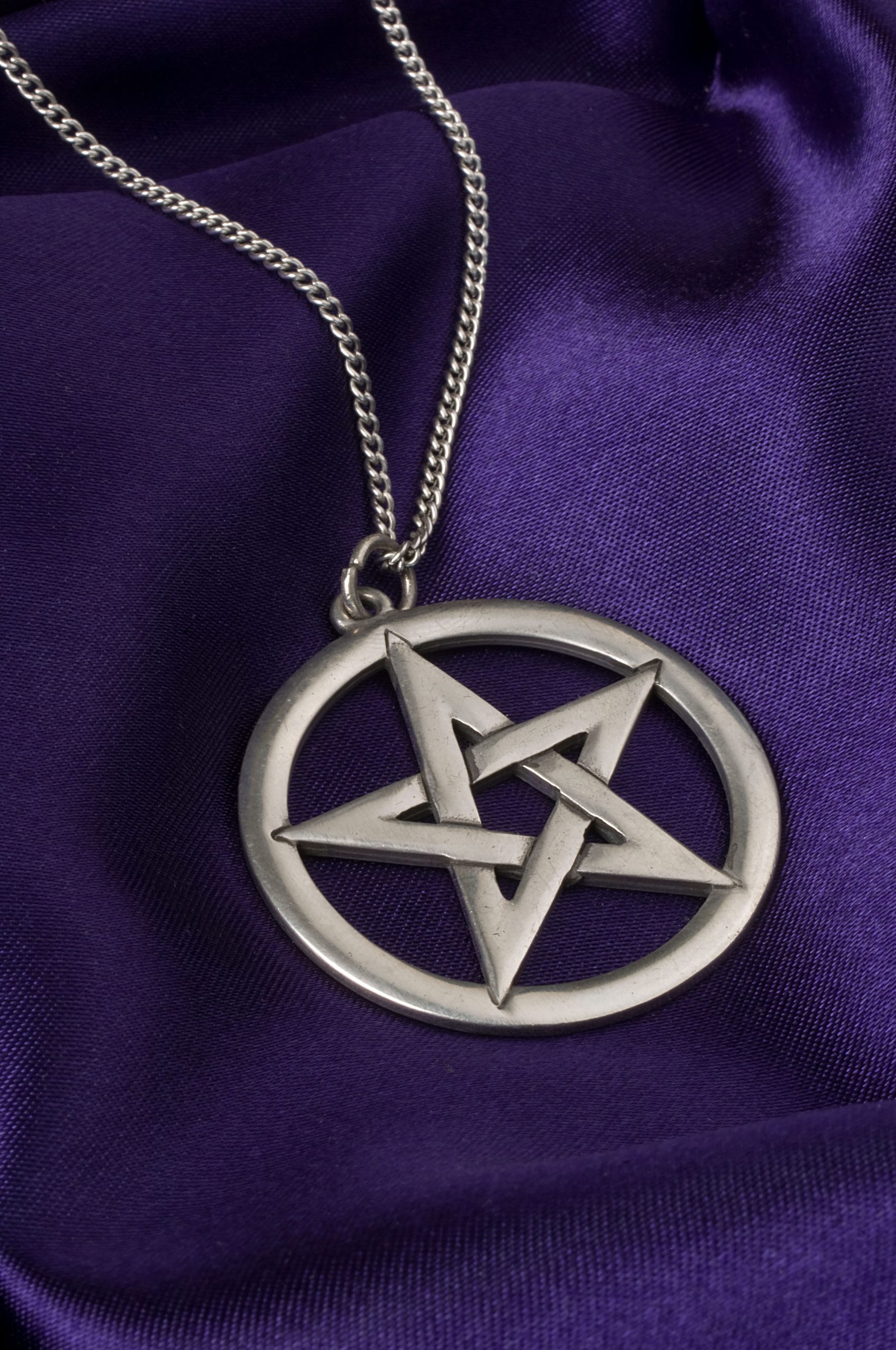
The pentagram, often worn as a necklace by Wiccan practitioners, is a sacred object that embodies both spiritual protection and religious identity. Most are relatively small and worn around the neck of the practitioner. A traditional Wiccan pentagram consists of a five-pointed star surrounded by a circle, making the shape of a pentacle (see Figure 1). The five-pointed star symbolizes the balance of the five elements–earth, air, fire, water, and spirit. As A Witches’ Bible explains, these elements exist “under the guidance of Spirit,” with the surrounding circle reinforcing their unity and balance, evoking both protection and cosmic order (Farrar and Farrar 1981).
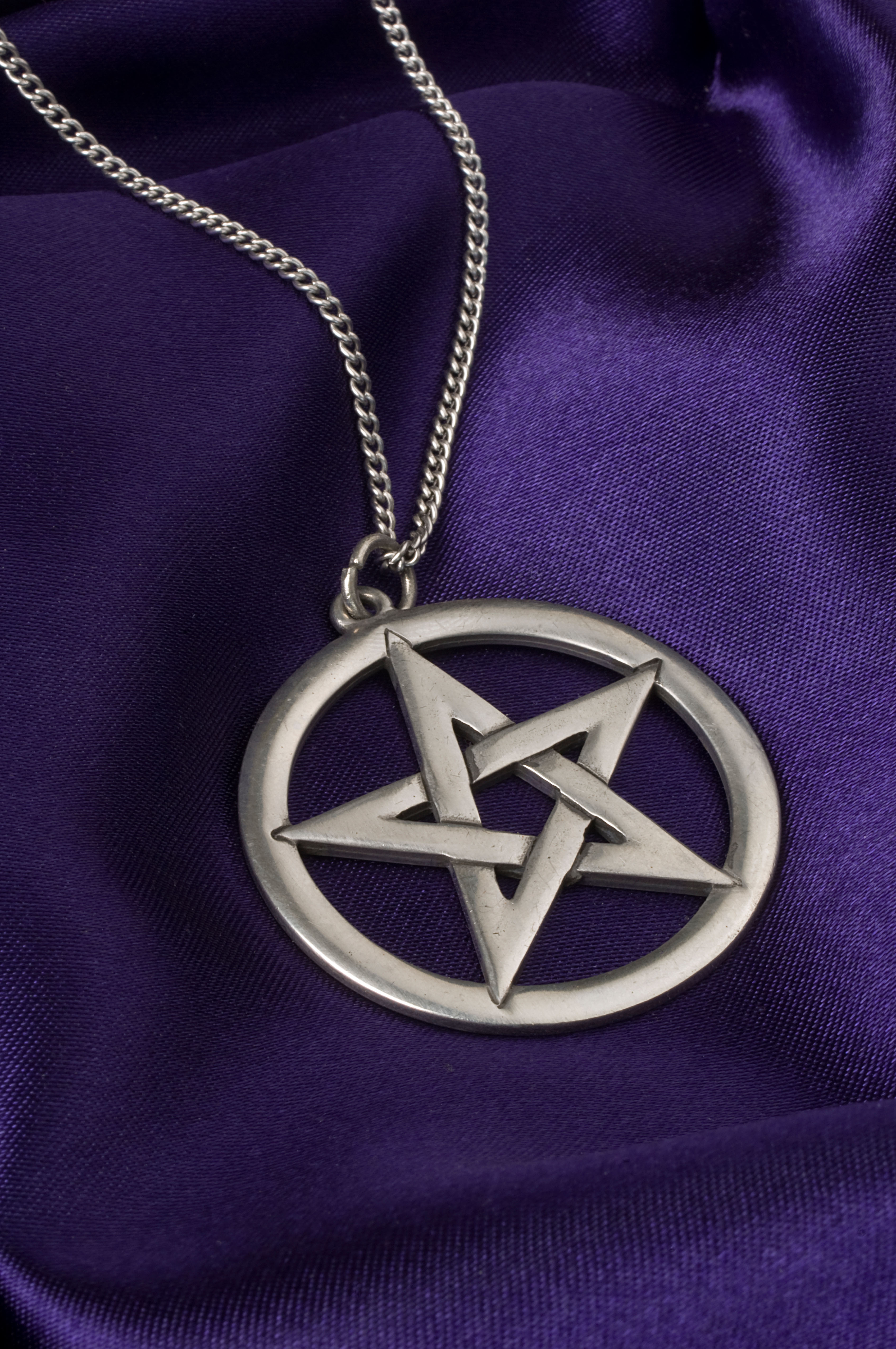
A pentagram or pentacle necklace (practitioners and observers vary in their labeling) functions very similarly to other sacred jewelry. For many, it serves as an amulet, a grounding emblem of protection and harmony. It also functions as a talisman, amplifying spiritual gifts and powers. Pentagram necklaces are normally made in silver because it is believed to have more spiritual energies than other metals (Malita-Król 2017, 232). As an object, the Pentagram necklace operates as both sacred jewelry and a declaration of identity, embodying Wicca’s ecological and spiritual values.
The Wearer and Reception:
For practitioners, wearing the pentagram necklace becomes an act of empowerment and belonging. Scott Cunningham, in Wicca: A Guide for the Solitary Practitioner, emphasizes that Wicca celebrates personal connection to the divine through ritual tools and symbols, each charged with individual intent (1988). When a practitioner wears the pentagram, it functions as both a protective charm and a quiet proclamation of faith connecting them to “the rhythms of nature,” and serving as a reminder of their role as “a priest or priestess of nature” (23, 27-28).
As a wearable expression of Wicca identity, the pentagram turns daily life into lived ritual. Janet and Stewart Farrar describe the pentagram as a ritual focal point that grounds magical energy and aligns the body with the five elements, reinforcing community through shared spiritual language (1981). Starhawk adds that ritual adornment allows Wiccans to “walk between the worlds,” blending the sacred and mundane (1979, 59). Religious Studies scholar Joanna Marlita-Król explains that Wiccan tools like the pentagram operate as “extensions of the self,” mediating the boundary between inner belief and outer world (2017, 228). Wearing a pentagram thus transforms everyday life into a continuation of ritual practice.
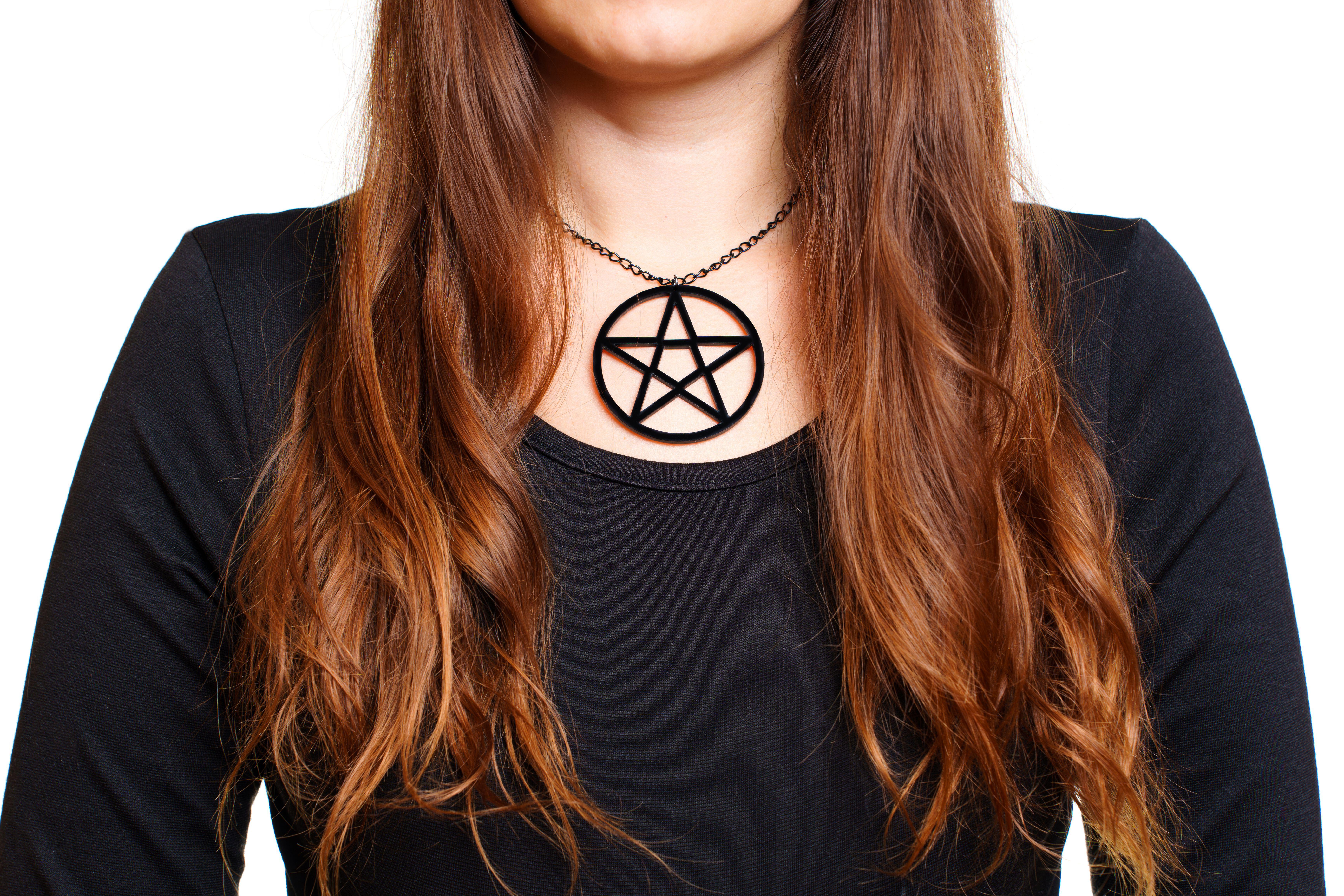
Publicly, wearing the pentagram challenges misconceptions, asserting that Wicca is a living, nature-based faith, not a fringe “cult.” In this way, the pentagram necklace becomes a vessel of spiritual autonomy and identity formation, anchoring wearers in both personal devotion and the broader Wiccan community.
Yet, wearing the pentagram in public can simultaneously invite misunderstanding or even stigma, given powerful media portrayals and stereotypes of Wiccans. Outsiders may view the pentagram as a dangerous occult item, while Wiccans understand it as a sacred religious object. The pentagram reveals the tensions between insider meanings and outsider misunderstandings that often define new religious movements. Ethan Doyle White explains that Wicca’s modern evolution has been shaped by external scrutiny and internal negotiation over legitimacy (2010). The pentagram’s contested reception—simultaneously revered and rejected—demonstrates how religious symbols gain cultural power precisely through the struggle over their meaning, reflecting broader questions about what constitutes a “legitimate religion.”
Grace Hernandez, Religious Studies Major with a concentration in Religion and Public Engagement and Minors in Writing and Middle East and South Asia Studies, Wake Forest University (‘26).
5 December 2025
Tags: Pentagram, Pentacle, Wicca, Pagan, Ritual Adornment, Nature-based religion, Modern Magical Traditions
References:
Cunningham, Scott. 1988. Wicca: A Guide for the Solitary Practitioner. St. Paul, MN: Llewellyn Publications.
Farrar, Janet, and Stewart Farrar. 1981. A Witches’ Bible: The Complete Witches’ Handbook. Custer, WA: Phoenix Publishing.
Laycock, Joseph P. 2023. Satanism. Cambridge University Press. https://doi.org/10.1017/9781009057349
Malita-Król, Joanna. 2017. “Wiccan Tools: On the Accessories of a Modern Witch.” In Walking the Old Ways in a New World, edited by Karolina Maria Hess, 225–236. Wrocław: University of Wrocław Press.
Starhawk. 1979. The Spiral Dance: A Rebirth of the Ancient Religion of the Great Goddess. San Francisco: Harper & Row.
Urmă, Maria. 2016. “The Pentagram as a Living Cross.” Anastasis: Research in Medieval Culture and Art 3, no. 1: 117–128.
White, Ethan Doyle. 2010. “The Meaning of ‘Wicca’: A Study in Etymology, History, and Pagan Politics.” The Pomegranate: The International Journal of Pagan Studies 12, no. 2: 185–207. https://doi.org/10.1558/pome.v12i2.185.
Wicca Living. “What Is Wicca?” Accessed November 15, 2025. https://wiccaliving.com/what-is-wicca/