
1982 Rajneeshee Sunrise Colors
Religion: NRMs
Time Period: 1980s
Type Of Garment: Varies
Tags: “orange people”, Oregon, Osho, Rajneesh, Rajneeshees, Rajneeshpuram, Sunrise colors, Wild Wild Country
The Context and the Creator:
In the 1980s, Bhagwan Shree Rajneesh (1931-1990) and his followers relocated from India to rural Oregon. Here they built a communal settlement, their intended utopia, named Rajneeshpuram on what used to be The Big Muddy Ranch in Wasco, Oregon (Oregon Public Broadcasting 2011).
Rajneesh (later and now known as Osho) led this religious movement focused on love and spiritual serenity. He rejected traditional religions in favor of his own religious teachings that combined Eastern principles with aspects from Western ideals. As religious studies scholar Hugh Urban explains:
The move to Oregon was thus a fulfillment of his [Osho’s] larger ideal of wedding East and West—what he called “Zorba the Buddha”—by bringing together the spirituality of the Buddha with the materialism and sensuality of Zorba the Greek. In this sense, Rajneesh was really one of the first truly “global gurus” of the modern era, tracing a complex circuit from India to the U.S. and back again, while also synthesizing Eastern philosophy with American-style capitalism
(Urban 2018).
This synthesis could be seen in Osho’s teachings and life. Even as he taught dynamic meditation and imparted his wisdom, he also enjoyed material possessions. He is known for acquiring over 90 Rolls-Royce vehicles, having a Rolex watch, enjoying lavish meals, and wearing sumptuous robes (see Figure 1). He did not see material possessions as a sinful thing. Nor did he endorse conservative religious ideas about sexuality. He promoted sexual freedom and the right to love was one of his main tenets (Wollaston 2018). As one follower stated, Rajneesh taught “sexual liberation” and promoted “full living and personal freedom, particularly in the realms of sexuality and self-expression” (Ma Ananda Sarita 2024).

The Object:
Osho also established a unique dress code. According to spokeswoman Ma Prem Veena in a 1983 interview, one day Bhagwan looked out his window and saw a “flame tree with red and gold and orange flowers.” In response to this sight, Rajneesh said, “I saw the red was flaming. I want my disciples to be the flaming of their human potential.” The bright colors not only represent the tree, but also “those of the rising sun” and “celebration” (Statesman-Journal 1983). Thus, unlike other New Religious Movements (NRMs) that implemented strict guidelines for clothing and ritual garb, such as the Nation of Islam and the Hare Krishnas, color(s), not form, dictated the dress code of the Rajneeshees.
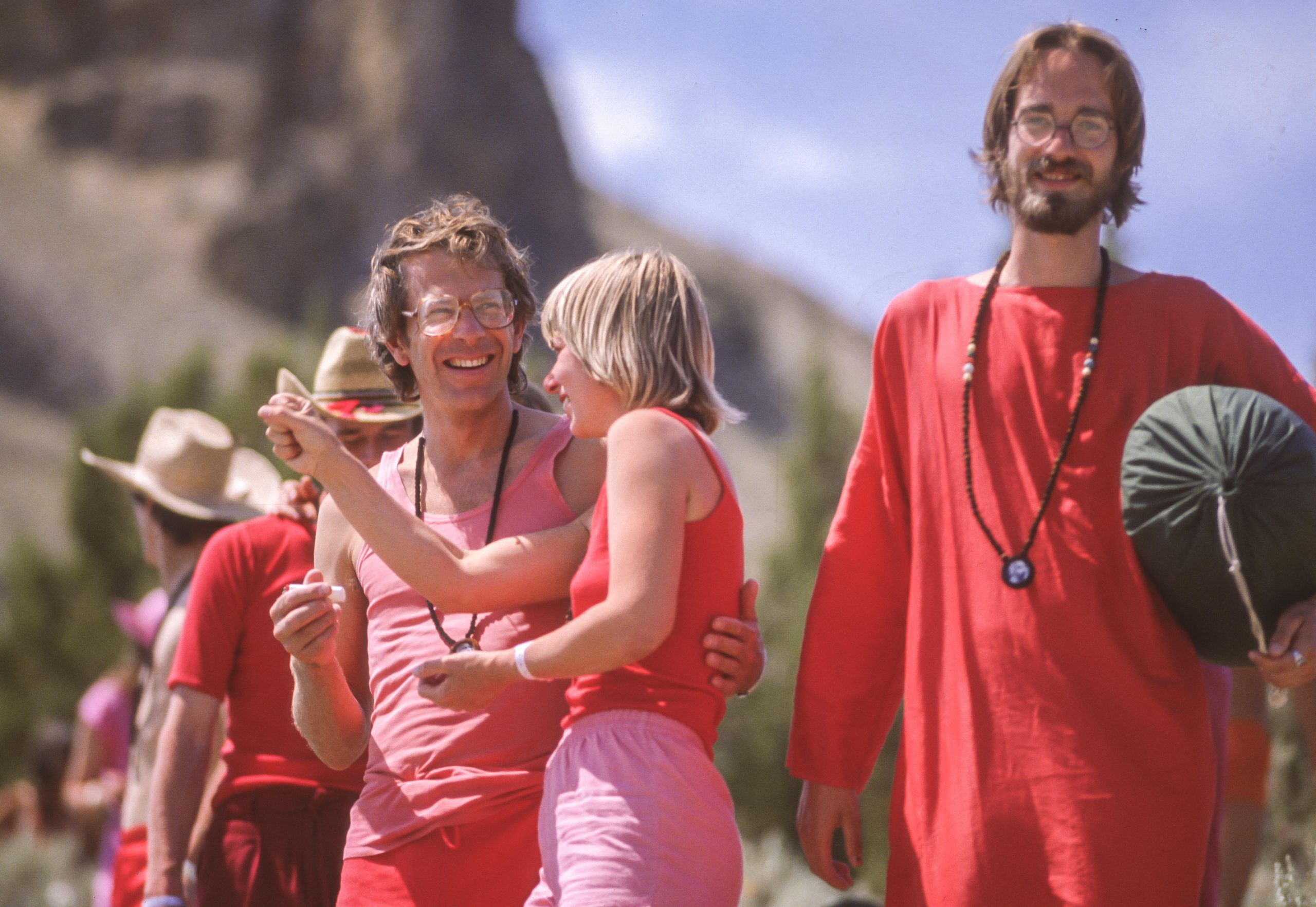
In the early 1980s, a Rajneeshee meditates with his eyes closed and his head tilted up towards the sky. The sun illuminates his red shirt and pants and he wears a red knit cap on his head. His brightly colored attire represents the bold and distinct aesthetic embraced by devotees of Rajneesh (see Figure 2). In another instance, a group of devotees stand together wearing T-shirts, tank tops, sweatpants and robes in various shades of pink, red, and orange (see Figure 3). Adherents could wear different styles, whether pants, shirts, dresses, hats, suits, and more, but they were unified through their color choices. Donning these bright colors in various shades of pink, purple, red, and orange symbolized devotees’ new beginnings and the enlightenment they gained by dedicating themselves to the movement.

While not as stringent as a prescribed uniform or modest dress code, the emphasis on sunrise colors is important in understanding the Rajneesh Movement. It shows Osho’s ability to unify and mobilize his followers. According to sociologist Rodney Stark, NRMs are successful to the extent that they “achieve effective mobilization; strong governance and a high level of individual commitment” (Stark 1987, 13). Effective mobilization refers to how “individual humans are mobilized to act on behalf of the collective interests expressed in the organization, and their activity is given coherence by leaders” (Stark 1987, 16). Devotees’ willingness to dress in these sunrise colors shows a high level of cohesion and Osho’s ability to inspire the commitment and collective action of his followers.
The Wearer:
This visible commitment to Osho’s teachings had profound effects on both internal community dynamics and external perceptions of the movement. For Rajneeshees, these sunrise colors created a sense of community and unity. The colorful clothes, which amounted to a uniform of sorts, created a distinct aesthetic and strong sense of identity. Wearing these colors not only aligned them with Osho’s teachings, but also demanded that they invest time and energy by finding clothing in the correct colors, sourcing and selling these colorful garments in the community’s clothing store, and sometimes dying clothing to adhere to these standards (Petrarca 2018). This tangible and visual form of unity strengthened “network ties” among the followers, while setting them apart from the outside world (Stark 1987, 22-23).
Devotees committed to wearing these sunrise colors in their lives and work at Rajneeshpuram and they also wore them for communal and ritual activities. For example, in Figure 4, you can see numerous Rajneeshees cheering and waving at one of the “drive-by” rituals, a daily occurrence in which Osho would drive by in one of his Rolls-Royces. Members of the community would greet him with “music, song, and dance.” This recognition of their “deep devotion” to him was symbolized not only in their musical offerings, but also through their clothing that symbolized “celebration,” as well as new beginnings and human potential (Ma Ananda Sarita 2024, Statesman-Journal 1983). In this photograph, you can see that there is not actually uniformity in their garments; instead, there is a wide variety of clothing styles. The uniformity lies in the color scheme. They wear the hues of the sunrise and together greet their leader, and in that way, they are unified.
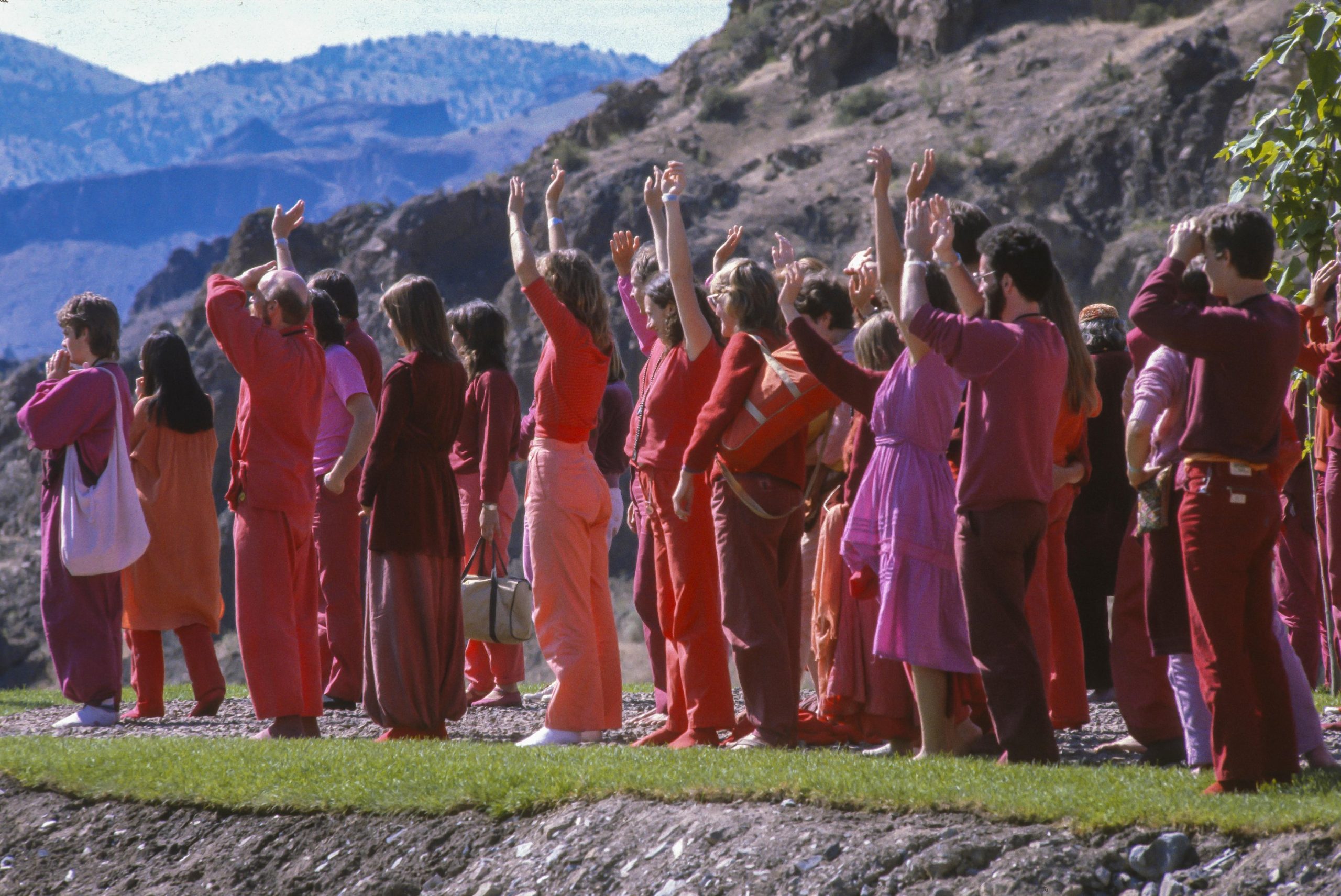
One way religions foster community is through renunciation. Sociologist Rosabeth Moss Kanter explains that this process involves leaving behind outside connections and minimizing in-group subunits, which might dilute members’ loyalty (Kanter 1973, 82-3). Kanter adds that geographic isolation, “institutional completeness” (the ability to meet all of the members’ needs), and a “distinctive style of dress” enhance community and build strong religious identity (82-84). The teachings of Osho and life at Rajneeshpuram encouraged members to renounce their old lives and embrace their new spiritual identities. The Rajneeshees did this, in part, through their clothing. By changing their attire and using it to align with the group’s vision of community, they renounced their old lives and committed themselves to the group by outwardly demonstrating their membership. The sunrise colors brought and enhanced a sense of bonds among one another and highlighted a sense of equality within the group. The colors became the visible reminder of their religion and the way they embodied it together.
The Rajneeshees’ distinct and colorful clothing also made them a target. A number of people in Wasco County were unhappy with the building of Rajneeshpuram and the ways it changed (and challenged) the local economic, political, and religious landscape. Hostility escalated to violent threats. One resident stated, “There will be open season on the Rajneesh, known locally as Red Vermin. These little red rats may be a little rough to dress, and if gut shot probably not worth it” (Smith 1990). And devotee Ma Ananda Sarita remembers that “trucks with large gun racks would drive slowly down the county road, sometimes with a big poster showing a rifle target with Osho’s photo, and the caption: “Better dead than red!” (2024). These accounts highlight not only the increasing hostility between the two groups, but the way Rajneeshee attire identified them to outsiders and potential enemies. To many in Wasco County, members’ distinct sunrise-colored clothing came to symbolize dangerous religious differences and a threat to their way of life.
This hostility had a paradoxical effect. The Rajneeshees remained undeterred, and, if anything, it made them stronger. As Kanter explains, “facing a common enemy binds people together” (1978, 102). It also, sociologist Lori Peek argues, enhances religious identity. When confronted with discrimination and harassment, as well as the threat and/or reality of physical assault, many religious adherents report “that their religious identity became even stronger during this time” (Peek 2005, 230-231). The Rajneeshees’ colorful garb was a testament to their faith and communal bonds and enhanced their spiritual commitments even as they faced opposition from the outside world. The sunrise colors they wore became not just markers of belonging, but symbols of defiance and spiritual resilience in the face of hostility.
Ana Knezevic, Wake Forest University (‘28)
5 December 2025
Tags: Rajneesh, Osho, Rajneeshpuram, Rajneeshees, Oregon, Sunrise colors, “orange people,” Wild Wild Country
References:
Cowan, Matthew. 2013. “Wild Wild Archive: Analog Videotape of the Rajneesh Movement at the Oregon Historical Society.” Still from 1983-1985 Video Footage. Oregon Historical Society. Available at: https://core.ac.uk/reader/212798341
Kanter, Rosabeth Moss. 1972. Commitment and Community: Communes and Utopias in Sociological Perspective. Harvard: Harvard University Press.
Oregon Public Broadcasting. 2011. “Rajneeshpuram.” Available at: https://www.opb.org/television/programs/oregon-experience/article/rajneeshpuram/
Peek, Lori. 2005. “Becoming Muslim: The Development of a Religious Identity.” Sociology of Religion 66 (3): 215–42. https://doi.org/10.2307/4153097.
Petrarca, Emilia. 2018. “The Clothes on Netflix’s ‘Wild, Wild Country’ are So Good, I Want This Cult’s Look,” The Cut, 28 March. Available at: https://www.thecut.com/2018/03/wild-wild-country-rajneesh-clothes-monochrome.html
Sarita, Ma Ananda. 2024. “What Really Happened at Rajneeshpuram? A Firsthand Account,” Tantra Essence, 28 November. Available at: https://www.anandasarita.com/blog/rajneeshpuram
Smith, Karen. 1990. “Oregon Bigots.” The Burlington Free Press, 20 February, 9A.
Stark, Rodney. 1987. “How New Religions Succeed: A Theoretical Model.” In The Future of New Religious Movements, edited by David G. Bromley and Phillip E. Hammond, 11–29. Macon, GA: Mercer University Press.
Statesman-Journal (Salem, Oregon). 1983. “Rajneesh Color Represents ‘Flaming’ Human Potential,” 3 July, 4-G.
Urban, Hugh. 2018. “Rajneeshpuram Was More Than a Utopia in the Desert. It Was a Mirror of the Time,” Humanities 39 (2). Available at: https://www.neh.gov/humanities/2018/spring/feature/rajneeshpuram-was-more-utopia-desert-it-was-mirror
Wollaston, Sam. 2018. “Growing up in the Wild Wild Country Cult: ‘You Heard People Having Sex All the Time, like Baboons.’” The Guardian, 24 April. Available at: https://www.theguardian.com/tv-and-radio/2018/apr/24/wild-wild-country-netflix-cult-sex-noa-maxwell-bhagwan-shree-rajneesh-commune-childhood