
1990s Christian Robes by MRTCG
Religion: Catholicism, Christianity, NRMs
Time Period: 1990s
Type Of Garment: Head Coverings, Robe
Tags: Apocalypticism, Asceticism, Catholicism, Christianity, NRM, Robes, Uganda
The Creator:
On March 17, 2000, the Movement for the Restoration of the Ten Commandments of God (MRTCG) held its final large gathering at their settlement in Kanungu, Uganda. Members slaughtered three bulls and drank seventy crates of soft drinks in a preparatory ritual. After assembling in the church on the property, the building was suddenly engulfed in flames, killing all 530 people inside (New Religious Movements 2023). The fate of the MRTCG drew immediate comparisons to the Peoples Temple tragedy at Jonestown, cementing the MRTCG’s fate as one of the most devastating in the late twentieth century. How do we begin to understand this movement and how did clothing function within it?
The MRTCG emerged from the political and social upheaval in Uganda during the late 20th century. It was a fringe Catholic religious group that mixed charismatic leadership with apocalyptic doctrines. Founded by Credonia Mwerinde (1952-2000) and Joseph Kibwetere (1932-2000), the group gained followers by “promising salvation and an escape from the impending apocalypse” (New Religious Movements 2023). Their teachings and theology drew on a long history of prophetic visions and Catholic teachings in eastern Africa.
Supernatural visions and experiences enhanced the leadership of Mwerinde and Kibwetere, functioning as a form of charismatic authority. They claimed to be individuals endowed with “supernatural, superhuman, or exceptional” gifts (Weber 358). Both Mwerinde and Kibwetere reported having visions of the Virgin Mary in the mid-1980s. They also professed to have seen Jesus, Mary, and Joseph in several locations. Their experiences were “heavily influenced by recognized Catholic apparitions,” including LaSalette (1846) (Introvigne 2005).
Mwerinde and Kibwetere worked together to spread the Virgin Mary’s message about the coming apocalypse (New Religious Movements 2023). The leaders reportedly continued to be in communication with the Virgin Mary as they guided the movement. Further, their teachings were codified in a booklet entitled, “A Timely Message From Heaven: The End of the Present Time,” which emphasized the imminent apocalypse. The group’s fixation on the biblical end times was central to its identity and foreshadowed its end (New Religious Movements 2023). These experiences solidified their status as charismatic leaders whose authority depended on being perceived as uniquely gifted and supernaturally guided.
The Context:
Jean-Francois Mayer, a Swiss religious historian, who has done extensive work on the movement, notes that it “cannot be separated from a wider religious milieu of popular Catholicism in Uganda” (Mayer 2001, 204). When he interviewed one of the original apostles of the MRTCG, they “affirmed strongly that they had always considered themselves Roman Catholics,” which is reflected in their monastic-like rules (night prayer, vow of silence and ritualized lifestyle) (Mayer 2001, 204).
The robes and head coverings used by the Movement for the Restoration of the Ten Commandments of God are from the long tradition of Catholic clothing in Eastern Africa. Varieties of churches and groups emerged from mainstream Christian Catholicism that combined traditional African culture and religion with Christian beliefs.
Groups present in Southeastern Africa, such as the Seven Apostles, “centered on a prophetic figure” and had church members wearing “long white robes and head coverings” (U.S. Senate, Committee on Foreign Relations 2004, 129). These local churches proliferated throughout eastern and southeastern Africa. This religious development shows how the Movement for the Restoration of the Ten Commandments of God was working within an established tradition of Christianity and African traditional religiosity.
The Object and Wearer:
The primary objective of the Movement was to “strictly adhere to the Ten Commandments and spread the teachings of Jesus Christ” (New Religious Movements 2023). This focus on moral purity shaped the group’s daily practices. Members communicated only in sign language to avoid committing verbal sins, engaged in fasting and celibacy, and participated in required nightly prayer.
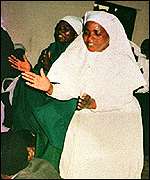
Members were required to wear robes of varying colors with long-sleeves that reached the ankles. Women had their heads covered with veils that matched the robe color. The attire emphasized modesty and resembled that of Catholic religious orders. In their role as spiritual leaders and laborers, nuns, monks, and priests take vows of poverty, chastity, and obedience, vows symbolized in part through their distinct modest and humble attire. These Catholic symbolic meanings would have resonated with the MRTCG and enhanced the significance of the movement’s dress code. While there are few journalistic or historical sources detailing the material of the robes nor are there many remaining photographs to provide more nuance, this attire highlights Catholic elements of the group’s theology and practice (see Figure 1).
Figure 1: Members of the Movement for the Restoration of the Ten Commandments of God worshipping. Source of photograph unknown. Fair Use.
The color of the robes worn by members of the MRTCG represented a follower’s position within the movement. Newly inducted members wore solid black robes, while “[solid] green was worn by those who had seen the commandments, and green and white” was reserved for those who were “ready to die” for God’s recreation of the world in “Noah’s Ark,” the MRTCG settlement in Kanungu, Uganda (Walliss 2005, 54) (see Figure 2).

The robes reflected MRTCG’s religious practice of piety and strict asceticism, and they also functioned as one of the group’s primary commitment mechanisms. Members were expected to live lives of “sacrifice, penance and mortification” and the robes served as a constant, visible marker of that sacrifice (Banura, Tuhirirwe, and Begumanya 2002). Following the “path to heaven” outlined by the leaders, required celibacy, fasting, and ascetic behavior. These and other forms of sacrifice and self-denial increased members’ psychological investment in the movement (Walliss 2005, 54). The sacrifices made their cause “sacred and inviolable,” as membership was “valuable and meaningful” (Kanter 1972, 76).
Clothing also functioned as a key mechanism of group investment. Members were prohibited from wearing ordinary apparel and required to give away or sell their former clothing and possessions (Banura, Tuhirirwe, and Begumanya 2002). This irreversible shedding of outside ties heightened “the relationship of individual to group,” as members’ dependence on the internal community deepened (Kanter 1972, 82).
The uniformity of their religious clothing served multiple religious functions. It emphasized the “significance of the spiritual office being occupied and performed,” (Neal 2025, 5). It also reinforced the sense of community, as members were bound together through a shared identity to “experience the fact of oneness with the group” while simultaneously “diminishing the importance of the individual” (Kanter 1972, 73; Neal 2025, 5). Through these daily expressions of sacrifice, investment, and communion, MRTCG members strengthened their commitment to the movement that was exemplified by their religious attire.
Camryn Walker, Religious Studies Major, Wake Forest University (‘26).
5 December 2025
Tags: Apocalypticism, Uganda, Christianity, Robes, NRM, Catholicism, Asceticism
References:
Atuhaire, Patience. 2020. “Uganda’s Kanungu Cult Massacre That Killed 700 Followers.” BBC News, 17 March 17. Available at: https://www.bbc.com/news/world-africa-51821411
Banura, Gerard, Chris Tuhirirwe, and Joseph Begumanya. 2002. The Kibwetere Cult Killings. The Citizen Report. https://thecitizenreport.ug/wp-content/uploads/2022/05/The-Kibwetere-Cult-killings.pdf
BBC News. 2000. “Quiet Cult’s Doomsday Deaths.” 29 March. Available at: https://news.bbc.co.uk/2/hi/africa/683813.stm
Fisher, Ian. 2000. “Uganda Survivor Tells of When the World Didn’t End.” CESNUR Center for Studies on New Religions, 3 April. Accessed October 5, 2025. Available at: https://www.cesnur.org/testi/uganda_022.htm
Kanter, Rosabeth Moss. 1972. Commitment and Community: Communes and Utopias in Sociological Perspective. Cambridge: Harvard University Press.
Introvigne, Massimo. 2005. “Movement for the Restoration of the Ten Commandments of God.” Encyclopedia of Religion. Encyclopedia.com. Available at: https://www.encyclopedia.com/environment/encyclopedias-almanacs-transcripts-and-maps/movement-restoration-ten-commandments-god
Mayer, Jean-François. 2001. “The Movement for the Restoration of the Ten Commandments of God.” Nova Religio: The Journal of Alternative and Emergent Religions 5 (1): 203–10. https://doi.org/10.1525/nr.2001.5.1.203
Neal, Lynn S. 2025. Wearing Their Faith: New Religious Movements, Dress, and Fashion in America. Cambridge: Cambridge University Press.
New Religious Movements. 2023. “Movement for the Restoration of the Ten Commandments of God.” Available at: https://newreligiousmovements.org/m/movement-for-the-restoration-of-the-ten-commandments-of-god/
U.S. Senate, Committee on Foreign Relations. 2004. Annual Report on International Religious Freedom 2004. S. Prt. 108-29. Washington, DC: U.S. Government Printing Office. Available at: https://www.govinfo.gov/content/pkg/CPRT-108JPRT20429/pdf/CPRT-108JPRT20429.pdf
Walliss, John. 2005. “Making Sense of the Movement for the Restoration of the Ten Commandments of God.” Nova Religio: The Journal of Alternative and Emergent Religions 9 (1): 49–66. https://doi.org/10.1525/nr.2005.9.1.049
Weber, Max. 1947. The Theory of Social and Economic Organization. Translated by A. M. Henderson and Talcott Parsons. Edited with an introduction by Talcott Parsons. New York: Oxford University Press.