
1945 Horoscope Dress by Emily Wilkens
Religion: NRMs
Time Period: 1940s
Type Of Garment: Dress
Tags: “horoscope dress, ” Emily Wilkens, astrology, date dress, Elsa Schiaparelli, horoscope, junior fashion, liberal Protestantism, spirituality, United States, youth fashion, zodiac
The Context:
In the 1940s, Christianity appeared in fashion primarily in the form of the Maltese cross jewelry made famous by Gabrielle “Coco” Chanel. The Christian imaginary (heaven, miracles, angels, Eve, etc.) permeated fashion advertising, while other religions occasionally made an apperance, too (Neal 2019). Though these symbols and figures occurred in advertising, they were not often used as embellishments or adornments on garments. This tacit rule helped designers avoid undue controversy about the appropriateness of pairing “sacred” symbols with “secular” fashions.
To situate these fashion patterns within their broader religious context, it is important to understand the religious landscape of 1940s America. Christianity dominated this landscape, but its forms varied. While conservative Protestantism retrenched after the 1925 Scopes Trial, liberal Protestantism and its values won the day (Hedstrom 2012, 5). Yet, as religious studies scholar Matthew Hedstrom points out, this branch of Christianity embraced “spiritual forms emerging from and moving beyond” its traditional boundaries as it emphasized psychology, mysticism, and individual experience (2012, 7-8). Hedstrom examines how this development and rise of Liberal Protestantism occurred through books, reading campaigns, and publishing programs. Yet, some of this individual seeking and expansive spirituality also unfolded through newspapers, magazines, and fashion–creating an environment where alternative spiritual practices could flourish alongside Christianity..
Astrology emerged as a popular paranormal practice and belief system in the 1940s. During this decade, newspaper columns highlighted the rise of astrology through daily horoscopes, women’s clubs, and magazines. One journalist stated: “The astrology business is enjoying a major boom in the US. It has always had a large public, but right now the astrology magazines are at their peak” (Smith 1941). And another noted, “There are a number of astrological magazines, the largest having a circulation of 100,000 copies. Some 250 newspapers print daily articles on astrology” (Beard 1942).
The popularity of astrology, these journalists and others went on to proclaim, was not a good thing. They criticized the money made by astrologers, emphasized its associations with Adolf Hitler, and sought out scholars and other learned groups, including the American Association of Scientific Workers and Society for the Psychological Study of Social Issues, to debunk its merits (Burton 1941). Such public criticisms indicated astrology’s increasing popularity at the time and newspapers lamented its widespread appeal to people from all stations and walks of life (Burton 1942). Astrology’s popularity, though, did not stop with reading horoscopes or buying magazines, it also appeared in fashion.
The Object:
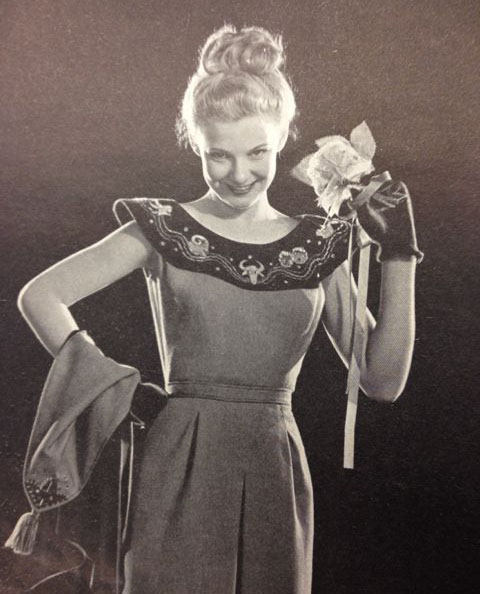
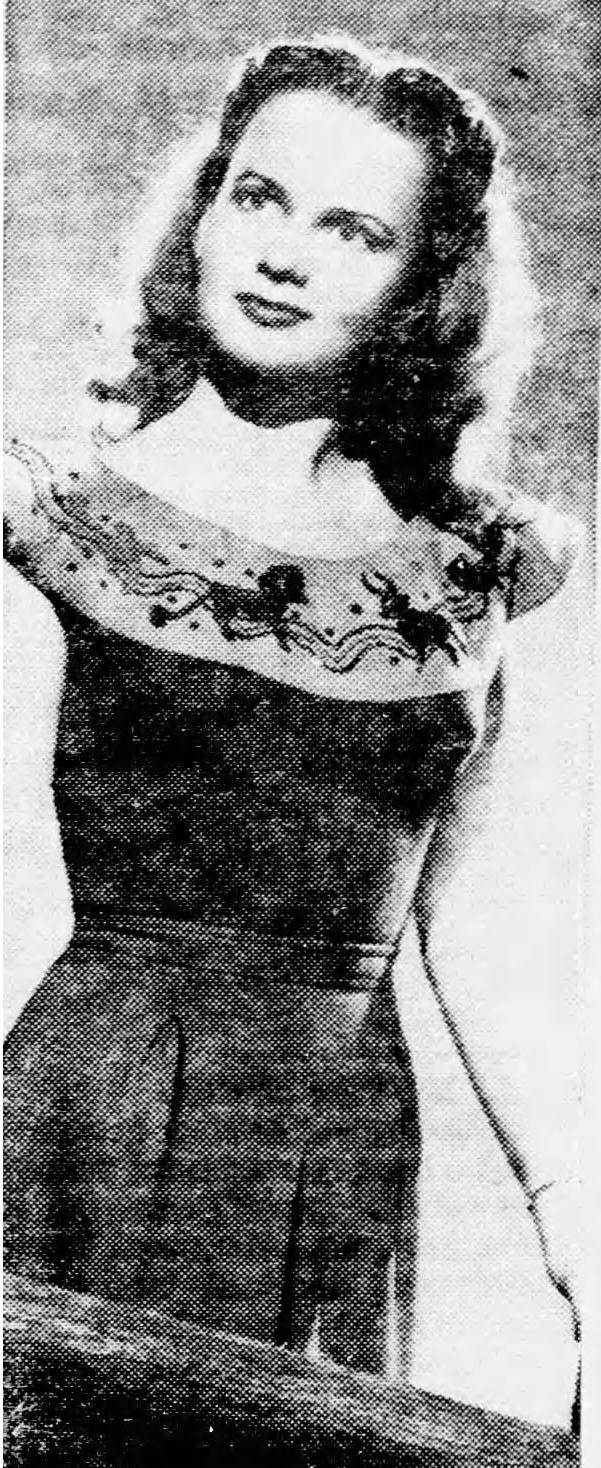
In 1945, American youth designer Emily Wilkens’ (1917-2000) “horoscope” dress appeared in the pages of Vogue and in numerous fashion columns in U.S. newspapers. It was the most notable part of her Fall/Winter 1945 collection entitled “The Life and Times of Important People.” Designed for young women, it featured princess lines (a fitted bodice that transitions into a more voluminous skirt) and a deep, curved “bertha” collar embroidered with the signs of the zodiac (Fegan 1945; Bedwell 1945). The silhouette with its emphasis on the shoulder, a fitted waistline, and voluminous skirts helped teens achieve the vaunted “hourglass figure.” The dress was made from “Everfast” cotton hopsacking, a lightweight and durable brand of cotton, or a soft Cohama wool (Fegan 1945). The dress came in a variety of colors, “olive, ice blue, green or brown, with contrasting collars,” and sold for $27.50 (approximately $490 in 2026 dollars) (“Teen Fall Fashions” 1945; “Teena Texas Cheers Emily Wilkens” 1945). Given that it was sleeveless and part of Wilkens’ winter ready-to-wear collection, it was often styled with short black gloves (Bedwell 1945).
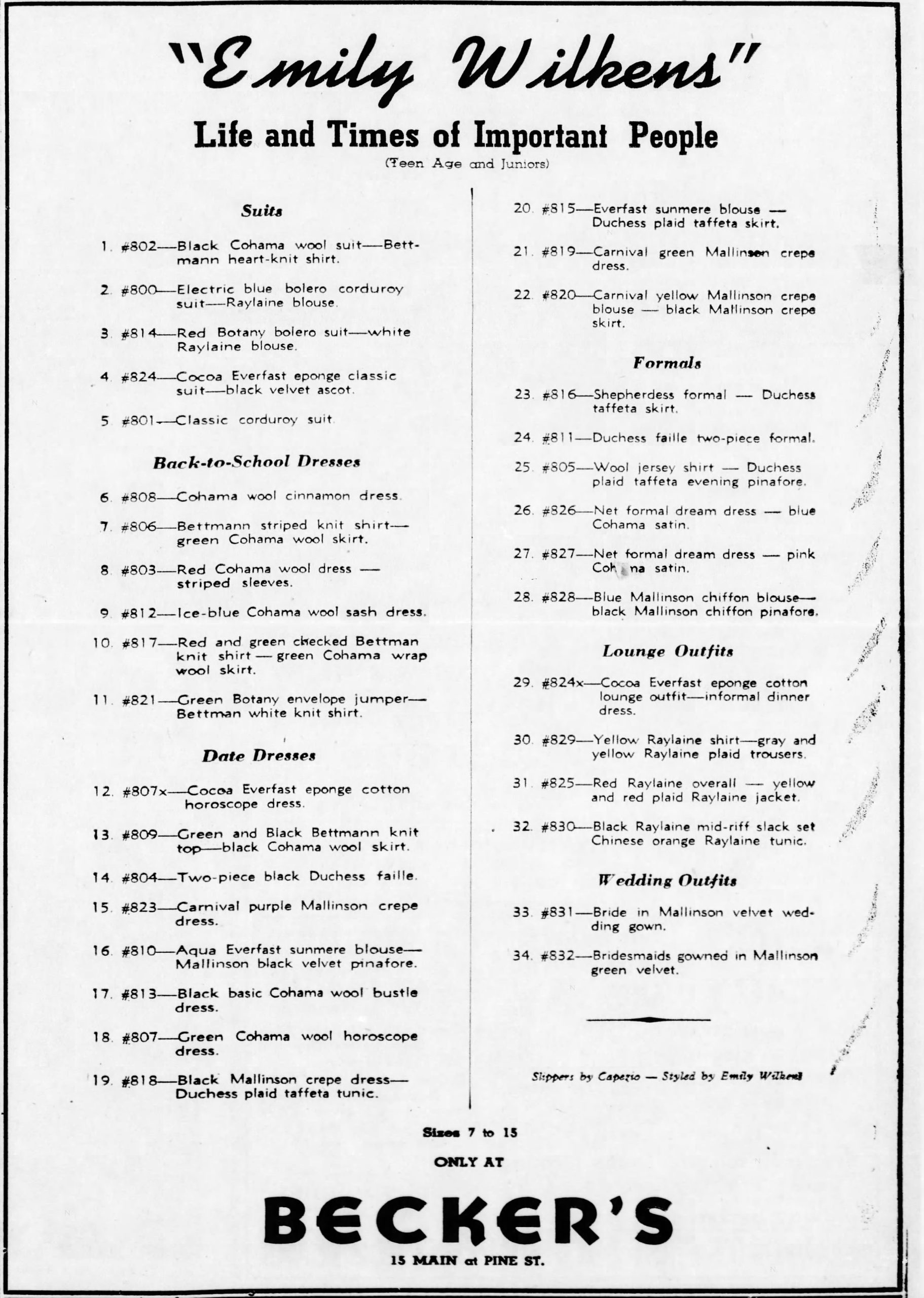
While not highlighted in the newspaper coverage, the dress came not only in different colorways, but also with slightly different designs. These variations can be seen in illustrations and photographs of the dress. For example, in a press photo “radio actress” Marilyn Erskine wears a version of the dress (see Figure 2). While the basic shape and style of the dress remains the same, the embroidery on the collar differs. Figure 1 shows small head-shaped symbols of the zodiac, while Figure 2 shows full-bodied zodiac signs. Further, a program for the collection includes two versions of the dress (see Figure 3).
Journalists repeatedly referred to the garment as a “date” dress. Emphasizing the importance of dating and finding a spouse, journalist Bettina Bedwell noted “a very important part of fashions for young girls is the date dress and the formal dress, both of which probably mean more in her life than they ever will again as long as she lives” (Bedwell 1945). The style of the dress made it suitable for dates and the embroidered horoscope design offered a “conversation piece” for the potential couple (CBS Fashions 1945). While this design predates the “what’s your sign?” romantic pickup line that became popular in the late 1960s and 1970s, it seems to foreshadow this eventuality. Fashion reporters also highlighted the popularity of astrology, as one article proclaimed, “every girl loves a fortune teller,” while another emphasized the dress’s “magic” (“Emily Wilkens Introduces New Fashion Ideas for Juniors” 1945; Gauen 1945a).
The Creator:
In the 1940s, designer Emily Wilkens gained prominence and acclaim as an American designer for young women. In doing so, she helped create and shape this emerging market (Matheson 2015). As journalist Bettina Bedwell explained, “Fashions for the Junior Miss, now an important lady from the designers’ point of view…Styles angled for these girls in their early teens have declared their independence of adult fashions. They go their own way” (1945). Other articles referred to Wilkens as the “number one designer for young juniors,” listed her accolades (winning an American Fashion Critics Award), and highlighted the “ingenious ways” her designs “flatter[ed] the adolescent figure” (“Emily Wilkens Introduces New Fashion Ideas for Juniors”).
In designing for the junior or teen market, Wilkens consistently took chances. Reporters, for example, noted her daring in designing black clothing for youth (Advertisement 1944a; Fegan 1945). Her designs also encouraged young women to embrace more form-fitting and elegant designs. As one journalist remarked, she encouraged young women to abandon casual and oversized “sloppy Jo sweaters and saddle oxfords” (“She Devotes Her Talents to Teen Agers Fashions” 1945; Fegan 1945).
Fashion historian Rebecca Jumper Matheson also details how Wilkens’ designs were influenced by famed Italian designer Elsa Schiaparelli. Wilkens, like Sciaparelli, focused “much of the visual interest” in her designs “in the bodice” (Matheson 2015, ch. 5). Wilkens also utilized motifs featured in Schiaparelli’s designs, including butterflies and zodiac signs. Schiaparelli’s Winter 1938-1939 collection combined themes from the Palace of Versailles with zodiac signs and constellations. Recognizing this influence, fashion editor Dorothy Roe referred to Wilkens as the “‘teenagers’ Schiaparelli” (Roe 1945). As World War II disrupted the fashion dominance of Paris and other European cities, American designers, like Wilkens, utilized these inspirations and made them their own as they forged their place in the American fashion scene.
The Reception:
While many news reporters lamented the popularity of astrology, fashion designers and journalists celebrated its artistic possibilities. Wilkens’ “horoscope” dress garnered substantial attention from newspapers around the country. As fashion journalist Mary Jane Gauen proclaimed, “Horoscope dress has bright future.” She continued, “It’s here–the horoscope dress that we earmarked at the New York openings in July. Of course we don’t pretend to be a fortune teller, but it’s safe to predict that this frock will be one of the most devastating at any get-together of the young set” (Gauen 1945b). This theme provided a fun and engaging way to build on the popularity of astrology, while avoiding the censure that more traditionally sacred symbols, such as Mary and Jesus, might have garnered if placed on a dress in the 1940s. Astrological symbols functioned differently. Their appearance on a fashion garment highlighted astrology’s ambiguous status as not quite science and not quite religion, making it “safe” for fashionable use, while reflecting the era’s broader openness to individual spiritual seeking beyond traditional religious boundaries.
Lynn S. Neal, Professor of Religious Studies, Wake Forest University
2 February 2026
Tags: astrology, date dress, spirituality, liberal Protestantism, zodiac, horoscope, “horoscope dress,” Emily Wilkens, United States, Elsa Schiaparelli, youth fashion, junior fashion
References:
Beard, Leslie C. 1942. “Astrology is Target of Broadcast by Scientists.” The Daily Mail (Hagerstown, MD), May 30.
Bedwell, Bettina. 1945. “Fall Date and Formal Dress for Junior Miss.” Daily News (New York, NY), July 29.
Bonwit Teller. 1944a. Advertisement. The New York Times, April 16.
Bonwit Teller. 1944b. Advertisement for Teen Shop @ Henri Bendel. New York Times, September 4.
Burton, Irving. 1941. “Scientists Dub Astrology ‘The Bunk.'” Portland Press Herald (Portland, ME), January 26.
CBS Fashions. 1945. “Conversation Piece.” Newsday (Suffolk Edition) (Melville, NY), August 22.
Crew, Mrs. C. J. 1942. “Astrology Discussed at Literary and Art.” Nebraska Signal (Geneva, NE), October 29.
Dean, Joan. 1945. “Hollywood’s Adrian Wins Fashion Critics Award.” Detroit Evening Times (Detroit, MI), February 15.
“Emily Wilkens Introduces New Fashion Ideas for Juniors.” 1945. The Arizona Republic (Phoenix, AZ), August 7.
“Emily Wilkens: The Life and Times of Important People.” 1945. The Bradford Evening Star (Bradford, PA), August 20.
“Fashion Designers Turn to Cotton For Garment Materials.” 1945. The Oklahoma Cotton Grower (Oklahoma City, OK), December 15.
Fegan, Lois. 1945. “Dress Parade.” Harrisburg Telegraph (Harrisburg, PA), August 30.
Gauen, Mary Jane. 1945a. “New York Fashion Report: Pitched for Bobby Soxers.” Detroit Free Press (Detroit, MI), July 25.
Gauen, Mary Jane. 1945b. “Horoscope Dress Has Bright Future.” Detroit Free Press (Detroit, MI), October 3.
Hedstrom, Matthew S. 2012. The Rise of Liberal Religion: Book Culture and American Spirituality in the Twentieth Century. New York: Oxford University Press.
Luft, Elizabeth. 1946. “Emily Wilkens Designs Whistle Bait for Slick Chick Activities.” The Cleveland Press (Cleveland, OH), February 22.
Matheson, Rebecca Jumper. 2015. Young Originals: Emily Wilkens and the Teen Sophisticate. Costume Society of America Series. Lubbock: Texas Tech University Press.
“She Devotes Her Talents to Teen Agers Fashions.” 1945. Tulsa World (Tulsa, OK), August 31.
Smith, H. Allen. 1941. “Astrology Boom.” The San Francisco Call Bulletin, December 11.
“Stay Young for Returning Servicemen, Girls Advised.” 1945. Telegraph-Forum (Bucyrus, OH), December 14.
“Teen Fall Fashion.” 1945. Pittsburgh Post-Gazette, July 7.
“Teena Texas Cheers Emily Wilkens.” 1945. San Antonio Express-News (San Antonio, TX), September 22.
Thursday, Tom. 1945. “Astrology is Four-Star Business.” The Miami Herald, March 11.
“Triple Feature for Today: Teen-Ager Shows.” 1945. The New York Times, March 3.