
1700s Transparent Cloth in a Cuzco School Painting
Religion: Catholicism, Christianity
Time Period: 1700s
Type Of Garment: Textile
Tags: Atahualpa, Cuzco School, Inca Empire, Mary Magdalene, naked dress, religious ecstasy, saints, Sexuality
The Object:
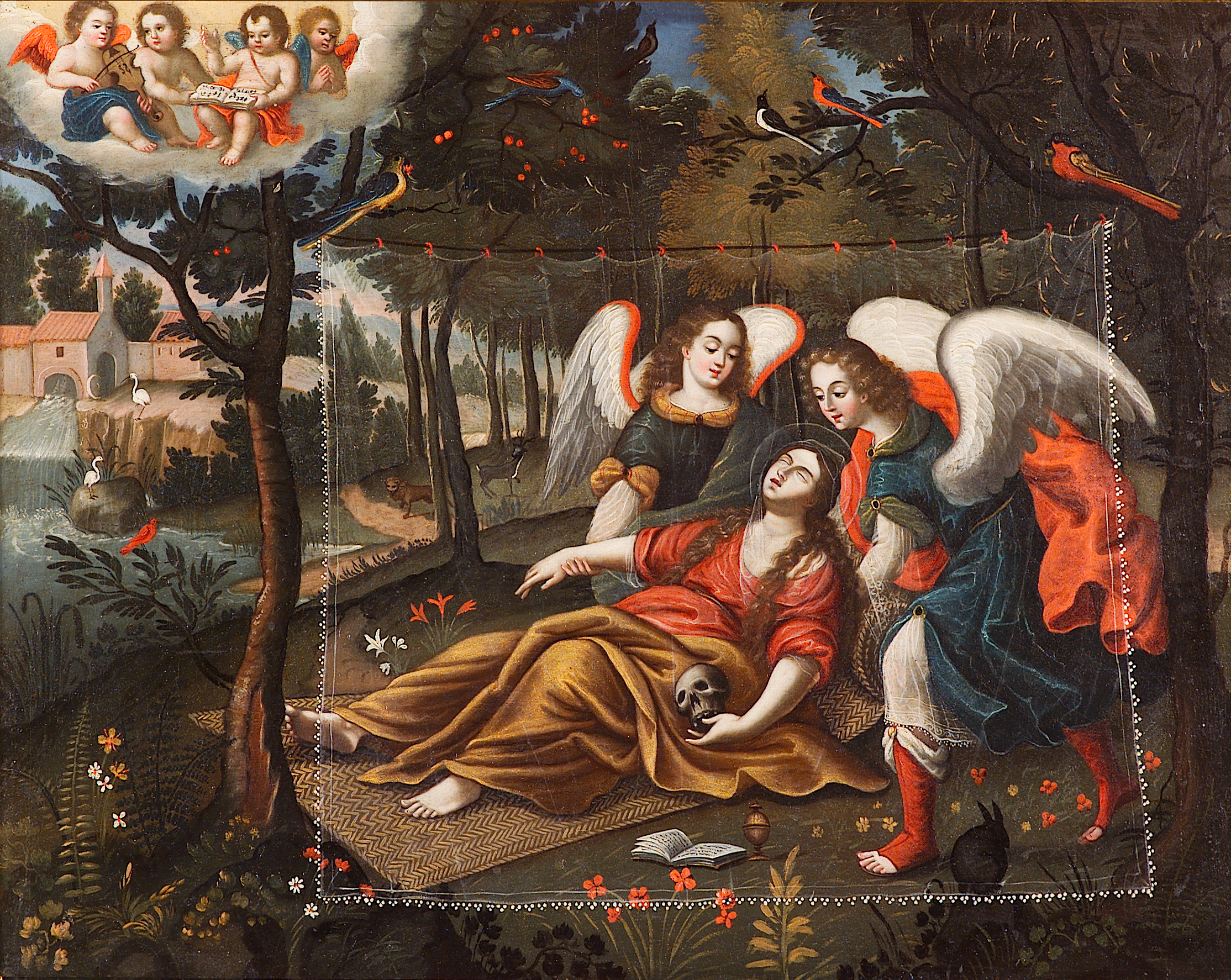
This vibrant oil painting was created in Cuzco, Peru during the period of Spanish colonial rule (see Figure 1). Depicting Mary Magdalene in ecstasy, it was based on works from Europe but includes a completely original element that makes striking allusions to sexuality: a panel of transparent white cloth is shown suspended on a rod, creating distance between the viewer and the scene yet still revealing the Magdalene and her angelic visitors. Sheer cloth has roots in the Andean textile tradition, and we know it was once used in a similar way to obscure a sexualized yet sacred human, the Inca emperor Atahualpa. Such cloth is also still used today to construct the “naked dress,” a popular garment for female models, actresses, and musicians at red carpet events.
The Creators:
In the late seventeenth century Indigenous artists in Cuzco, which had been the capital of the Inca Empire, established their own guild apart from that of Spanish painters. Their work became sought after throughout South America for its rich colors, unique interpretations of Christian themes, depictions of sumptuous textiles, and charming details such as birds and angels. This unsigned painting was likely created in a multi-person workshop under the direction of a master painter. Its size and current location in a private collection in Peru, as well as its delicately sexualized theme, suggests it was created for a private home. People often displayed paintings of saints in their homes, as inspiration for leading devout lives. It is tempting to imagine that this work could have been hung in a bedroom, a place of prayer and sleep but also of sexual union.
The Context:
The figures in the painting were probably adopted from two different European prints modeled after a painting by the Dutch Baroque artist Peter Paul Rubens. One, seen in Figure 2, created by Gaspar Huybrechts around 1680 shows roughly the same human figures seen in the Cuzco work—a reclining Mary Magdalene attended by two angels and a group of childlike angels singing and playing music at upper left.

The Bible’s Gospel of Luke (7:37–50) recounts that a sinful woman visited Jesus and washed his feet, drying them with her hair and anointing them with perfume. She then renounced her corrupt life and became one of his followers. Later interpreters inferred that this woman had been a prostitute and associated her with Mary Magdalene, who according to the Gospel of Mark (16:9) was among the first people to see him after his resurrection.
The scene in the Baroque works was likely based on The Golden Legend, a book about saints’ lives published in 1620. It said Magdalene retreated to a wilderness to live alone in contemplation, and each seventh day was carried heavenward by angels and heard glorious celestial music.
The Cuzco painting shows her reclining with eyes closed on a woven reed mat, head tipped back. A skull sits in her left hand to indicate her state of renunciation, but a gold-toned vessel in front of her refers to the perfume used in her prior life. Her prone position, closed eyes, and open mouth seem to suggest sexual ecstasy, which for the Catholic Church at the time was an acceptable analogue to religious ecstasy.
The transparent cloth in some ways helps establish the decorum of the scene and communicate its sacred rather than profane quality. But Rosario Granados argues that the cloth, as a membrane penetrable only by sight, likely refers to Magdalene’s having recovered her virginity after renouncing her sinful life. The painting also points to native Andean ideas about sexuality as related to nature’s abundance, with elements such as the viscacha (a rabbit-like rodent) between the frontmost angel’s feet, the flowers and fruiting tree surrounding Magdalene, and the flowing water of the river at left.
Of the many textile types mastered by Andean weavers, one was gauze, a type of openwork often created in white cotton. When in 1532 Spaniards first met the Inca emperor Atahualpa, they said he appeared seated in a doorway, while two women raised a sheet of sheer cloth in front of him to partially obscure him from view. The Spaniards read sexual undertones in the setting, as the ruler was surrounded by his wives and other female companions. Reproductive potency was required of Inca emperors, as they formed extended kin groups by procreating with multiple women. One Andean metaphor for male sexual vigor was frothy water, and its white color and transparency may have likened it to openwork cloth. As Adam Herring writes about Atahualpa’s first appearance to the Spanish soldiers, the gauze scrim that preceded him at the “house of pleasure” as they called it was both a screen and “an invitation to knowingness.”
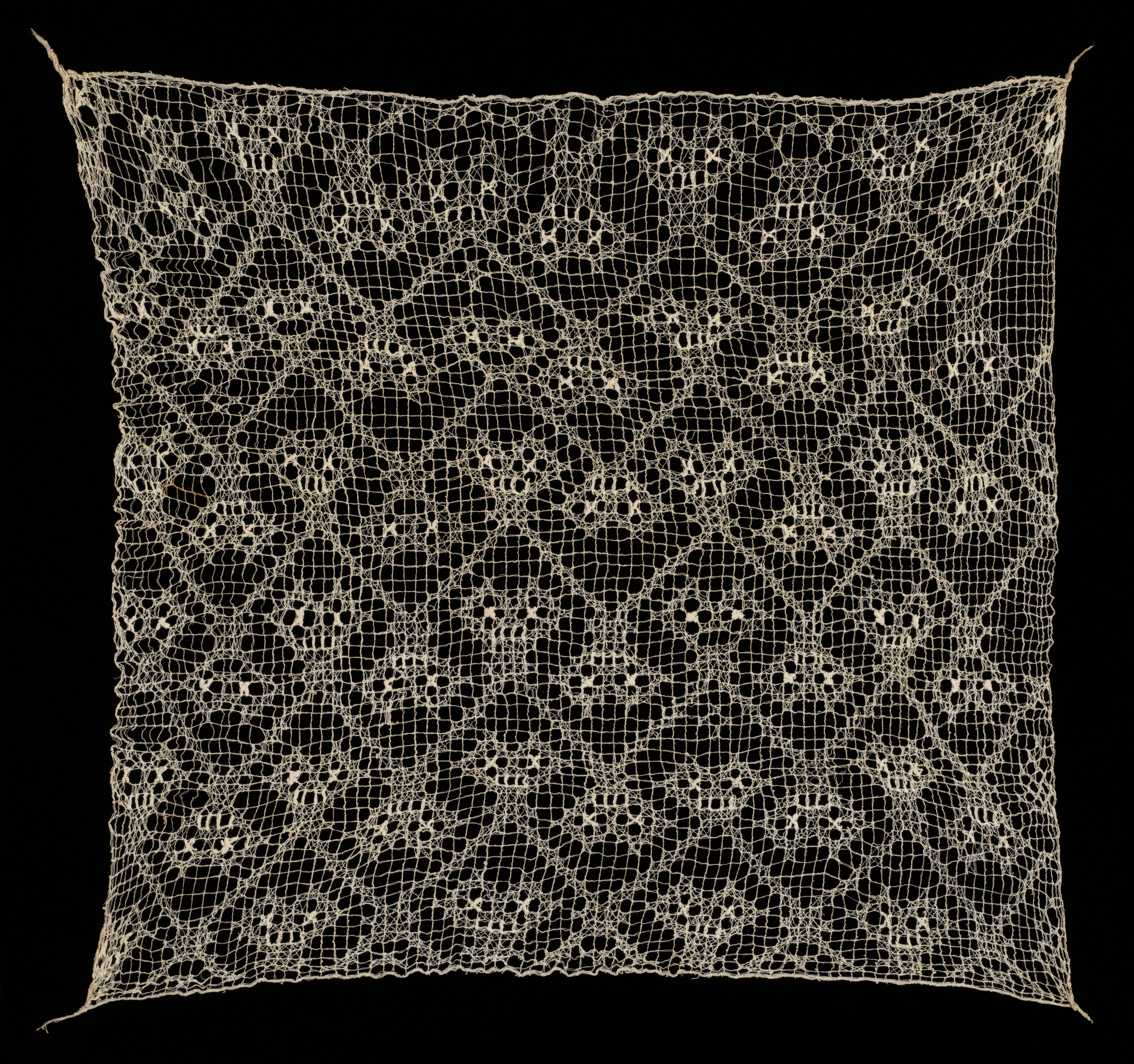
By the colonial era discourses around sexuality had shifted to the female body, wherein the bodies of Indigenous women were conceived of by Europeans as grounds for conquest, while those of European women were highly circumscribed. Female nudity was relatively rare in Andean art and society, but new types of transparent cloth from Europe became popular and may have politely expressed novel “invitations to knowingness.” Gauze made of linen was exported from northern Europe, as was needle and bobbin lace.
The painting appears to represent a sheet of gauze that is pierced with red threads along the top to be attached to the wooden rod, all possibly an oblique reference to women’s loss of virginity. Its other edges are trimmed with a lace border seen commonly in other art of the time, a row of triangles formed by white balls. The same border is also seen on the gauze underskirt worn by the frontmost angel. Across the canvas, white pigment is used to depict materials of various levels of transparency and lightness: cloth, feathers, water, paper, and flower petals.
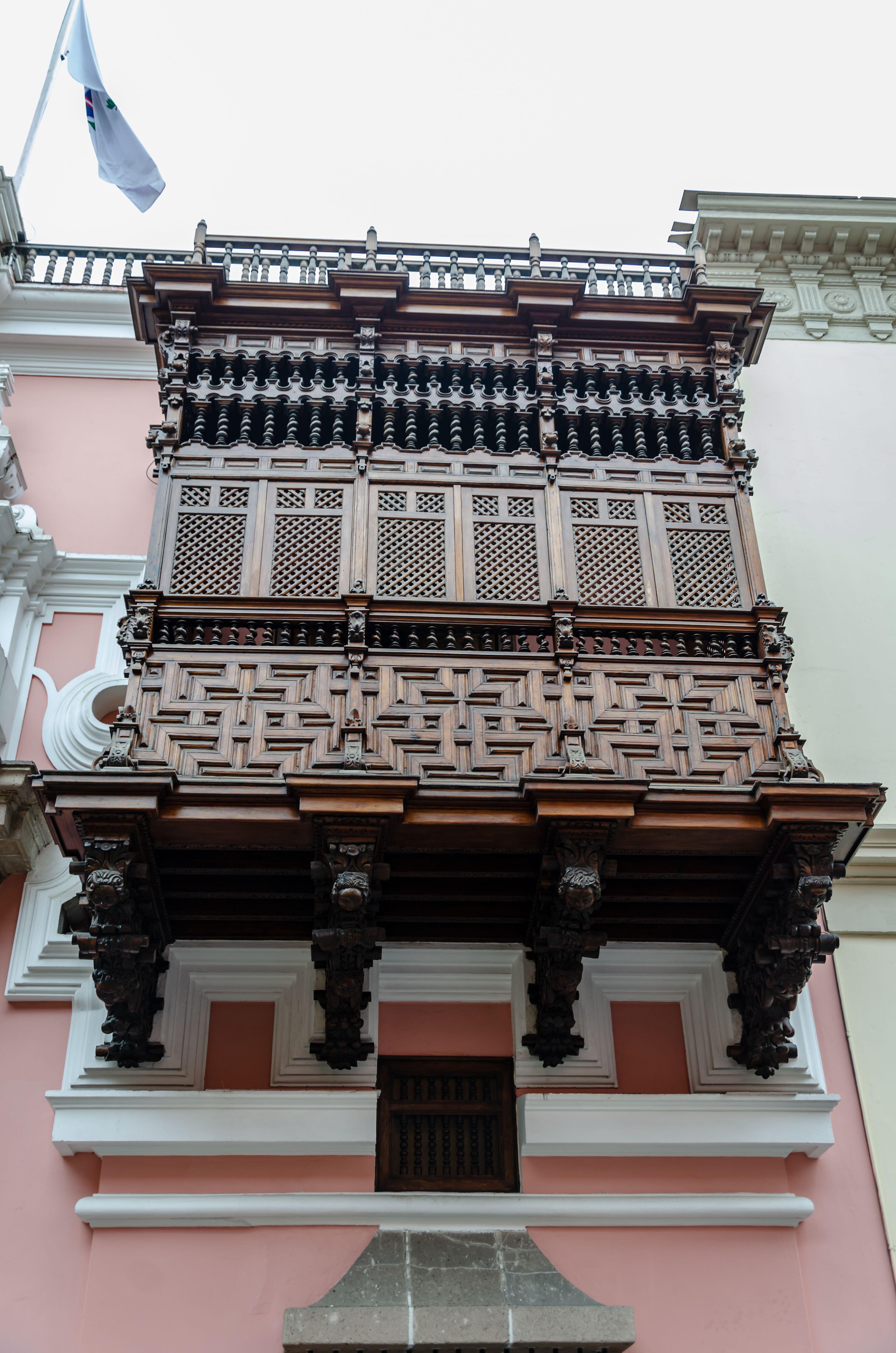
Mary Magdalene’s skin is also extremely white. While this may suggest a pallor befitting her semi-conscious state, it also expresses her racial identity. As a white woman Magdalene’s sexuality, and that of real women of European descent living in the Andes, was perceived as needing to be protected. As in Spain, the popularity of convent life, in which celibate women were conceived as brides of Christ, was one symptom of this. So also were balconies created with openwork wooden shutters, from behind which women could observe city life without being seen (see Figure 4).
But transparent cloth is the foremost, and most unique, signifier in the painting. Magdalene herself wears a bit of naked dress, as her head, upper arms, and especially chest are veiled in white gauze. Viewers are encouraged to allow their eyes to penetrate the suspended veil and explore which elements of Magdalene’s body are revealed and which are not. This historical example may spur us to think further about what today’s naked dresses are intended to obscure, reveal, and express (see Figure 5).

Maya Stanfield-Mazzi, Professor, University of Florida
10 February 2026
Tags: Cuzco School, Mary Magdalene, naked dress, Inca Empire, religious ecstasy, sexuality, saints, Atahualpa
References:
Burns, Kathryn. 1999. Colonial Habits: Convents and the Spiritual Economy of Cuzco, Peru. Duke University Press.
Granados, Rosario I., and Blanton Museum of Art. 2022. Painted Cloth: Fashion and Ritual in Colonial Latin America. Tower Books.
Herring, Adam. 2015. Art and Vision in the Inca Empire: Andeans and Europeans at Cajamarca. Cambridge University Press.
Hyman, Aaron M. 2021. Rubens in Repeat: The Logic of the Copy in Colonial Latin America. Getty Research Institute.
Mormando, Franco. 2023. “Did Bernini’s Ecstasy of St. Teresa Cross a Seventeenth-Century Line of Decorum?” Word & Image 39, no. 4: 351–83.
Ojeda Di Ninno, Almerindo. “4382A/6039B.” PESSCA, Project on the Engraved Sources of Spanish Colonial Art. Available at: https://colonialart.org/archives/subjects/saints/individual-saints/mary-the-magdalen#c4382a-6039b
Pacheco Bustillos, Adriana. 2017. “The Nuns of Colonial Bolivia and the Art of Painting / Las monjas en la Bolivia colonial y el arte de la pintura.” In The Art of Painting in Colonial Bolivia / El arte de la pintura en Bolivia colonial, edited by Suzanne L. Stratton-Pruitt. St. Joseph’s University Press.
Seth, Radhika. 2025. “What Does the Naked Dressing Ban Actually Mean for the Cannes Red Carpet?” Vogue, May 12, 2025. Available at: https://www.vogue.com/slideshow/cannes-red-carpet-naked-dressing-ban
Uparela, Paola. 2024. Invaginaciones Coloniales: Mirada, Genitalidad y (De)Generación en la Modernidad Temprana. Nuevos Hispanismos 31. Iberoamericana Vervuert.
Weismantel, Mary. 2021. Playing with Things: Engaging the Moche Sex Pots. University of Texas Press.