
1954 Holy Robe, Unification Church
Religion: NRMs
Time Period: 1950s
Type Of Garment: Robe
Tags: Art history, Asia, Asian Religions, Blessing Ceremony, Christianity, Communal Identity, Holy Robe, Korean rituals, Lineage, Mass Wedding, Material Religion, New Religious Movement, purity, Ritual Clothing, Sacred Identity, Sacred Rituals, Symbolism, Unification Church
The Object:
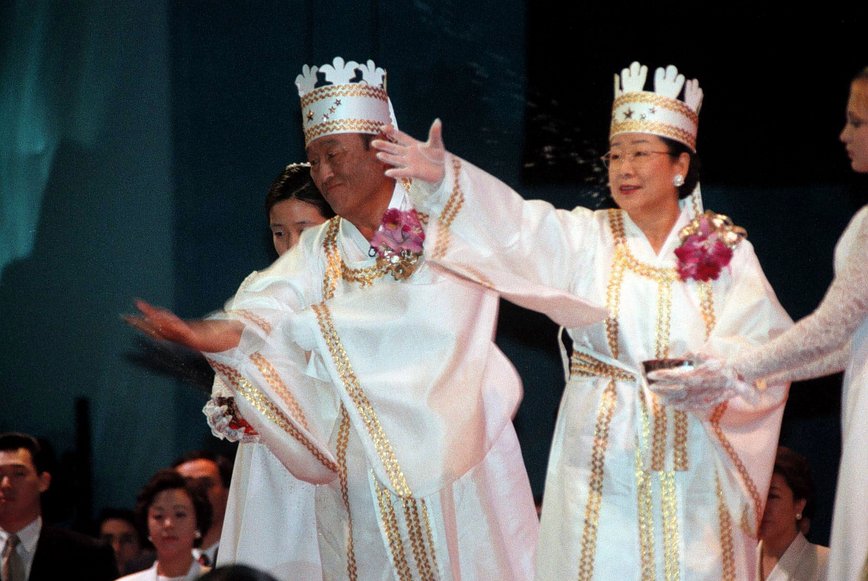
The Holy Robe of the Unification Church is an all-white, ankle-length garment worn by both men and women during major rituals such as the Blessing ceremony, Parents’ Day, and the Coronation of God’s Kingship. The robe has flowing, wide sleeves, which extend down in a straight fashion along the arms. Some designs use textile or lining to create a more graceful fit, resulting in an elegant appearance intended to represent purity of faith. The sash used to define the waist is made of white fabric, pulling in the robes to impart its desired definition while maintaining its unified appearance.
The robe’s white color is inspired by two things–Christian baptism and traditional Korean ritual garments, such as shamanic robes (Introvigne 2021, 91-92). Dr. Kim, who served in early church leadership and is often cited in Unification object origin stories, said, “The design of the robes was received in a revelation by Ji Seung Do, one of the earliest disciples of Father.” (Barker 1984, 219-220). Kim also emphasized the robe’s spiritual impact on self-recognition (Stolovy 2024).
When you first look at the robe, it might appear insignificant, but this garment has a deeper meaning. For both its creators and wearers, the robe’s simplicity represents equality, purification, and rebirth. It shows the shared public identity that the Church wants its members to embody.
The Creator and Context:
The Unification Church, officially known as the Family Federation for World Peace and Unification, was founded by Reverend Sun Myung Moon in 1954. The Church teaches that humanity can be spiritually restored through new, God-centered families created in the Blessing ceremony. Since the Blessing is so important, the clothing worn during it is incredibly significant. The robe is created and regulated by the Church’s leadership and ritual committees, such as ritual designers and Reverend Moon’s close early disciples. These leaders determine the robe’s design, when it can be worn, and how it should be treated. Though design changes occur over time, Church regulation keeps the garment recognizably unified across different places and eras (Chryssides 2012, 422).
Leaders describe the robe as a sign of purity, unity, and reborn lineage. The design of the robe, though, is not just for group uniformity or the pretty aesthetic. Within Unification theology, symbolism is specifically tied to the Moons’ role as “True Parents.” According to Unification teachings, “True Parents” represent God’s appointed agents who will restore the broken lineage of humanity and revert to God’s original plan for the family. Through the Blessing ceremony, the robe is not only a symbol but also the physical embodiment of each individual’s entrance into the restored lineage offered by the Moons, their “True Parents.”
The robe’s design and regulation are both theological and social tools, ways for leaders to communicate what the group is and what the group wants to become. Leaders intentionally use the robe to express authority, theology, and identity all at once (see Figure 1). They encourage approved members to wear the robe publicly, which leaders often frame as an act of openness and commitment. This overt use of ritual clothing pushes back against stereotypes that new religions are secretive or coercive (Kim 2019, 173). The robe’s loose, status-neutral shape removes everyday markers of status or personality, making it an ideal symbol that simultaneously represents and builds “one family under God.” In short, the robe communicates leadership goals to build unity, resist negative media stereotypes, and establish a global spiritual family.
The Wearer:
The meaning of the Holy Robe becomes most visible through the people who wear it. Wearing the robe during the Blessing is described by many Church members as emotional and transformative. It symbolizes the start of a new spiritual life in the “universal family,” and the moment a person accepts spiritual rebirth and communal belonging (Kim 2019, 180; Barker 1984, 220).
By putting on the robe, members experience a symbolic transformation, shifting from a fallen human past to a state of spiritual rebirth made possible through the Moon’s blessing. When paired with sashes and prayer crowns, the robe also takes on a royal quality. This shows Reverend Moon’s teachings about members entering a “heavenly kingship” as true sons and daughters. The robe functions as a marker of personal spiritual change and as a visual claim to an elevated communal status.
This is where the robe shows its cost, not in the sense of money, but in the sense of commitment. Putting on the robe becomes a meaningful act of sacrifice and investment because members give up their everyday personal style and individuality to wear something that represents the group and their communal belonging (Kanter 1972, 70-73). Choosing not to wear regular clothes shows one is open to the group’s values and committed to being part of the community.
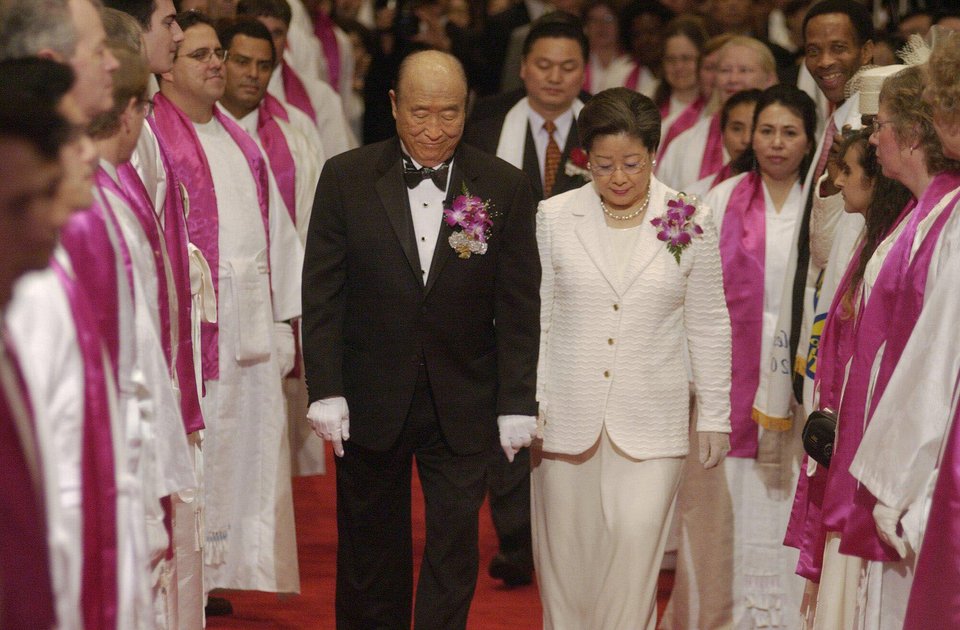
Photos of Mass Blessing ceremonies and other Unification rituals (see Figure 2), where thousands of people stand in identical white robes, show how the garment creates a sense of unity, family, power, and shared identity (Kim 2019, 167). The magnitude of the identical clothing draws one’s attention to the sea of participants, showing that the robe creates communal identity, regardless of nationality, ethnicity, or age. Through the wearers’ bodies and emotions, the robe becomes not just symbolic but lived, an embodied practice that makes theological claims visible and felt.
As material culture scholars argue, clothing can “trigger emotion” and visibly index belonging. Clothes can produce dignity, joy, and self-recognition (Kieschnick 2007, 4-6; Griswold 2013, 1-18; Stolovy 2024, 12). The robe shapes how people see themselves and how the community recognizes them. A modest garment can still have an extraordinary impact: it turns a massive crowd into a single, ordered community that sees itself and is seen by others as part of one spiritual family.
Salima Zeira, Double Major in Politics and International Affairs and Religious Studies, Wake Forest University (’26).
8 December 2025
Tags: Unification Church, Holy Robe, Blessing Ceremony, Mass Wedding, Material Religion, Christianity, New Religious Movement, Korean rituals, Asia, Asian Religions, Purity, Lineage, Communal Identity, Ritual Clothing, Sacred Rituals, Art history, Sacred Identity, Symbolism
References:
Barker, Eileen. 1984. The Making of a Moonie: Choice or Brainwashing? Oxford: Blackwell.
Chryssides, George D. 2012. Historical Dictionary of New Religious Movements. Lanham, MD: Rowman & Littlefield.
Griswold, Wendy. 2013. “Culture and the Cultural Diamond.” In Cultures and Societies in a Changing World, 4th ed., 1-18. Los Angeles: Sage Publications.
Introvigne, Massimo. 2021. “Blessing Ceremonies and Marriage Symbolism in the Unification Church.” Nova Religio 24 (3): 90-108.
Kanter, Rosabeth Moss. 1972. Commitment and Community: Communes and Utopias in Sociological Perspective. Cambridge, MA: Harvard University Press.
Kim, Chul Woo. 2019. “Challenges and New Development in the Emerging Women’s Leadership in Unification Church Ministry.” Journal of Unification Studies 20: 163-185.
Kieschnick, John. 2007. “Material Culture.” In The Oxford Handbook of Religion and Emotion, 4-13. Oxford University Press.
Stolovy, Tali. 2024. “Befriending the Body Through Clothes: The Role of Clothing in Secular and Religious Women’s Body Appreciation.” Frontiers in Psychology 15: 1297663. Available at: https://doi.org/10.3389/fpsyg.2024.1297663